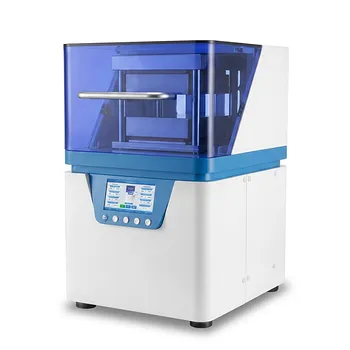
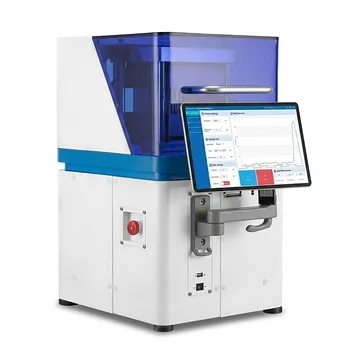
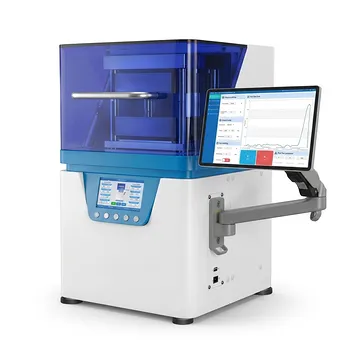
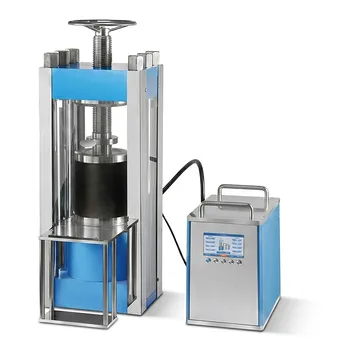
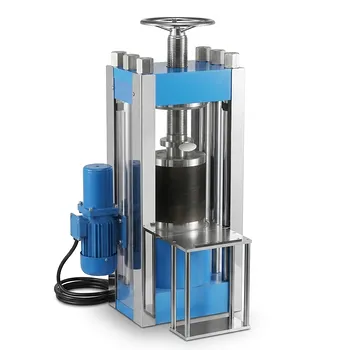
The vacuum hot press is the critical facilitator of diffusion bonding and densification in the fabrication of fiber-reinforced metal matrix composites (MMCs).
By applying simultaneous high temperature and axial pressure, the equipment induces plastic flow in the metal matrix (such as aluminum foil or powder), forcing it to encapsulate reinforcing fibers and fill all interstitial gaps. The high-vacuum environment is essential because it prevents metal oxidation at elevated temperatures, ensuring a high-quality, clean metallurgical bond between the matrix layers and the fiber reinforcement.
A vacuum hot press enables the creation of fully dense, high-strength MMCs by combining mechanical pressure with thermal energy to trigger atomic diffusion and material flow. This synchronized process ensures robust interfacial bonding while protecting the material from atmospheric degradation and internal defects.
The Mechanics of Diffusion Bonding and Consolidation
Inducing Plastic Flow and Matrix Impregnation
The primary function of the hot press is to transform a solid metal matrix into a state where it can move and "wet" the reinforcing fibers. Under high heat and pressure, the matrix undergoes plastic deformation, flowing into the micro-pores and gaps between fiber bundles to ensure total encapsulation.
Facilitating Atomic Diffusion
High-quality MMCs rely on a strong bond at the interface of the fiber and the matrix. The simultaneous application of heat and pressure triggers atomic diffusion, where atoms move across the boundary of the materials to create a unified structure without needing to reach the metal's melting point.
Achieving Near-Theoretical Density
By using pressure-assisted technology, the vacuum hot press accelerates rheological processes that eliminate internal pores. This results in a composite that is nearly 100% dense, which is vital for maximizing the mechanical, thermal, and wear-resistant properties of the finished component.
The Necessity of the Vacuum Environment
Prevention of Surface Oxidation
Metals like aluminum and copper are highly reactive and form oxide layers almost instantly when heated in the presence of oxygen. The high-vacuum environment removes these gases, allowing for "clean" metal-to-metal contact that is essential for high-strength diffusion bonding.
Elimination of Internal Outgassing and Bubbles
During the heating process, trapped air or volatile contaminants can expand and create structural voids. The vacuum environment effectively evacuates these gases, preventing the formation of bubbles or "haze" and ensuring the internal integrity of the composite.
Stabilization of the Chemical Environment
For certain matrix materials, such as polymers or specialized alloys, the vacuum provides an oxygen-free environment for stable thermal cross-linking or sintering. This prevents unwanted chemical side reactions that could degrade the superelastic properties of the reinforcement or the matrix itself.
Understanding the Technical Trade-offs
Balancing Pressure and Fiber Integrity
While high pressure is necessary for densification, excessive force can lead to fiber breakage or misalignment. Precision control is required to ensure the matrix flows sufficiently without compromising the structural skeleton provided by the fibers.
Thermal Cycle Management
The vacuum hot pressing process involves significant heating and cooling times to maintain structural stability. These long cycle times can limit production throughput compared to other manufacturing methods, making it a high-cost, high-precision operation.
Material Compatibility and Grain Growth
Extended exposure to high temperatures can lead to grain growth in the metal matrix, which may reduce its strength. Designers must carefully calibrate the "dwell time" at peak temperature to achieve bonding without degrading the metal's inherent mechanical properties.
How to Optimize Process Parameters for Your Goal
Application Guidance
- If your primary focus is maximum interfacial strength: Prioritize a higher vacuum level and longer dwell times to ensure complete atomic diffusion across the fiber-matrix boundary.
- If your primary focus is maintaining fiber structural integrity: Utilize a "stepped" pressure approach, increasing force only after the matrix has reached a sufficient temperature to flow plastically.
- If your primary focus is achieving full densification in powder-based MMCs: Focus on the synergy of temperature and axial pressure to trigger power-law creep mechanisms that fill all internal voids.
By masterfully balancing the variables of heat, pressure, and atmosphere, the vacuum hot press transforms raw constituents into a high-performance, integrated composite material.
Summary Table:
| Key Function | Mechanism | Impact on MMC Quality |
|---|---|---|
| Plastic Flow | High heat/axial pressure | Forces matrix to encapsulate fibers and fill micro-pores. |
| Diffusion Bonding | Atomic migration | Creates clean, high-strength metallurgical bonds between layers. |
| Vacuum Environment | Gas evacuation | Prevents metal oxidation and eliminates internal structural voids. |
| Densification | Pressure-assisted rheology | Reaches near-theoretical density for maximum mechanical strength. |
Elevate Your Composite Fabrication with KINTEK Precision
Unlock the full potential of your material research with KINTEK’s advanced vacuum hot press technology. Our laboratory pressing solutions are engineered to deliver the precise control needed for superelastic MMC fabrication and battery research.
We offer a comprehensive range of equipment, including:
- Manual & Automatic Hot Presses
- Heated & Multifunctional Models
- Glovebox-Compatible Systems
- Cold & Warm Isostatic Presses
Ensure perfect interfacial bonding and 100% density in your next project. Contact KINTEK today to find the perfect pressing solution for your lab!
References
- Mohammad Sayyar, Parviz Soroushian. Energy absorption capacity of pseudoelastic fiber-reinforced composites. DOI: 10.1515/secm-2013-0021
This article is also based on technical information from Kintek Solution Knowledge Base .
Related Products
- Heated Hydraulic Press Machine with Heated Plates for Vacuum Box Laboratory Hot Press
- Heated Hydraulic Press Machine With Heated Plates For Vacuum Box Laboratory Hot Press
- Automatic Hydraulic Hot Press with Large Plate and Precision Temperature Control for Advanced Material Sample Preparation and Industrial Research
- Laboratory Manual Heated Hydraulic Press Machine with Hot Plates
- Automatic Hydraulic Heat Press Machine with Multi Stage Programmable Control and Integrated Water Cooling Plate Size 180x180mm
People Also Ask
- Function of a Laboratory Hydraulic Press with Heated Platens in SSE? Enhance Battery Density & Conductivity
- What are the requirements for electrode pressing with high-viscosity ionic liquids like EMIM TFSI? Optimize Performance
- How are heated hydraulic presses utilized in the preparation of thin films? Key Mechanisms and Applications
- What industrial applications does a heated hydraulic press have beyond laboratories? Powering Manufacturing from Aerospace to Consumer Goods
- How does a laboratory heated hydraulic press facilitate PBN sample prep for WAXS? Achieve Precise X-Ray Scattering