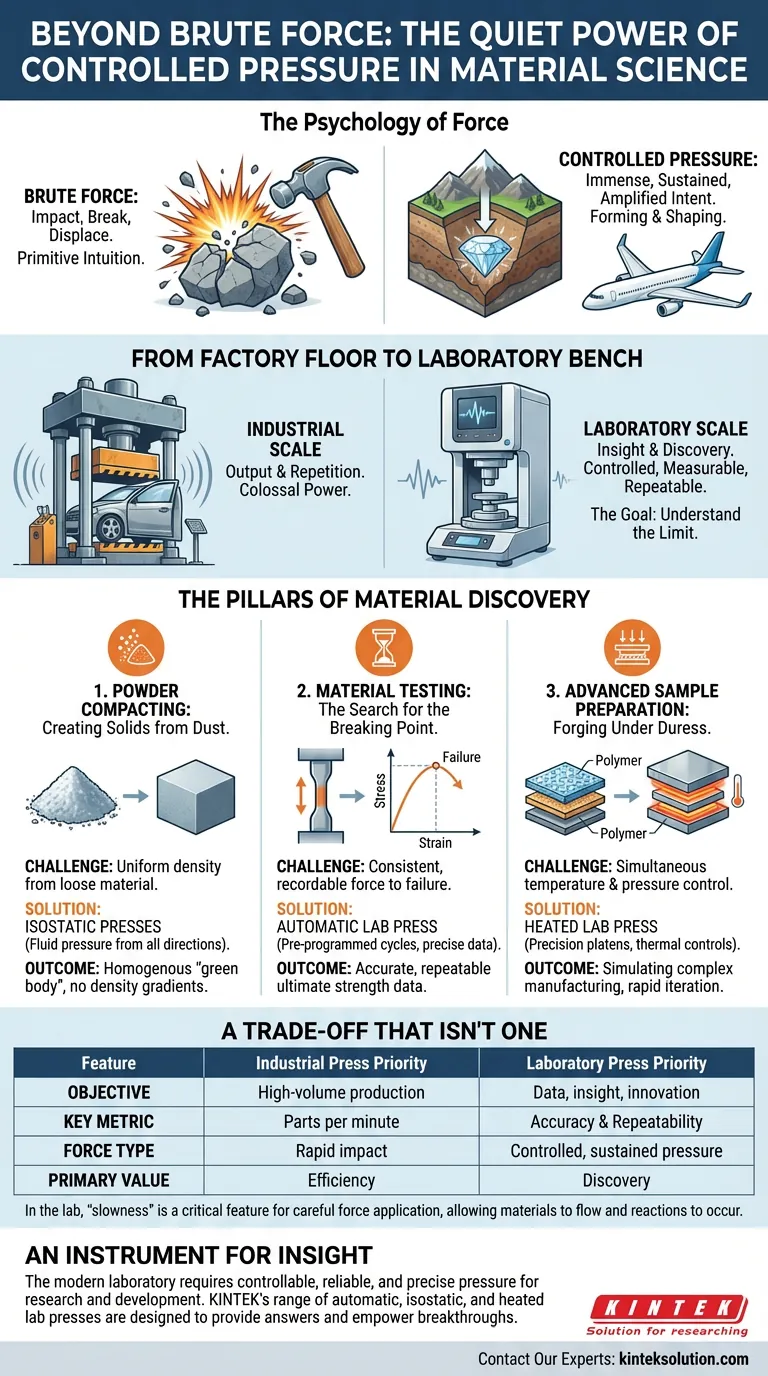
The Psychology of Force
Our intuition about force is primitive. We think of a hammer's strike, a sudden impact, an explosive release of energy. This is the force of brute action, designed to shatter, break, or rapidly displace.
But there is another kind of force. A quieter, more deliberate kind. It’s the immense, sustained pressure that forms diamonds deep within the Earth or the steady, unwavering force that shapes the wing of a jet.
This is the world of the hydraulic press. It doesn't operate on impact; it operates on the principle of amplified intent. And in the world of engineering and material science, intent is everything.
From Factory Floor to Laboratory Bench
The most visible applications of hydraulic power are colossal. In an automotive plant, a press descends with hundreds of tons of force, stamping a flat sheet of steel into a complex car door in a single, deafening stroke. This is power at an industrial scale, focused on output and repetition.
But shrink the scale and raise the stakes, and you find yourself in a laboratory.
Here, the goal isn't to mass-produce a known quantity. The goal is to discover an unknown one. To understand the absolute limit of a new alloy, to form a ceramic with perfect internal density, or to create a polymer sample that will define the next generation of materials.
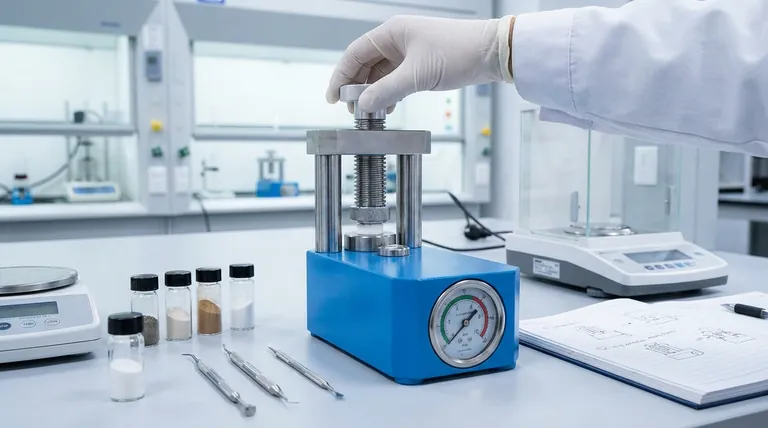
In this environment, brute force is useless. What you need is controlled, measurable, and perfectly repeatable pressure. The deafening roar of the factory is replaced by the quiet hum of a laboratory press—a tool built not for production, but for insight.
The Pillars of Material Discovery
The fundamental functions of a hydraulic press—shaping, compacting, and testing—take on a new level of precision in a research setting. Each task is a search for knowledge, demanding specialized equipment.
1. Powder Compacting: Creating Solids from Dust
Turning a fine powder into a solid, uniform component is a delicate art. Simply crushing it creates internal stresses and cracks, a hidden weakness. The goal is uniform density.
- The Challenge: Applying pressure evenly to a loose material to create a homogenous "green body" before sintering.
- The Solution: This is the domain of isostatic presses, which use fluid pressure to compact powders from all directions simultaneously. This eliminates density gradients and is crucial for creating high-performance ceramics and powdered metal parts.
2. Material Testing: The Search for the Breaking Point
Destructive testing isn't about destruction; it's about understanding. To verify a material's strength, you must apply a precisely measured load until it fails. That failure point is not a mistake; it is the most important piece of data.
- The Challenge: Applying a consistent, recordable force profile to a sample to determine its ultimate tensile strength, compressive strength, or flexural modulus.
- The Solution: An automatic lab press provides this control. It can execute pre-programmed force cycles, hold pressure at specific levels, and provide exact data for analysis, ensuring that tests are both accurate and repeatable.
3. Advanced Sample Preparation: Forging Under Duress
Some of the most innovative materials require both heat and pressure to be formed. Polymers, composites, and certain alloys must be molded under specific thermal conditions to achieve their desired properties.
- The Challenge: Simultaneously controlling temperature and pressure to cure resins, mold thermoplastic samples, or bond layered materials.
- The Solution: A heated lab press integrates precision platens with sophisticated temperature controls. This allows researchers to simulate complex manufacturing processes on a small scale, rapidly iterating on new material formulations.
A Trade-Off That Isn't One
In manufacturing, the hydraulic press's main trade-off is speed. It is slower than a mechanical press.
But in the laboratory, this "slowness" is a critical feature, not a bug.
It allows for the careful, gradual application of force. It provides time for materials to flow, for chemical reactions to occur, and for data to be meticulously recorded. The deliberate pace of a lab press is the pace of discovery. It prioritizes precision over throughput, because a single, perfect sample is infinitely more valuable than a thousand flawed ones.
| Application Focus | Industrial Press Priority | Laboratory Press Priority |
|---|---|---|
| Objective | High-volume production | Data, insight, innovation |
| Key Metric | Parts per minute | Accuracy & Repeatability |
| Force Type | Rapid impact | Controlled, sustained pressure |
| Primary Value | Efficiency | Discovery |
An Instrument for Insight
Choosing the right press is a question of your core objective. If you need to make thousands of things, you need a workhorse. But if you need to understand one thing completely, you need an instrument.
The modern laboratory requires more than just force. It requires controllable, reliable, and precise pressure tailored for research and development. This is where specialized equipment like KINTEK's range of automatic, isostatic, and heated lab presses becomes essential. They are designed not just to apply force, but to provide answers.
By delivering the exact pressure and temperature required, these instruments empower the quiet, deliberate work that leads to the next breakthrough.
If your work is about discovering the future of materials, Contact Our Experts.
Visual Guide
Related Products
- Automatic High Temperature Heated Hydraulic Press Machine with Heated Plates for Lab
- Manual Heated Hydraulic Lab Press with Integrated Hot Plates Hydraulic Press Machine
- Heated Hydraulic Press Machine with Heated Plates for Vacuum Box Laboratory Hot Press
- Laboratory Hydraulic Press 2T Lab Pellet Press for KBR FTIR
- Laboratory Hydraulic Press Lab Pellet Press Machine for Glove Box
Related Articles
- The Architecture of Slow: Why Physical Precision Dictates Chemical Destiny
- The Architecture of Certainty: Why the Laboratory Press is the Anchor of Material Science
- The Vanishing Boundary: The Hidden Thermodynamics of LTCC Lamination
- The Alchemy of 160°C: Why Precision Pressing is the Silent Backbone of Rubber Science
- The Invisible Forge: Why the Laboratory Press is the Soul of Nano-Composites



















