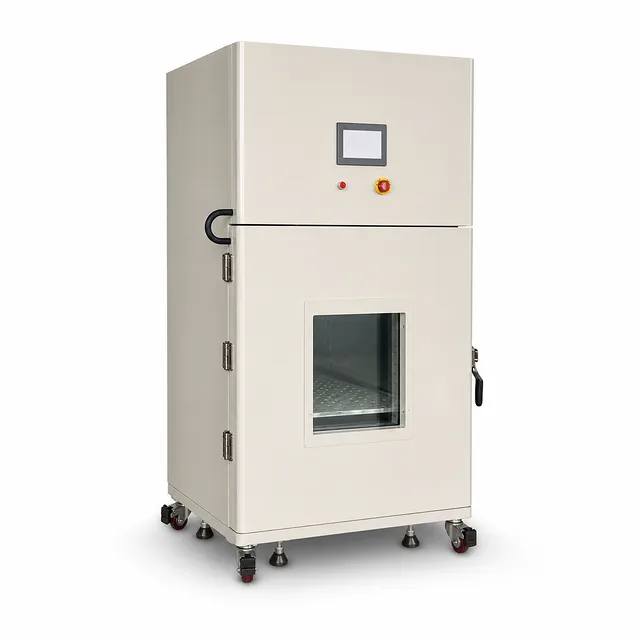
Battery Safety Testing Equipment
Low Pressure Test Chamber High Altitude Test Chamber Battery Explosion Proof Test Chamber
Item Number : DA06
Price varies based on specs and customizations
- Test Pressure
- 11.6kPa (1.68psi) negative pressure
- Control System
- PLC touchscreen control with manual vacuum input, unit selection, actual test result display, and corresponding test data
- Viewing Protection
- 20mm thick tempered explosion-proof glass with explosion-proof film and external LED lighting

Shipping:
Contact us to get shipping details Enjoy On-time Dispatch Guarantee.
Why Choose Us
Easy ordering process, quality products, and dedicated support for your business success.
Product Overview
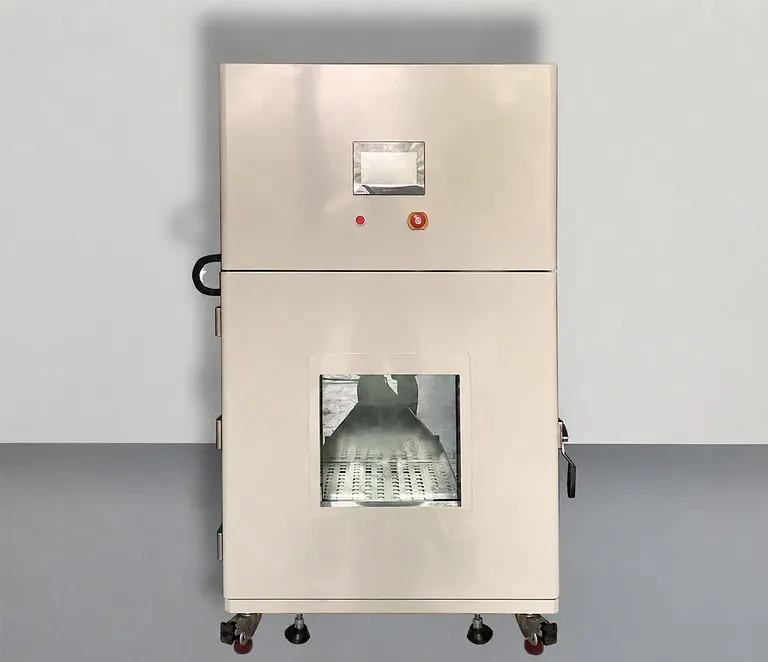
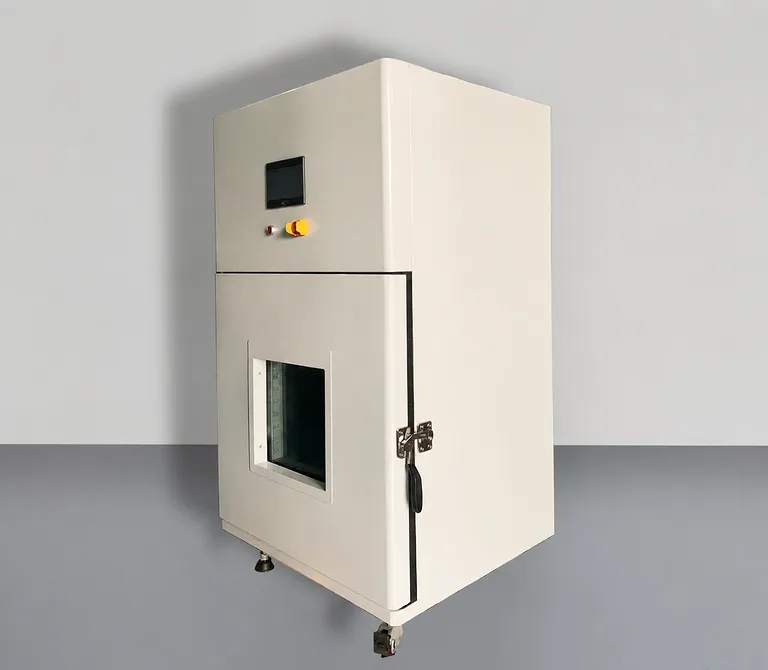
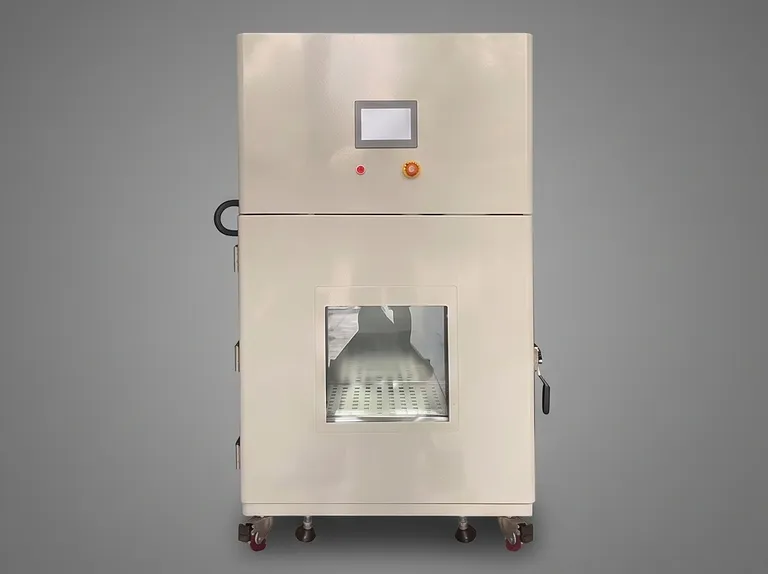
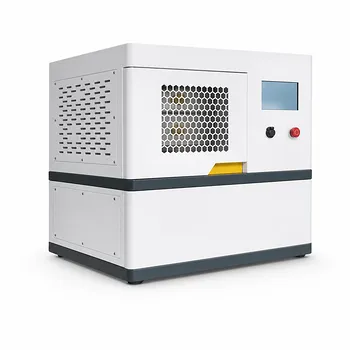
This low pressure test chamber is designed for battery low-pressure and high-altitude simulation testing. Every test sample is exposed to a negative pressure of 11.6kPa (1.68psi), allowing laboratories and quality teams to evaluate battery behavior under reduced atmospheric pressure. The core safety objective is clear: the tested battery must not explode, catch fire, produce smoke, leak liquid, or suffer damage to its protection valve.
The equipment is suited to battery R&D, safety verification, reliability assessment, and production quality control. Its integrated configuration places the low-pressure chamber below and the vacuum pump above, creating a compact unit that is easy to operate and move. A PLC touchscreen control system provides direct access to vacuum values, vacuum units, test status, and corresponding test data.
Built for repeated laboratory use, the unit combines a corrosion-resistant powder-coated exterior, a smooth easy-clean steel working chamber, reinforced door construction, and high-strength hardware. The sealed enclosure, explosion-resistant viewing system, external lighting, and automatic vacuum replenishment support controlled testing while helping operators observe the sample condition clearly.
Key Features
-
11.6kPa Low-Pressure Simulation: Applies a controlled negative pressure of 11.6kPa (1.68psi) for battery low-pressure and high-altitude simulation tests. This supports direct evaluation of whether a battery remains safe when exposed to reduced atmospheric pressure.
-
Battery Safety Verification: The test objective covers the key failure conditions that matter in battery qualification: explosion, fire, smoke, liquid leakage, and damage to the battery protection valve. The enclosure provides a controlled environment for observing these outcomes.
-
PLC Touchscreen Control: The integrated PLC touchscreen allows operators to manually enter the target vacuum value and select the vacuum unit. During testing, the interface displays the actual test result and related test data for straightforward monitoring.
-
Automatic Vacuum Replenishment: The system can automatically set the vacuum value and replenish vacuum when required. This helps maintain the intended low-pressure condition throughout the test process.
-
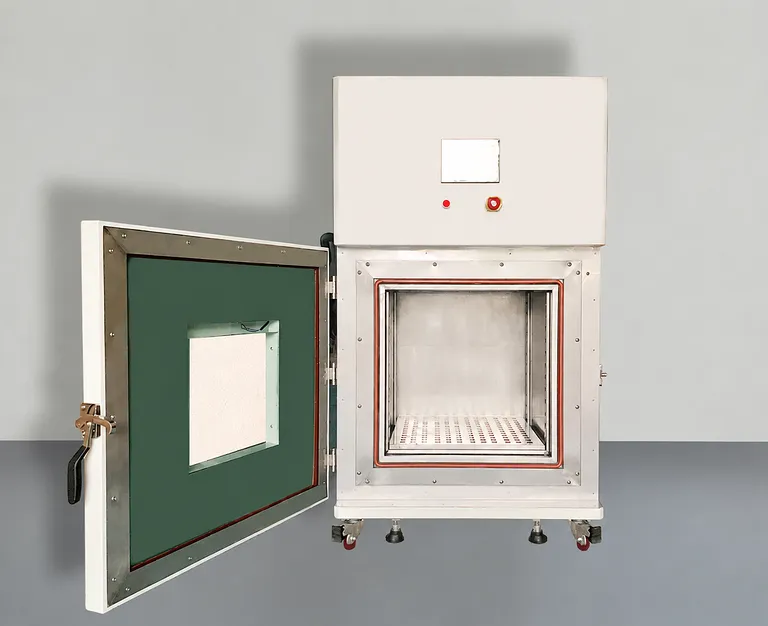
Reinforced Explosion-Resistant Door: The door uses 20mm thick tempered explosion-proof glass with an explosion-resistant film for double protection. Internal reinforcing ribs increase door strength, while the reinforced hinge and locking structure support secure enclosure closure.
-
High-Strength Sealing System: A rubber sealing ring is installed between the working chamber and glass door to help the enclosure reach a higher vacuum level. Reliable sealing is essential for stable pressure simulation and repeatable test conditions.
-
Durable Corrosion-Resistant Construction: The outer cabinet uses high-quality cold-rolled steel with electrostatic powder coating. The hard, firmly bonded coating provides strong rust resistance for demanding laboratory and industrial environments.
-
Easy-Clean Working Chamber: The interior is made from high-quality steel with rounded corners and a smooth, flowing surface. This geometry minimizes difficult-to-clean areas and simplifies routine maintenance after battery testing.
-
Clear External Illumination: An LED light is mounted outside the viewing window and reflects into the chamber. Operators can observe the battery test area clearly while keeping the lighting component outside the test space for improved service life and safety.
-
Mobile Integrated Configuration: The low-pressure chamber is positioned below the vacuum pump in one integrated structure. Four casters allow the equipment to be moved and fixed conveniently within the laboratory or production area.
Applications
| Application | Description | Key Benefit |
|---|---|---|
| Battery low-pressure safety testing | Simulates reduced atmospheric pressure by testing battery samples at 11.6kPa (1.68psi) negative pressure. | Helps verify that batteries do not explode, ignite, smoke, leak, or damage their protection valves under low-pressure conditions. |
| High-altitude battery simulation | Reproduces the low-pressure environment associated with high-altitude operation or transportation. | Provides a controlled method for evaluating battery safety before use in elevated locations or altitude-related scenarios. |
| Lithium-ion battery development | Supports battery R&D teams assessing cell or battery behavior during abnormal-environment testing. | Generates observable test outcomes through direct viewing, displayed test results, and controlled vacuum conditions. |
| Battery quality control | Provides a repeatable enclosure for production or incoming inspection teams performing safety-oriented pressure tests. | Helps standardize test conditions and supports consistent review of pressure-related failure behavior. |
| Battery protection valve verification | Examines whether the battery protection valve remains intact after exposure to the specified negative pressure. | Supports confirmation that critical protective components are not damaged during testing. |
| Battery failure observation | Allows operators to monitor the test area through 20mm tempered explosion-proof glass, explosion-resistant film, and external LED lighting. | Improves visibility of smoke, leakage, fire, or other abnormal conditions without opening the chamber during testing. |
| Academic and advanced materials research | Provides a dedicated low-pressure environment for university, research institute, and materials laboratory investigations involving batteries. | Combines programmable touchscreen operation, automatic vacuum replenishment, and an easy-clean chamber for repeatable research workflows. |
Technical Specifications
| Parameter | Specification |
|---|---|
| Product item number | DA06 |
| Primary application | Battery low-pressure and high-altitude simulation testing |
| Test pressure | 11.6kPa negative pressure |
| Test pressure in psi | 1.68psi negative pressure |
| Test sample requirement | All tested samples are tested under 11.6kPa (1.68psi) negative pressure |
| Safety test objective | Battery must not explode or catch fire; battery must not produce smoke or leak liquid; battery protection valve must not be damaged |
| Control system | PLC touchscreen control system |
| Vacuum input | Touchscreen manual input of vacuum value |
| Vacuum unit selection | Touchscreen input and selection of vacuum unit |
| Test display | Actual test result and corresponding test data displayed during testing |
| Vacuum setting | Automatic vacuum value setting available |
| Vacuum maintenance | Automatic vacuum replenishment available |
| Cabinet material | High-quality cold-rolled steel plate |
| Cabinet surface treatment | Electrostatic powder coating |
| Cabinet coating characteristics | Hard, firmly bonded coating with strong rust resistance |
| Working chamber material | High-quality steel plate |
| Working chamber design | Rounded-corner, smooth, flowing interior surface |
| Working chamber cleaning | Easy-clean interior design |
| Door construction | Reinforced front door design |
| Door glass | 20mm thick tempered explosion-proof glass |
| Door glass protection | Explosion-proof film applied to the viewing window for double protection |
| Door reinforcement | Reinforcing ribs welded inside the door to increase strength |
| Door hinge | External hinge on the left side; reinforced equipment-specific standard component |
| Door lock | High-strength door locking buckle on the right side; reinforced equipment-specific standard component |
| Hinge and lock serviceability | Standard high-strength components designed for safe, convenient installation and replacement |
| Door sealing | Rubber sealing ring between the working chamber and glass door |
| Sealing function | Helps the chamber reach a higher vacuum level |
| Lighting | LED lighting mounted outside the viewing window |
| Lighting arrangement | Light reflects into the inner chamber for observation |
| Lighting purpose | Clear observation of battery condition while supporting lighting component service life and safety |
| Configuration | Integrated construction with low-pressure chamber below and vacuum pump above |
| Mobility | Four casters at the bottom |
| Caster function | Convenient movement and fixing |
Why Choose This Product
-
Purpose-Built Battery Safety Engineering: The system is designed around the specific failure criteria required for low-pressure battery testing, including explosion, fire, smoke, liquid leakage, and protection-valve damage.
-
Controlled and Observable Testing: PLC touchscreen operation, manual vacuum input, actual-result display, automatic vacuum setting, and automatic vacuum replenishment provide a practical control framework for consistent testing.
-
Robust Enclosure Construction: Cold-rolled steel, durable powder coating, reinforced door ribs, high-strength hinges and locks, and a sealed working chamber create a reliable structure for repeated laboratory operation.
-
Enhanced Operator Visibility and Protection: The 20mm tempered explosion-proof glass, explosion-resistant film, external LED illumination, and sealed door design support clear observation while maintaining separation from the test area.
-
Practical Laboratory Integration: The compact integrated chamber-and-pump arrangement, smooth easy-clean interior, and four-wheel mobility make the equipment easier to install, relocate, operate, and maintain.
Contact us for a quotation, configuration guidance, or a low-pressure battery testing solution tailored to your laboratory workflow and safety verification requirements.
Trusted by Industry Leaders

REQUEST A QUOTE
Our professional team will reply to you within one business day. Please feel free to contact us!
Related Products
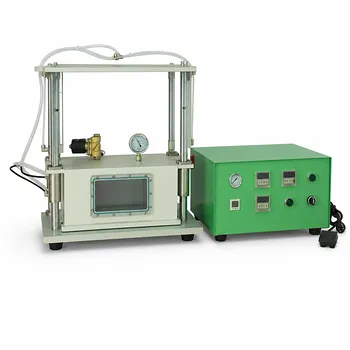
Laboratory Battery Vacuum Standing Box for Electrolyte Soaking
Laboratory battery vacuum standing box supports electrolyte absorption in pouch and cylindrical cells, using stable deep vacuum, programmable cycle operation, adjustable resting time, and a compact split control design for flexible research workflows and pilot-scale battery preparation tasks.
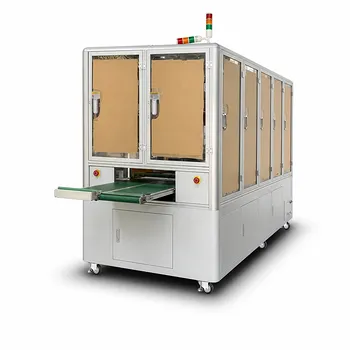
Pouch Prismatic Battery OCV DCIR Testing Machine with Barcode Scanning and Inkjet Coding
Automated pouch prismatic battery OCV and DCIR testing machine with barcode scanning, voltage resistance measurement, data traceability, and OK NG sorting for high throughput cell production across pouch cell manufacturing lines with reliable server integration
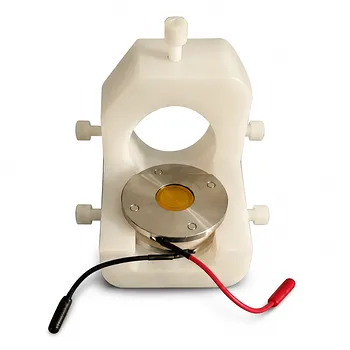
Aqueous Battery Testing Fixture for Laboratory Cell Evaluation
Aqueous battery testing fixture for cells up to 20 mm internal diameter and 4 mm thickness, featuring a 50 mm diameter clamp, PI film window, PEEK insulation, and high-purity titanium metal components for adaptable laboratory evaluation of aqueous battery performance.
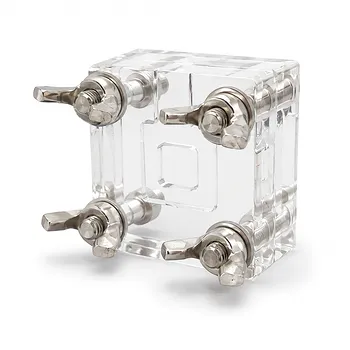
Solid State Zinc Air Battery Test Fixture Flexible Zinc Air Mold
Transparent solid state zinc air battery test fixture with flexible zinc air mold design, compact assembly, 1 to 4 cm² reaction areas, 0.2 cm electrode spacing, customizable construction, and clear observation for zinc air battery research and practical laboratory evaluation.
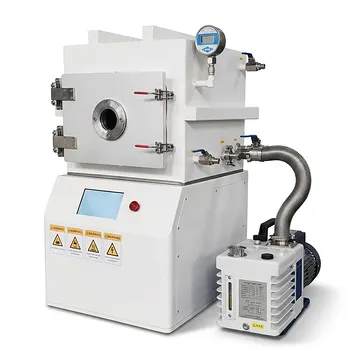
30 Ton 350x350mm Vacuum Hot Press for Battery Research and Materials Processing
30-Ton laboratory vacuum hot press featuring 350×350mm work area, 300°C max temperature, multi-zone heating, precise ±0.1T pressure control, dual-loop water cooling, and PLC automation. Ideal for battery research, solid-state electrolyte processing, ceramic sintering, and advanced composite materials fabrication.
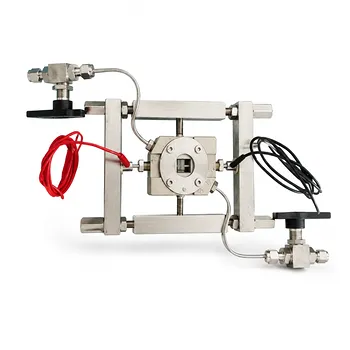
Optical Testing Solid State Battery Device for Microscopy Raman and Infrared Cross Section Analysis
Optical testing solid state battery device with compact fixtures for microscope, Raman, and infrared cross section analysis, including venting configuration for advanced battery research. Supports precise laboratory characterization, flexible sample dimensions, and controlled access for materials science and cell development.
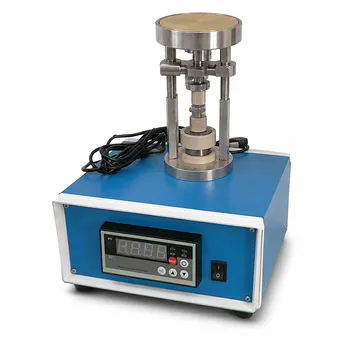
CT Testing Solid State Battery Device
CT testing solid state battery device for compact cell fixture evaluation with 2 mm inner diameter, optional display, external fixture, and 2 ton sensor integration for laboratory research workflows.
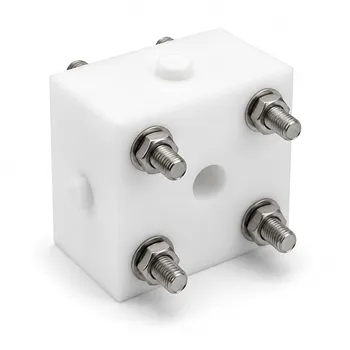
Secondary Zinc Air Reactor Metal Fuel Cell Test Apparatus
Secondary zinc air reactor metal fuel cell test apparatus with leak resistant polypropylene construction, defined electrode spacing, selectable reaction areas, and controlled electrolyte volume for reliable laboratory evaluation of electrochemical performance, cathode behavior, anode response, and repeatable experimental workflows
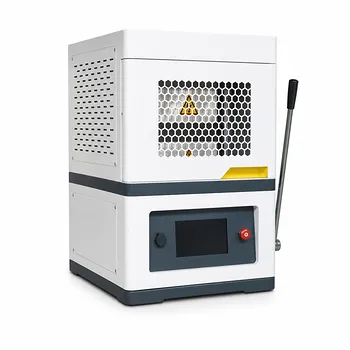
Solid State Battery Research Hydraulic Hot Press Machine
Benchtop hydraulic hot press for solid-state battery research. Precision temperature up to 300°C, 30-ton pressure, automatic holding, water cooling, touch-screen control. Ideal for electrolyte densification, electrode lamination, polymer membrane fabrication. Compact benchtop fits gloveboxes, customizable software, hardware, CE certified safety.
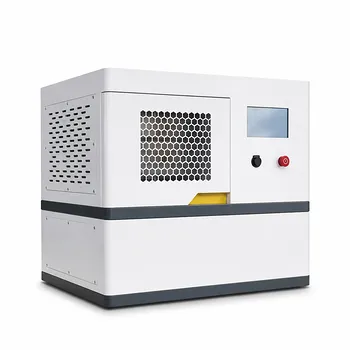
Laboratory Hydraulic Hot Press for Solid-State Battery Research
Compact benchtop hydraulic hot press for solid-state battery research, with dual heated platens, programmable touchscreen, and precise temperature control up to 300°C and 5 tons force. Ideal for electrolyte synthesis and electrode lamination, with automatic pressure holding. CE certified.
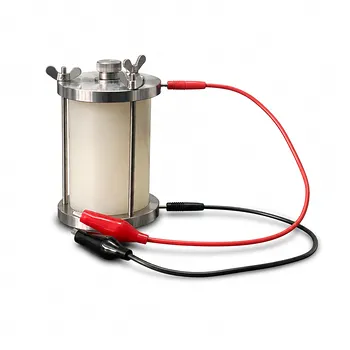
4680 Cylindrical Battery Detachable Split Test Kit
Detachable split test kit for 4680 cylindrical battery research with corrosion resistant sealing, stainless steel end caps, PTFE insulation, and secure spring loaded cell fastening for repeatable laboratory testing and flexible advanced materials workflows
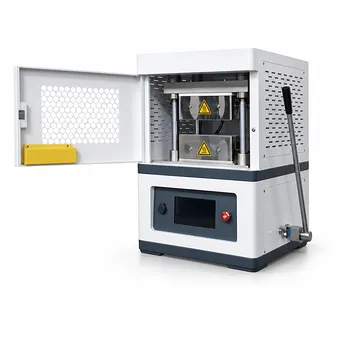
Laboratory Hydraulic Hot Press for Solid-State Battery and Polymer Electrolyte Research
Compact benchtop hydraulic hot press for solid-state battery and polymer electrolyte research with dual-zone heating, automatic pressure compensation, and active cooling system, ensuring uniform temperature up to 300°C and stable load for extended tests with CE certification and safety features.
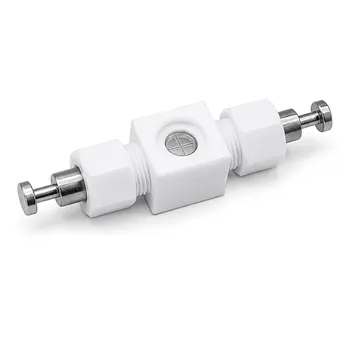
Optical Testing Cross Section Aqueous Battery Device for Microscopy Raman and Infrared Analysis
Optical testing cross section aqueous battery device for microscopy Raman infrared analysis dendrite observation and conductivity measurement in advanced battery research applications
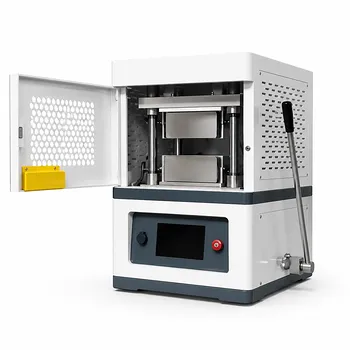
Laboratory Hydraulic Hot Press Machine for Solid-State Battery Research
Compact benchtop laboratory hydraulic hot press for solid-state battery research featuring independent dual-zone heating up to 300°C, 25-ton automatic pressure control, and integrated water cooling for precise compaction of electrolytes and polymer membranes in small-footprint design ideal for R&D applications.
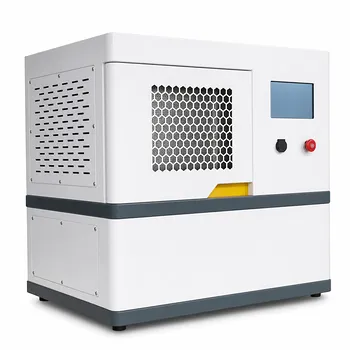
Solid-State Battery Laboratory Hydraulic Hot Press Machine
Precision laboratory hydraulic hot press for solid-state battery research, with dual-plate heating up to 300°C, 50-ton active pressure holding, programmable touchscreen control, and robust benchtop design, ideal for academic and industrial laboratories compacting electrolyte pellets and laminating electrodes.
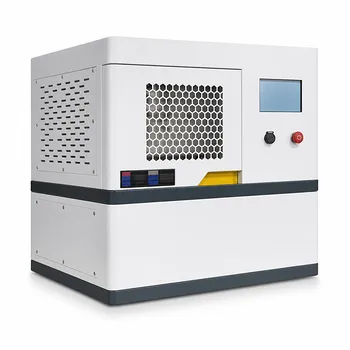
Solid-State Battery Research Laboratory Hydraulic Hot Press Machine
Designed for solid-state battery research, this laboratory hydraulic hot press features servo-driven pressurization up to 2 tons, dual-platen heating up to 300°C, programmable pressure cycles, and a 7-inch touch-screen controller for precise thermal compaction of electrolytes and electrodes.
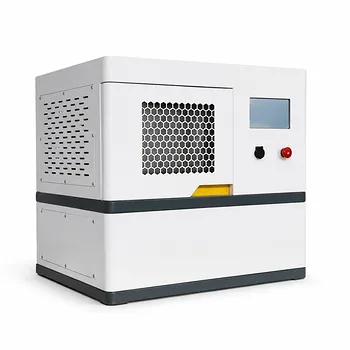
Laboratory Hydraulic Hot Press for Solid State Battery and MEA Fabrication
Compact laboratory hydraulic hot press with independent dual platen heating up to 300°C and programmable 50 ton pressure for solid state battery electrolyte compaction and membrane electrode assembly fabrication, featuring water cooling and safety shields, suitable for advanced material research.
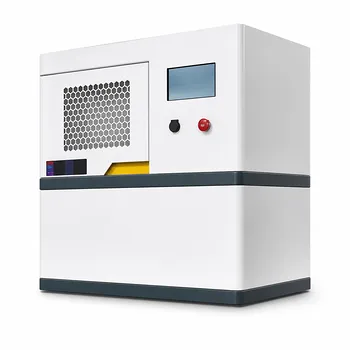
Programmable Laboratory Hydraulic Hot Press for Solid-State Battery Fabrication
Hydraulic hot press with 75 tons force programmable pressure control dual-zone heating up to 300°C ideal for solid-state battery electrolyte consolidation polymer composite curing electrode lamination features automatic pressure compensation adjustable ramp rates water cooling customizable options CE certified.
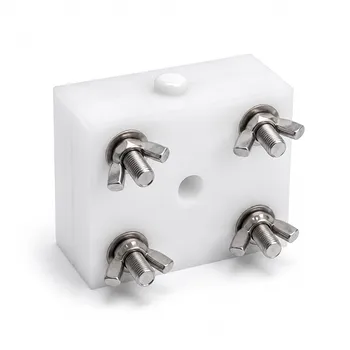
Rechargeable Zinc Air Electrolytic Cell Zinc Air Cycling Test Device Metal Fuel Cell Reactor
Rechargeable zinc air electrolytic cell cycling test device with modular PP reactor, 1 to 4.5 cm² reaction areas, circulating electrolyte, forced oxygen supply, leak resistant sealing, and customizable gas connections for metal fuel cell research and advanced materials laboratories.
Solid-State Battery Laboratory Electric Hot Press Machine
Compact benchtop electric hot press for solid-state battery research, polymer lamination, and MEA fabrication. Features dual-plate independent heating up to 200°C, programmable pressure up to 1800 kgf. Oil-free electric servo drive ensures clean, high-repeatability pressing, integrated water cooling.