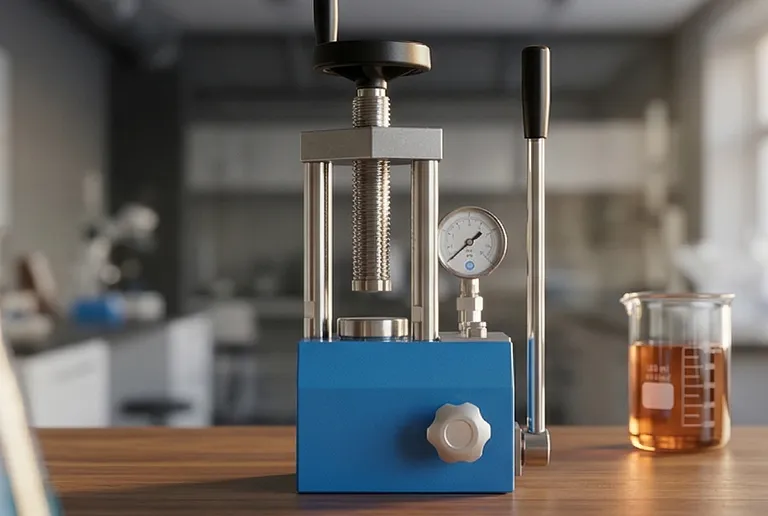
The Mirror-Image Puzzle
In chemistry, as in life, geometry is destiny. Chiral molecules—those that are non-superimposable mirror images of one another—can have vastly different effects on the human body. One version of a drug might heal, while its twin might be inert or even harmful.
Separating these "twins" requires a surface that is more than just a filter. It requires a crystalline landscape designed with absolute precision.
Cellulose Tribenzoate (CTBe) is the material of choice for this task. But to work, CTBe cannot be a random tangle of polymer chains. It must be ordered. It must be oriented. And that orientation begins long before the first X-ray is fired.
The Unseen Mechanical Bridge
We often romanticize the final discovery—the sharp peaks of an X-ray fiber diffraction pattern or the clean separation in a chromatograph.
However, the quality of that discovery is decided at the lab bench, during the transition from a liquid solvent cast to a solid film. This is the "silent foundation" of material science.
Solvent casting creates the raw material, but it is high-performance hydraulic molding that dictates the material's future. It is the critical mechanical stage where consolidation happens. Without it, the "map" of the molecules is lost in a haze of uneven density and structural irregularities.
Designing the Lattice: From Chaos to Order
The fabrication of CTBe films is a three-act play. Each stage builds the mechanical tension necessary for the next.
- The Cast: CTBe is dissolved and poured. It is a soup of potential.
- The Press: Controlled hydraulic force consolidates the film. This eliminates the micro-voids and "weak spots" that would cause the film to snap during stretching.
- The Draw: The film is stretched. The polymer chains, previously a chaotic nest, align themselves along a single axis.
The Dynamics of Film Fabrication
| Stage | The Goal | The Resulting Reality |
|---|---|---|
| Solvent Casting | Initial Formation | A delicate, preliminary substrate. |
| Hydraulic Molding | Consolidation | Uniform density; mechanical stability. |
| Drawing Orientation | Alignment | Crystalline order; axial chain maps. |
| Fiber Diffraction | Observation | Clear X-ray patterns for molecular modeling. |
Interrogating the Micro-World
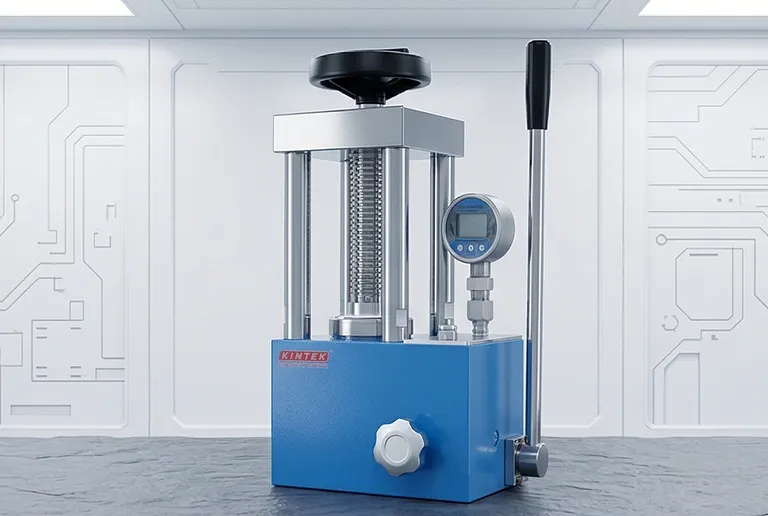
Why go through the trouble of such precise molding? Because the "parallel" and "anti-parallel" models of molecular chains are not just theoretical constructs. They are the gears that drive chiral recognition.
When we use high-performance presses to prepare these films, we are creating a "standardized world" for the enantiomers to navigate.
A perfectly oriented CTBe film allows researchers to see exactly how a molecule interacts with the stationary phase. It transforms a "black box" separation process into a visible, predictable system. If the molding is flawed, the "roadmap" is blurry. If the roadmap is blurry, the chemistry is guesswork.
The Psychology of the Press
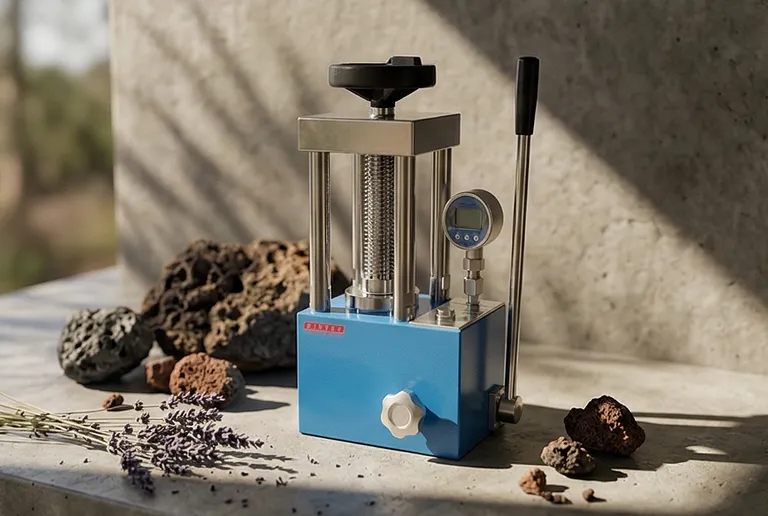
In the lab, as in finance, we tend to overcomplicate the solution and underappreciate the tool.
The hydraulic press is often viewed as a "dumb" tool—just a source of raw power. But in the context of CTBe, the press is a precision instrument. It is the arbiter of thickness and the guarantor of uniformity.
The challenge is the trade-off between compaction and flexibility.
- Too little pressure, and the film is too porous to orient.
- Too much pressure, and you induce material stress that leads to "relaxation"—where the molecules lose their alignment and return to chaos.
Precision as a Selective Advantage
At KINTEK, we understand that the difference between a breakthrough and a failed experiment is often measured in microns and megapascals. Our pressing solutions are engineered for the "Engineer's Romance"—the pursuit of that perfect, repeatable result.
Whether you are developing oriented CTBe films for chiral drugs or pioneering the next generation of solid-state batteries, the equipment you choose defines the ceiling of your research.
Our comprehensive range of laboratory solutions includes:
- Manual & Automatic Lab Presses: For repeatable consolidation.
- Heated & Multifunctional Models: To manage the thermal-mechanical stress of advanced polymers.
- Isostatic Presses (Cold/Warm): For uniform compaction from every angle.
- Glovebox-Compatible Systems: For research that cannot touch the air.
The architecture of clarity begins with the right force. Let’s build the foundation of your next discovery together.
Related Products
- Cylindrical Lab Electric Heating Press Mold for Laboratory Use
- Lab Cylindrical Press Mold for Laboratory Use
- Lab Infrared Press Mold for No Demolding
- Lab Infrared Press Mold for Laboratory Applications
- Lab Isostatic Pressing Molds for Isostatic Molding
Related Articles
- The Geometry of Energy: Why Precision Pressing Dictates Radiation Outcomes
- The Conscience of the Lab: Precision, Pressure, and the Invisible Architecture of Rubber
- The Glass Transition Ritual: Why Heat is the Secret Language of High-Density Materials
- The Geometry of Resilience: Why the Electric Press is the Soul of Vulcanization
- Precision's Edge: The Physics and Psychology of Temperature Control in Laboratory Presses



















