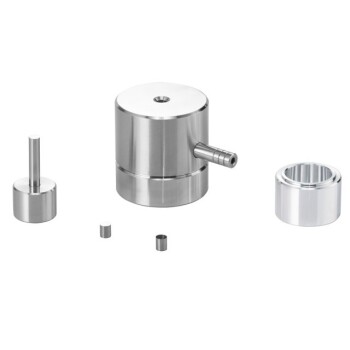
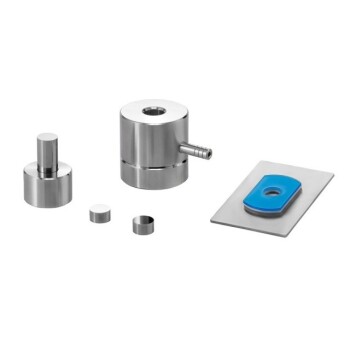
Designing all-solid-state battery (ASSB) molds requires a precise balance between electrical isolation and mechanical force transmission. The combination of a Teflon cylinder and stainless steel plungers achieves this by preventing internal short circuits while ensuring that externally applied stack pressure is delivered to the battery components without loss. This synergy is fundamental for maintaining the mechanical boundary conditions necessary for accurate electrochemical characterization and long-term cycling stability.
The core advantage of the Teflon-stainless steel configuration lies in its ability to decouple electrical conductivity from mechanical pressure. Teflon provides the essential dielectric barrier and low-friction environment, while stainless steel plungers serve as both high-strength current collectors and robust mechanical conduits.
Electrical Isolation and Circuit Integrity
Prevention of Internal Short Circuits
In an all-solid-state cell, the upper and lower current collectors must be perfectly isolated to prevent a catastrophic short. Teflon acts as a high-performance electrical insulator, ensuring that the only path for electron flow is through the external circuit and the active battery materials.
The Plunger as an Integrated Current Collector
The stainless steel plungers are not merely mechanical tools; they function as the primary current collectors for the cell. This dual-role design ensures a uniform charge distribution across the active material surface, which is critical for consistent ion transport during charge and discharge cycles.
Enhancing Electrochemical Data Accuracy
By utilizing stainless steel, the mold provides a stable mechanical constraint that prevents contact resistance fluctuations. This stability ensures that the electrochemical results observed during testing are a true reflection of the battery's chemistry rather than an artifact of the mold's hardware.
Mechanical Precision and Pressure Dynamics
Minimizing Friction for Direct Force Transfer
One of the most significant challenges in solid-state testing is ensuring that the pressure measured at the press is the pressure felt by the electrolyte. Teflon’s exceptionally low friction coefficient ensures that the plungers do not "bind" against the cylinder walls, allowing nearly 100% of the applied force to reach the battery internals.
Maintaining Targeted Stack Pressure
Accurate testing often requires a constant stack pressure, such as 5 MPa, to maintain contact between solid particles. Because Teflon minimizes friction-related "force loss," researchers can be confident that the mechanical boundary conditions remain precise throughout the duration of the test.
Uniform Compression of Active Materials
The rigidity of the stainless steel plungers ensures that pressure is applied homogeneously across the electrode surface. This prevents localized high-pressure zones that could lead to non-uniform lithium plating or premature mechanical failure of the solid electrolyte.
Understanding the Trade-offs
Mechanical Strength vs. Insulation
While Teflon is an excellent insulator, it is softer than materials like Polyether ether ketone (PEEK). Under extreme pressures, Teflon may undergo creep or deformation, which can compromise the dimensional stability of the mold compared to higher-strength polymer alternatives.
Chemical and Thermal Stability
Teflon is highly inert, but in specialized high-temperature testing, its thermal expansion rate must be considered. While it offers excellent chemical stability, researchers must ensure that the operating temperature does not reach a point where the material softens, potentially affecting the alignment of the stainless steel plungers.
Implementing the Right Mold Strategy
When selecting components for your battery mold, consider the specific mechanical and electrical demands of your solid-state chemistry.
- If your primary focus is pressure precision: Utilize the Teflon-stainless steel combination to ensure that friction does not interfere with the transmission of stack pressure to your cell internals.
- If your primary focus is high-voltage stability: Prioritize the Teflon cylinder for its superior dielectric properties, which provide a reliable safety margin against short circuits during high-potential testing.
- If your primary focus is extreme structural rigidity: Consider PEEK components as a supplementary alternative to Teflon to provide higher mechanical resistance against deformation under ultra-high pressing loads.
Correct material selection ensures that your testing environment facilitates, rather than obscures, the true electrochemical performance of your battery.
Summary Table:
| Component | Primary Function | Functional Advantage |
|---|---|---|
| Teflon Cylinder | Dielectric Insulation | Prevents internal short circuits; provides high-performance electrical isolation. |
| Teflon Cylinder | Low-Friction Barrier | Minimizes force loss; ensures nearly 100% of applied pressure reaches the cell. |
| Stainless Steel Plunger | Mechanical Conduit | Delivers robust, homogeneous stack pressure across the electrode surface. |
| Stainless Steel Plunger | Current Collector | Functions as a high-strength electrode contact for stable electrochemical data. |
Maximize Your Battery Research Precision with KINTEK
To achieve reliable all-solid-state battery (ASSB) performance, your equipment must deliver perfect mechanical and electrical boundary conditions. KINTEK specializes in comprehensive laboratory pressing solutions designed for the rigors of battery research.
Our extensive range includes:
- Manual & Automatic Presses: High-precision force control for consistent stack pressure.
- Specialized Models: Heated, multifunctional, and glovebox-compatible designs for sensitive chemistries.
- Isostatic Solutions: Cold (CIP) and warm isostatic presses (WIP) for superior material density.
Ensure your testing environment reflects your chemistry's true potential. Contact KINTEK today to discover how our pressing technology can enhance your laboratory’s efficiency and data accuracy!
Related Products
- Lab Button Battery Disassembly and Sealing Mold
- Lab Button Battery Tablet Press Sealing Mold
- Carbide Lab Press Mold for Laboratory Sample Preparation
- Warm Isostatic Press for Solid State Battery Research Warm Isostatic Press
- Lab Cylindrical Press Mold for Laboratory Use
People Also Ask
- How does a sealed battery mold facilitate the assembly and testing of asymmetric supercapacitors using VO2?
- What is the function of specialized battery molds and sealing consumables? Optimize Your In-situ XRD Testing Today
- How does the geometry of laboratory molds influence mycelium-based composites? Optimize Density and Strength
- Why are specialized battery test molds used? Ensure Peak Performance for All-Solid-State Sodium Batteries (ASSIBs)
- What role do battery testing molds play in electrolyte performance? Exploring Pressure vs. Viscoelasticity