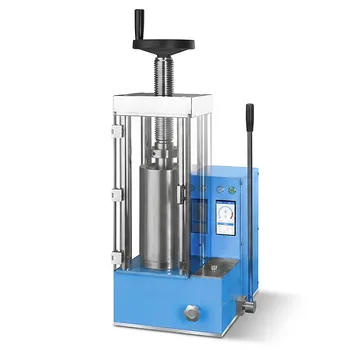
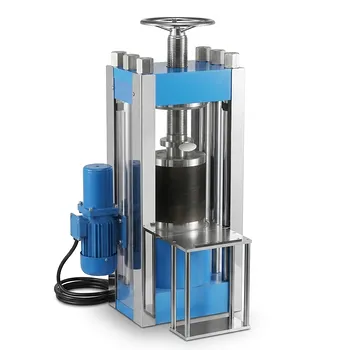
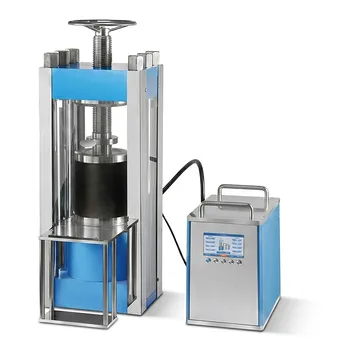
Cold isostatic pressing (CIP) is the critical mechanism for achieving structural uniformity and high density in 10NiO-NiFe2O4 composite ceramic anodes. It applies uniform, omnidirectional pressure to eliminate internal density gradients and microcracks, creating a stable foundation for the subsequent sintering process. This step is essential for ensuring the material can withstand the harsh corrosive environment of aluminum electrolysis.
Core Takeaway: Cold isostatic pressing (CIP) transforms loose 10NiO-NiFe2O4 powder into a high-quality green body by applying isotropic pressure, which ensures uniform particle rearrangement and eliminates structural defects. This uniformity is the primary driver for achieving the high relative density required to prevent electrolyte penetration and premature material failure.
Eliminating Internal Gradients and Defects
Isotropic Pressure Application
Unlike traditional uniaxial pressing, CIP uses a liquid medium to transmit equal pressure from all directions to the powder mold. This process typically utilizes ultra-high pressures, often reaching 200 MPa, to ensure the force is distributed evenly throughout the entire volume of the green body.
Particle Rearrangement and Bonding
The application of omnidirectional force facilitates the full rearrangement of 10NiO-NiFe2O4 particles. This leads to tighter mechanical bonding and the elimination of internal voids that often plague materials formed through single-axis compression.
Elimination of Microcracks
By removing internal pressure gradients, CIP significantly reduces the presence of internal stresses and microcracks. This creates a structurally sound "green" state that is far less likely to fail during the transition to the furnace.
The Impact on Sintering and Material Integrity
Reducing Sintering Risks
A green body with a uniform density gradient undergoes uniform shrinkage during the high-temperature sintering phase. This consistency is vital for preventing common manufacturing defects such as warping, distortion, or catastrophic cracking.
Achieving Uniform Microstructure
The density established during the CIP stage provides the physical foundation for a consistent microstructure. This uniformity ensures that the final ceramic product possesses stable mechanical and chemical properties throughout its entire structure.
Density and Porosity Control
CIP effectively reduces internal porosity, which is a prerequisite for achieving high relative density. Minimizing these microscopic gaps is the most effective way to ensure the material remains impermeable to aggressive chemical agents.
Enhancing Long-term Performance
Corrosion Resistance in Aluminum Electrolysis
In the context of aluminum electrolysis, a highly dense ceramic structure is required to block the penetration of cryolite electrolytes. Without the density provided by CIP, grain boundary attacks would rapidly degrade the anode.
Wear Rate Optimization
When combined with specific additives like BaO, the densification achieved through CIP can significantly enhance the material's lifespan. Research indicates that this process can help reduce the annual wear rate of the anode to approximately 3.66 cm per year.
Understanding the Trade-offs
Process Complexity and Cost
While CIP provides superior results, it is a more complex and expensive process than standard die pressing. It requires specialized high-pressure equipment, flexible molds (often made of rubber or latex), and additional steps for sealing and dewatering.
Production Speed
The cycle time for cold isostatic pressing is generally longer than uniaxial pressing. This can lead to lower throughput in a mass-production environment, making it a premium forming method reserved for high-performance components.
Geometric Limitations
Because the powder is compressed within a flexible mold under liquid pressure, maintaining precise dimensional tolerances can be more challenging than with rigid steel molds. Post-pressing machining or precise mold engineering is often required to achieve the final desired shape.
How to Apply This to Your Project
Recommendations Based on Goals
- If your primary focus is maximum component longevity: Utilize CIP to ensure the highest possible relative density, which is the best defense against electrolyte-driven corrosion.
- If your primary focus is minimizing manufacturing defects: Prioritize CIP over uniaxial pressing to eliminate the internal stresses that cause cracking during the sintering of complex ceramic shapes.
- If your primary focus is reducing initial capital expenditure: Consider using uniaxial pressing for initial shaping, but recognize that the final density and corrosion resistance will likely be inferior to CIP-processed materials.
Ensuring the structural integrity of 10NiO-NiFe2O4 anodes through cold isostatic pressing is the most reliable way to achieve the high-density requirements of modern electrolysis.
Summary Table:
| Key Factor | Impact on Ceramic Anode Performance |
|---|---|
| Isotropic Pressure | Eliminates internal density gradients and microcracks |
| Particle Bonding | Ensures high relative density to block electrolyte penetration |
| Sintering Control | Enables uniform shrinkage, preventing warping and cracking |
| Durability | Enhances corrosion resistance; reduces wear to ~3.66 cm/year |
Transform Your Material Research with KINTEK
Achieve superior structural uniformity and high-density results in your 10NiO-NiFe2O4 anodes with KINTEK. As specialists in comprehensive laboratory pressing solutions, we offer a diverse range of equipment tailored for battery research and high-performance ceramics, including:
- Cold and Warm Isostatic Presses for maximum densification.
- Manual, Automatic, and Heated Models for versatile lab processing.
- Multifunctional & Glovebox-Compatible Systems for specialized environments.
By choosing KINTEK, you gain the precision needed to eliminate internal defects and optimize material lifespan in harsh chemical environments. Contact our experts today to find your solution!
References
- Hanbing HE, Hanning Xiao. Effect of Additive BaO on corrosion resistance of 10NiO-NiFe2O4 Composite Ceramic anodes. DOI: 10.2991/emeit.2012.305
This article is also based on technical information from Kintek Solution Knowledge Base .
Related Products
- Electric Lab Cold Isostatic Press CIP Machine
- Automatic Lab Cold Isostatic Pressing CIP Machine
- Electric Split Lab Cold Isostatic Pressing CIP Machine
- Manual Cold Isostatic Pressing CIP Machine Pellet Press
- Electric Isostatic Pressing Machine 40 Tons Automatic Laboratory Powder Compacting Press
People Also Ask
- What are the applications of electric lab cold isostatic presses in research settings? Advance Material R&D with High-Pressure CIPs
- What role do electric lab cold isostatic presses play in industrial contexts? Bridge R&D and Manufacturing with Precision
- How does electrical Cold Isostatic Pressing (CIP) contribute to cost savings? Unlock Efficiency and Reduce Expenses
- What are some research applications of electric lab CIPs? Unlock Uniform Powder Densification for Advanced Materials
- What are the characteristics of standard off-the-shelf electric lab CIP solutions? Achieve Immediate, Cost-Effective Processing