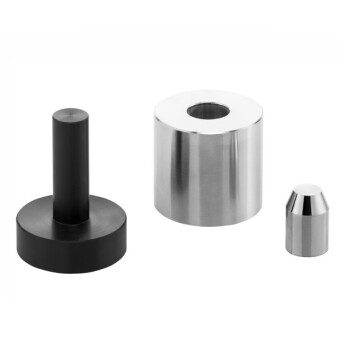
The use of a floating die and die wall lubrication is essential for managing friction and ensuring density uniformity in PM Ti-3Al-2.5V alloy powder compaction. These two elements function synergistically to reduce the resistance between the powder and the die walls, which translates to more consistent pressure transmission throughout the compact. By utilizing die wall lubrication instead of internal mixing, you achieve a clean, high-density green compact while preventing the contamination of the titanium alloy with carbon and oxygen.
Core Takeaway: A floating die combined with die wall lubrication minimizes density gradients and ejection forces while preserving the chemical purity of the Ti-3Al-2.5V alloy, leading to superior mechanical properties in the final sintered component.
Achieving Pressure Uniformity with Floating Dies
Reducing Internal Density Gradients
In a fixed-die setup, friction against the walls causes the applied pressure to drop as it moves through the powder column. A floating die allows the die barrel to move during compaction, effectively applying pressure from both ends relative to the powder.
Improving Pressure Transmission
This movement ensures that the compaction force is distributed more evenly across the entire height of the part. By minimizing the "dead zones" of low pressure, the floating die creates a green compact with a highly uniform density distribution.
The Strategic Role of Die Wall Lubrication
Minimizing Frictional Resistance
Applying a lubricant like zinc stearate directly to the die walls creates a low-friction interface. This reduces the energy lost to wall friction, allowing more of the press’s force to be used for the actual densification of the Ti-3Al-2.5V powder.
Facilitating Smooth Ejection
High-pressure compaction, often reaching 700 MPa, can cause the green compact to stick to the tool surfaces. Die wall lubrication drastically reduces the ejection force required, preventing the compact from delaminating or cracking as it is pushed out of the die.
Protecting Surface Integrity
Beyond structural stability, lubrication ensures the surface finish of the green part remains pristine. It prevents galling and scratching, which simultaneously extends the service life of precision-engineered dies.
Preserving Alloy Purity and Performance
Avoiding Carbon and Oxygen Contamination
Titanium alloys are highly sensitive to interstitial elements like carbon and oxygen, which can embrittle the material. By applying lubricant only to the die walls—rather than mixing it into the powder—you prevent these contaminants from being trapped within the alloy matrix.
Enhancing Sintering Outcomes
A high green density achieved through clean compaction provides a strong driving force for solid-state sintering. This leads to a final product with higher relative density and optimized mechanical properties, as there are no residual lubricant spaces to form uncontrolled internal pores.
Understanding the Trade-offs
Process Complexity vs. Material Purity
While die wall lubrication preserves the purity of Ti-3Al-2.5V, it requires specialized spraying or coating equipment within the press cycle. This adds complexity compared to simply mixing a lubricant into the powder, which is common in less sensitive materials like aluminum.
Tooling Wear at High Pressures
Achieving the necessary mechanical interlocking in titanium powder requires extremely high pressures. Even with lubrication, the intense stress of 700 MPa or higher can lead to accelerated fatigue in die components if the floating mechanism is not perfectly aligned.
Recommendations for Your Compaction Process
How to Apply This to Your Project
- If your primary focus is Maximum Chemical Purity: Strictly utilize die wall lubrication with zinc stearate rather than internal lubricants to prevent carbon and oxygen pickup during sintering.
- If your primary focus is Uniform Part Density: Implement a floating die structure to ensure the compaction pressure is balanced, reducing the risk of structural weak points in tall or complex parts.
- If your primary focus is Extending Tooling Life: Ensure a consistent, automated application of lubricant to the die walls before every stroke to minimize the frictional heat and galling associated with high-pressure titanium pressing.
By mastering the balance between floating die mechanics and precise wall lubrication, you ensure the structural and chemical integrity of high-performance titanium alloy components.
Summary Table:
| Element | Role in Compaction | Impact on Final Result |
|---|---|---|
| Floating Die | Enables movement to apply pressure from both ends. | Ensures uniform density and eliminates "dead zones." |
| Wall Lubrication | Reduces friction between powder and die interface. | Prevents carbon contamination and facilitates smooth ejection. |
| Synergistic Effect | Minimizes internal gradients and ejection force. | Produces high-density green compacts with superior purity. |
Master Your Powder Compaction with KINTEK
Achieve industry-leading density and chemical purity in your Ti-3Al-2.5V components. KINTEK specializes in comprehensive laboratory pressing solutions designed for precision metallurgy and battery research. Our extensive range includes:
- Manual & Automatic Presses for versatile lab environments.
- Heated & Multifunctional Models for advanced densification.
- Glovebox-Compatible Systems for sensitive material handling.
- Cold (CIP) and Warm (WIP) Isostatic Presses for complex geometries.
Whether you are scaling your battery research or optimizing high-performance alloys, our equipment ensures consistent pressure transmission and maximum surface integrity.
Contact KINTEK today to find your ideal pressing solution
References
- L. Bolzoni, E. Gordo. Investigation of the factors influencing the tensile behaviour of PM Ti–3Al–2.5V alloy. DOI: 10.1016/j.msea.2014.05.017
This article is also based on technical information from Kintek Solution Knowledge Base .
Related Products
- Lab Cylindrical Press Mold with Scale
- Lab Ball Press Mold
- XRF KBR Plastic Ring Lab Powder Pellet Pressing Mold for FTIR
- Lab XRF Boric Acid Powder Pellet Pressing Mold for Laboratory Use
- Lab Ring Press Mold for Sample Preparation
People Also Ask
- What is the purpose of incorporating cartridge heaters into a lab press mold for MLCC block compression? Optimize Results
- What is the function of a pressing tool in thermoplastic panels? Master Precision Shaping & Fusion Bonding
- Why is precise cooling management of the lab press mold necessary? Protect Core Integrity in Thermoforming
- Why is a standardized cylindrical mold necessary when testing electrode materials? Ensure Data Precision & Consistency
- What is the technical significance of specific cylindrical molds in aluminum foaming? Achieve Near-Net-Shape Precision