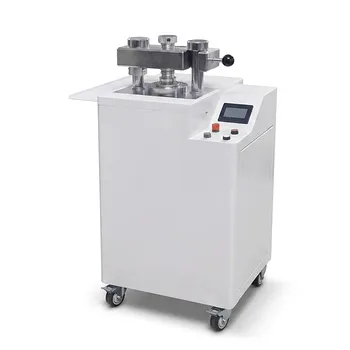
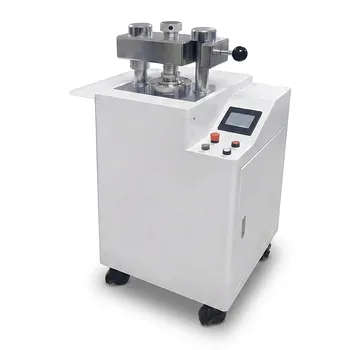
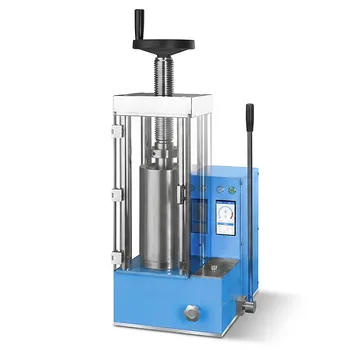
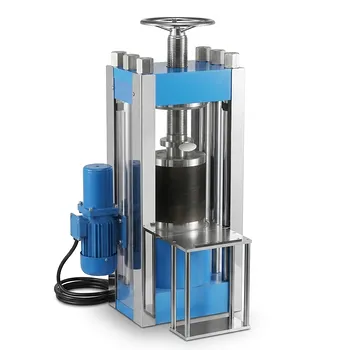
The use of a laboratory powder pellet press is essential for transforming opaque adsorbent powders into transparent media suitable for infrared light transmission. By compressing a mixture of the sample and potassium bromide (KBr) under extreme pressure, the press eliminates air gaps and minimizes light scattering. This ensures the resulting FTIR spectrum has the high signal-to-noise ratio required to detect subtle chemical changes occurring on the adsorbent surface.
A laboratory pellet press creates uniform, air-free, and transparent KBr-sample discs that allow infrared radiation to penetrate the material effectively. This preparation is the standard for obtaining the high-resolution data needed to identify specific functional group shifts and new chemical bonds after an adsorption reaction.
The Physics of Light Transmission in FTIR
Eliminating Infrared Light Scattering
Raw adsorbent powders are naturally opaque and scatter infrared radiation, which prevents the beam from reaching the detector. A pellet press applies axial pressure—often up to 150 MPa—to compact the powder into a dense, solid matrix. This compaction removes the voids between particles, allowing the infrared light to pass through the sample rather than bouncing off its surface.
Inducing Plastic Flow and Transparency
When mixed with an alkali halide like Potassium Bromide (KBr), high pressure induces a phenomenon known as plastic flow. The KBr matrix deforms and flows around the sample particles, creating a glass-like, translucent pellet. This transparency is a prerequisite for the infrared instrument to capture accurate molecular bond vibration signals.
Enhancing Spectroscopic Precision
Maximizing the Signal-to-Noise Ratio
A high signal-to-noise (S/N) ratio is critical when analyzing reacted adsorbents, where chemical changes may be subtle. By ensuring high light transmittance through the pellet, the press allows the FTIR detector to distinguish meaningful molecular signals from background electronic noise. This clarity is vital for observing precise shifts in interlayer carbonate ions or O-H stretching vibrations.
Ensuring Uniform Sample Thickness
Precise pressure control by the lab press ensures that every pellet has a uniform thickness and a consistent density. This uniformity is necessary for reproducible results, especially when comparing a "fresh" adsorbent to a "reacted" one. Without a standardized pressing process, variations in sample thickness would make it impossible to quantitatively compare the intensity of functional group peaks.
Resolving the Deep Need: Detecting Surface Reactions
Identifying Subtle Functional Group Changes
Adsorption reactions often result in the modification of existing surface groups, such as the consumption of surface hydroxyl (OH-) groups. The high resolution provided by a well-pressed pellet allows researchers to confirm the disappearance of these groups or their shift in frequency. This level of detail is necessary to understand the mechanism behind the adsorption process.
Monitoring New Bond Formation
Reacted adsorbents may develop entirely new chemical signatures, such as metal chloride characteristic peaks or newly formed C=C bonds. A laboratory press ensures the sample is distributed evenly enough for the FTIR beam to interact with these new species. This enables the definitive identification of "fingerprint" regions that characterize the successful adsorption of pollutants like HCl.
Understanding the Trade-offs and Pitfalls
Moisture Sensitivity and Contamination
KBr is highly hygroscopic, meaning it absorbs moisture from the air almost immediately. If the pellet-making process is not performed quickly or in a controlled environment, water peaks will appear in the spectrum, potentially masking the O-H bond signals of the adsorbent.
Pressure-Induced Sample Alteration
While high pressure is necessary for transparency, extreme force can occasionally alter the crystalline structure of sensitive materials. It is important to find the balance where the pressure is high enough for plastic flow (typically around 100-120 kN) but not so excessive that it induces unwanted phase changes in the adsorbent.
The Risk of Air Bubbles
If a vacuum is not applied during the pressing process, air can remain trapped within the pellet, appearing as small white opaque spots. These "bubbles" cause significant light scattering, which degrades the quality of the spectra and can lead to misleading data regarding the functional groups.
How to Apply Performance Pressing to Your Research
Guidelines for Effective Sample Preparation
To achieve the highest quality FTIR characterization, tailor your pressing technique to your specific analytical goals.
- If your primary focus is Maximum Transparency: Use a hydraulic press capable of applying constant, high pressure (15-20 tons) while simultaneously using a vacuum pump to evacuate air from the die.
- If your primary focus is Qualitative "Fingerprinting": Ensure a thorough grinding of the sample with KBr (usually 1:100 ratio) to prevent large particles from distorting the peak shapes.
- If your primary focus is Quantifying Adsorption Capacity: Maintain a strictly consistent mass of both KBr and adsorbent to ensure that peak intensity correlates directly to the concentration of the functional groups.
Proper sample preparation through a pellet press is the bridge between a raw, unreadable powder and a definitive molecular map of your adsorbent's surface chemistry.
Summary Table:
| Key Feature | Benefit for FTIR Characterization | Technical Requirement |
|---|---|---|
| High-Pressure Compaction | Eliminates light scattering and air gaps | Typically 100-150 MPa pressure |
| Plastic Flow Induction | Creates a glass-like, transparent KBr matrix | High axial force (15-20 tons) |
| Uniform Thickness | Enables reproducible and quantitative data | Precision-controlled press dies |
| Vacuum Integration | Prevents air bubbles and spectrum noise | Evacuable die set & vacuum pump |
| Consistent Density | Improves signal-to-noise (S/N) ratio | Standardized pressing protocols |
Optimize Your Sample Preparation with KINTEK
Achieve the ultimate precision in your FTIR and battery research with KINTEK’s comprehensive laboratory pressing solutions. We specialize in providing the tools you need for high-quality characterization, including:
- Versatile Press Models: Manual, automatic, heated, and multifunctional presses tailored to your lab's volume.
- Specialized Environments: Glovebox-compatible models for moisture-sensitive research.
- Advanced Materials Processing: Cold and warm isostatic presses widely applied in cutting-edge battery research.
Don't let poor sample quality compromise your data. Contact KINTEK today to discuss how our laboratory presses can enhance your research efficiency and results!
References
- Jun Cao, Hualun Zhu. Unlocking high-performance HCl adsorption at elevated temperatures: the synthesis and characterization of robust Ca–Mg–Al mixed oxides. DOI: 10.1007/s11356-024-32752-w
This article is also based on technical information from Kintek Solution Knowledge Base .
Related Products
- XRF KBR Steel Ring Lab Powder Pellet Pressing Mold for FTIR
- XRF KBR Plastic Ring Lab Powder Pellet Pressing Mold for FTIR
- Lab XRF Boric Acid Powder Pellet Pressing Mold for Laboratory Use
- Automatic Laboratory Hydraulic Press Lab Pellet Press Machine
- Laboratory Hydraulic Pellet Press for XRF KBR FTIR Lab Press
People Also Ask
- What considerations are important regarding the die size of an XRF pellet press? Optimize for Your XRF Spectrometer and Sample
- Why are pellets used in XRF analysis, and what is their limitation? Boost Accuracy and Speed in Your Lab
- What is the general process for preparing a sample pellet for XRF? Master Consistency for Accurate Analysis
- What are the primary factors to consider when deciding between a manual and an automatic XRF pellet press? Optimize Your Lab's Efficiency
- What are the main methods for preparing XRF pellets? Boost Accuracy and Efficiency in Your Lab