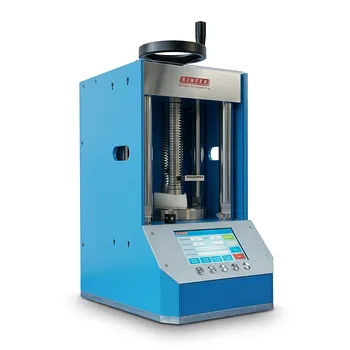
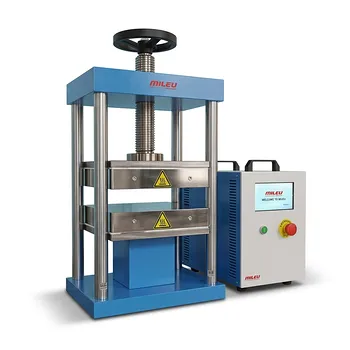
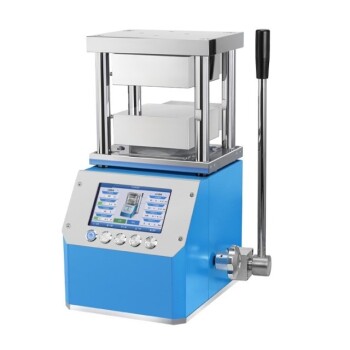
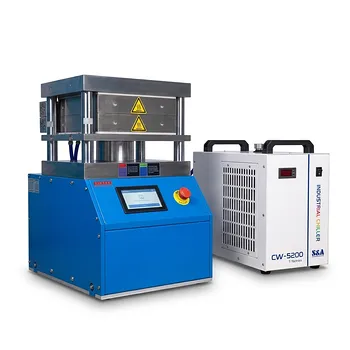
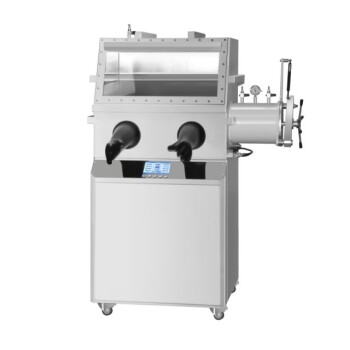
The application of 30 MPa of pressure during the sealing of CR2032 coin cells serves a dual purpose: achieving a hermetic seal and ensuring intimate mechanical contact between solid layers. Using a hydraulic tool at this specific pressure ensures the cell casing is airtight while simultaneously forcing the cathode, solid electrolyte, and anode into a unified structure. This process is critical for minimizing interfacial resistance, which is the primary hurdle in solid-state battery performance.
Applying 30 MPa of pressure transforms individual battery components into a functional electrochemical system by replacing the "wetting" action of liquid electrolytes with mechanical force. This pressure is essential for establishing the ion transport pathways required for stable battery cycling.
Maximizing Solid-Solid Interfacial Contact
Eliminating Interfacial Voids
In liquid batteries, the electrolyte flows into every pore; in solid-state batteries, the materials are rigid and do not naturally "wet" the surfaces. The 30 MPa of pressure forces the lithium anode and LLZTO electrolyte pellet together, eliminating microscopic gaps and voids that would otherwise block ion flow.
Minimizing Contact Resistance
High-pressure application is a fundamental requirement for lowering interfacial contact resistance. By maximizing the physical contact area at the solid-solid interfaces, the hydraulic tool ensures that ions can move efficiently between the cathode, electrolyte, and anode.
Establishing Ion Transport Pathways
Without sufficient pressure, the path for lithium ions is fragmented and high in impedance. The mechanical force creates continuous transport pathways, which are necessary to achieve the rate performance and cycle life targets required for battery testing.
Achieving a Reliable Hermetic Seal
Preventing Environmental Contamination
The hydraulic tool provides a precise, uniform crimp that creates an airtight seal between the battery case and the sealing gasket. This prevents the ingress of external air and moisture, which would otherwise react violently with the lithium anode or degrade the LLZTO electrolyte.
Ensuring Internal Component Integrity
A tight mechanical seal maintains the internal pressure throughout the testing phase, preventing the evaporation of internal components (if any additives are used) and keeping the stack in place. This structural stability is vital for obtaining accurate and reproducible electrochemical data.
Suppressing Interlayer Delamination
As batteries cycle, materials often expand and contract; the constant mechanical pressure provided by a proper seal helps suppress delamination. This keeps the layers in contact even as volume changes occur during the charging and discharging processes.
Understanding the Trade-offs and Pitfalls
The Risk of Brittle Fracture
While high pressure is beneficial for contact, solid-state electrolytes like LLZTO pellets are often ceramic and brittle. Exceeding the recommended pressure or applying it unevenly can lead to cracks in the electrolyte, causing a short circuit and total cell failure.
Pressure Uniformity Issues
If the hydraulic tool is not properly calibrated or the dies are misaligned, the 30 MPa of pressure may be distributed unevenly. Non-uniform pressure creates "hotspots" of high current density, which can accelerate the growth of lithium dendrites and lead to premature battery death.
How to Apply This to Your Battery Testing
Making the Right Choice for Your Goal
- If your primary focus is minimizing impedance: Ensure the hydraulic press is held at the peak 30 MPa pressure for several seconds to allow the materials to settle and maximize the contact area.
- If your primary focus is long-term cycle stability: Focus on the precision of the crimping die to ensure a perfect hermetic seal, as even trace amounts of moisture can cause gradual degradation over hundreds of cycles.
- If your primary focus is preventing short circuits: Inspect the LLZTO pellets for micro-cracks before assembly, as the 30 MPa sealing pressure can turn a minor flaw into a catastrophic structural failure.
By precisely controlling the sealing pressure, researchers can overcome the inherent mechanical challenges of solid-state interfaces to ensure valid, high-performance battery data.
Summary Table:
| Key Function | Impact on Performance | Potential Risk |
|---|---|---|
| Interfacial Contact | Minimizes contact resistance & ion transport voids. | Excessive force causes brittle ceramic fracture. |
| Hermetic Sealing | Prevents moisture/air ingress; protects lithium. | Poor sealing leads to contamination & failure. |
| Structural Stability | Suppresses delamination during charging/cycling. | Non-uniform pressure accelerates dendrite growth. |
Elevate your solid-state battery research with KINTEK’s comprehensive laboratory pressing solutions. We specialize in providing the precision required for high-performance battery testing, offering a wide range of manual, automatic, heated, multifunctional, and glovebox-compatible models. Our advanced cold and warm isostatic presses are designed to help you achieve the perfect 30 MPa seal, ensuring intimate interfacial contact and long-term cycle stability. Don't let mechanical hurdles limit your data—contact our experts today to find the ideal pressing solution for your lab!
Related Products
- Automatic High Temperature Heated Hydraulic Press Machine with Heated Plates for Lab
- Automatic Heated Hydraulic Press Machine with Heated Plates for Laboratory
- Automatic Heated Hydraulic Lab Press Machine 200x200 Plate Size for Battery Research and Materials Science
- Automatic Laboratory Hydraulic Press Lab Pellet Press Machine
- Split Automatic Heated Hydraulic Press Machine with Heated Plates
People Also Ask
- Function of a Laboratory Hydraulic Press with Heated Platens in SSE? Enhance Battery Density & Conductivity
- What are the requirements for electrode pressing with high-viscosity ionic liquids like EMIM TFSI? Optimize Performance
- How does a laboratory heated hydraulic press facilitate PBN sample prep for WAXS? Achieve Precise X-Ray Scattering
- What are the industrial applications of heated hydraulic presses? Master Heat & Force for Precision Manufacturing
- Why is a laboratory hydraulic press with heating plates required for PLA/TEC films? Achieve Precise Sample Integrity