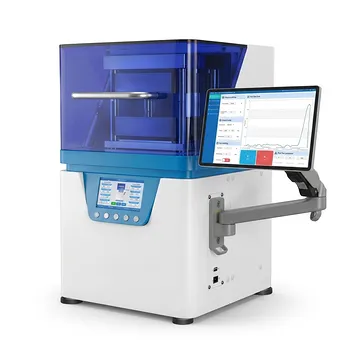
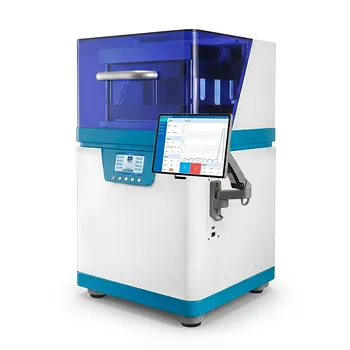
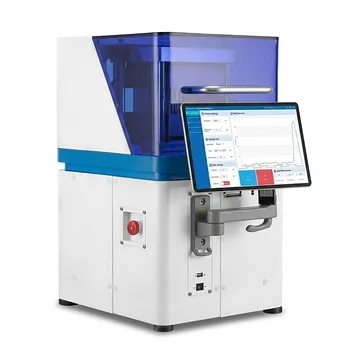
A laboratory hydraulic press is the critical bridge between synthesized powder and a functional solid-state electrolyte. In the preparation of Sn-doped NZSP, the press applies precise axial pressure (typically 15 MPa) to compress loose ceramic micro-powders into uniform, dense "green pellets."
The hydraulic press transforms loose powder into a cohesive green body, establishing the necessary particle-to-particle contact required for material migration and grain growth during high-temperature sintering. Without this high-pressure compaction, the resulting electrolyte would suffer from high porosity and poor ionic conductivity.
The Physical Transformation: From Powder to Green Body
Establishing Intimate Particle Contact
The primary role of the hydraulic press is to force individual Sn-doped NZSP powder particles into close proximity. By applying controlled uniaxial pressure, the press eliminates large air gaps and rearranges particles to fill internal voids.
This physical closeness is a prerequisite for the chemical reactions that occur later. It ensures that atoms can migrate across particle boundaries once the material reaches sintering temperatures.
Achieving Geometric Uniformity
The press uses specialized dies to produce pellets with precise dimensions, such as a 15 mm diameter and a thickness of 1.0 to 1.1 mm. Consistent thickness and diameter are essential for accurate downstream measurements of the material's intrinsic properties.
Uniformity in the green body prevents localized stress concentrations. This helps ensure the pellet remains crack-free and structurally sound during the intense thermal expansion of the furnace.
The Foundation for High-Temperature Sintering
Facilitating Material Migration and Grain Growth
High-density green bodies are the "blueprint" for the final ceramic structure. The tightness achieved by the hydraulic press provides the physical paths necessary for grains to fuse together during sintering.
If the initial compaction is insufficient, the grains cannot bridge the gaps between them. This results in a weak, disconnected structure that fails to conduct sodium ions effectively.
Minimizing Internal Porosity and Voids
A key goal in NASICON preparation is reducing internal porosity, which acts as a barrier to ion transport. The hydraulic press "cold-presses" the powder to a high initial density, minimizing the volume of air that must be removed during sintering.
By reducing these internal voids at the start, the final electrolyte achieves a much higher relative density. This leads to a low-porosity ceramic sheet that is both mechanically robust and chemically stable.
Impact on Ionic Conductivity and Performance
Reducing Grain Boundary Resistance
In solid-state electrolytes, resistance often occurs at the boundaries where different grains meet. A well-pressed pellet ensures that these boundaries are tight and well-connected.
By optimizing the pressing stage, researchers can significantly enhance ion transport efficiency. This directly improves the final product's total ionic conductivity, a core requirement for high-performance batteries.
Enhancing Mechanical Stability
The hydraulic press provides the green body with enough mechanical strength to be handled and placed in a furnace. Without this initial structural integrity, the pellets would crumble under their own weight or during the transition to the sintering stage.
Understanding the Trade-offs and Pitfalls
The Risk of Over-Pressurization
While high pressure is necessary for densification, exceeding the material's limits (such as applying 155 MPa when 15 MPa is required) can cause "capping" or laminations. These are structural flaws where the pellet splits into horizontal layers due to trapped air or internal stress.
Pressure Distribution Inconsistency
If the pressure is not applied uniformly, the green body will have varying densities across its diameter. This leads to uneven shrinkage during sintering, which often results in warped or cracked ceramic sheets.
How to Apply This to Your Project
Making the Right Choice for Your Goal
- If your primary focus is maximizing ionic conductivity: Ensure the hydraulic press is used to achieve the highest possible green density to minimize grain boundary resistance.
- If your primary focus is structural integrity and crack prevention: Use a moderate, precise pressure (like the 15 MPa recommended for Sn-doped NZSP) and ensure slow pressure release to avoid internal stress fractures.
- If your primary focus is standardized material testing: Utilize precision dies and a digital pressure gauge to ensure every pellet has identical dimensions and initial density for comparative analysis.
By mastering the application of the laboratory hydraulic press, you ensure that the complex chemistry of Sn-doped NZSP is supported by a flawless physical structure.
Summary Table:
| Stage | Function | Benefit for Sn-doped NZSP |
|---|---|---|
| Powder Compaction | Transforms loose powder into a cohesive green body | Establishes particle contact for material migration |
| Geometric Control | Produces pellets with precise 15 mm diameter | Ensures uniform thermal expansion & measurement accuracy |
| Density Optimization | Minimizes internal air gaps and voids | Reduces grain boundary resistance and boosts conductivity |
| Structural Stability | Provides mechanical handling strength | Prevents cracks or crumbling during high-temp sintering |
Elevate Your Solid-State Battery Research with KINTEK
Achieve the ultimate structural integrity and ionic conductivity for your NASICON-type electrolytes. KINTEK specializes in comprehensive laboratory pressing solutions tailored for advanced battery research. Our range includes:
- Manual & Automatic Presses: For precise pressure control (e.g., 15 MPa).
- Heated & Multifunctional Models: To support complex material synthesis.
- Glovebox-Compatible Systems: For moisture-sensitive NZSP preparations.
- Cold and Warm Isostatic Presses (CIP/WIP): To eliminate internal porosity effectively.
Don't let poor compaction hinder your material's performance. Contact KINTEK today to find the ideal pressing solution for your lab!
References
- Muhammad Akbar, Kyung Yoon Chung. Novel Sn‐Doped NASICON‐Type Na<sub>3.2</sub>Zr<sub>2</sub>Si<sub>2.2</sub>P<sub>0.8</sub>O<sub>12</sub> Solid Electrolyte With Improved Ionic Conductivity for a Solid‐State Sodium Battery. DOI: 10.1002/cey2.717
This article is also based on technical information from Kintek Solution Knowledge Base .
Related Products
- Laboratory Hydraulic Press Lab Pellet Press Machine for Glove Box
- Laboratory Hydraulic Press 2T Lab Pellet Press for KBR FTIR
- 24T 30T 60T Heated Hydraulic Lab Press Machine with Hot Plates for Laboratory
- Laboratory Hydraulic Press Lab Pellet Press Button Battery Press
- Laboratory Hydraulic Pellet Press for XRF KBR FTIR Lab Press
People Also Ask
- How does a laboratory hydraulic press contribute to the preparation of Li3-3xScxSb samples? Optimize Ionic Conductivity
- What is the function of a laboratory hydraulic press in FT-IR of curcumin-coated MWCNTs? Achieve Optical Clarity.
- Why is a laboratory hydraulic press required for compression molding boron-siloxane? Solve High-Loading Density Challenges
- What role does a laboratory hydraulic press play in the preparation of piezoelectric ceramic discs for DC-PG? | KINTEK
- What role does a laboratory hydraulic press play in reaction pellets? Optimizing Lunar Soil and Metal Fuel Density