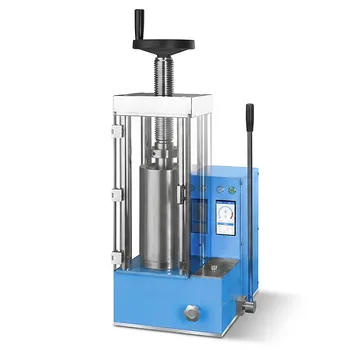
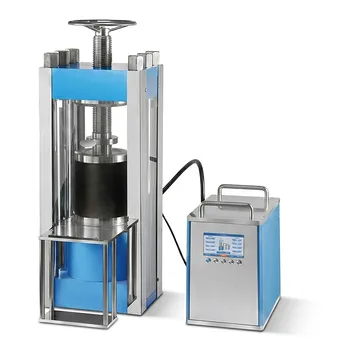
A laboratory pressing machine is the foundational tool for creating dense, standardized specimens. It applies high pressure to transform loose powders or composites into uniform pellets, eliminating internal voids and ensuring tight particle-to-particle contact. This physical densification is mandatory to obtain accurate and reproducible ionic conductivity data during Electrochemical Impedance Spectroscopy (EIS).
The necessity of a laboratory press stems from the fact that solid-state electrochemical performance is entirely dependent on the quality of solid-to-solid interfaces. By removing air gaps and standardizing specimen geometry, the press ensures that measured resistance reflects the material's intrinsic properties rather than processing flaws.
Eliminating Internal Impedance Barriers
Maximizing Particle-to-Particle Contact
Solid-state electrolytes rely on continuous pathways for ion transport, which require intimate contact between individual particles. High-pressure compaction, often reaching several hundred megapascals (MPa), forces these particles together to reduce contact resistance. Without this pressure, ions cannot jump across the "gaps" between grains, resulting in artificially low conductivity readings.
Suppression of Voids and Air Bubbles
Internal voids act as insulators that block ion flow and create "bottlenecks" within the material. A laboratory press drives out trapped air and, in the case of composite systems, forces resin or polymer matrices to flow through fiber networks or around inorganic fillers. This leads to a high fiber volume fraction and minimal porosity, which are critical for high-performance composites.
Facilitating Solid-to-Solid Interface Bonding
In all-solid-state batteries, the interface between the electrode and the electrolyte is a frequent point of failure. A high-tonnage hydraulic press provides the extreme pressure needed to tightly bond these surfaces at the atomic level. This physical prerequisite is what enables efficient lithium-ion transport across the different layers of the battery cell.
Ensuring Geometric and Structural Consistency
Standardization of Specimen Thickness
Electrochemical testing requires precise measurements of thickness to calculate bulk resistance and ionic conductivity. A laboratory press allows for the creation of pellets with a fixed, repeatable thickness. This consistency ensures that data collected across different batches is comparable and scientifically valid.
Production of "Green Bodies" for Sintering
For ceramic electrolytes, the press creates a self-supporting "green pellet" through uniaxial compaction. This initial mechanical densification prevents the material from deforming, cracking, or warping during subsequent high-temperature sintering stages. A uniform green body is the only way to achieve a final, fully densified electrolyte with consistent properties.
The Synergy of Heat and Pressure
Thermal-Mechanical Softening
Many laboratory presses feature heated platens, which are essential for processing polymer-based electrolytes like PEO. The combination of heat and pressure facilitates the softening of the polymer matrix, allowing it to flow and fill gaps at lower mechanical pressures than would be required at room temperature.
Diffusion Bonding and Rate Performance
Heated pressing promotes diffusion bonding between the solid electrolyte and the active electrode materials. This creates continuous ion transport channels that significantly improve the battery's rate performance and cycling stability. By optimizing the interface through thermal-mechanical means, researchers can minimize the interfacial impedance that often plagues solid-state systems.
Understanding the Trade-offs
Pressure Limits and Material Deformation
While high pressure is generally beneficial, exceeding the material's structural limits can cause micro-cracking or "capping," where the pellet delaminates upon release from the mold. Precision control over the "dwell time"—the duration the pressure is held—is just as important as the total tonnage to ensure the material reaches a stable state.
Thermal Sensitivity of Components
When using a heated press, one must be cautious of the thermal stability of the composite components. Excessive heat can lead to the degradation of polymer chains or unwanted side reactions between the electrolyte and the fillers. Success depends on finding the "sweet spot" where the material softens enough to flow without losing its chemical integrity.
How to Apply This to Your Project
Recommendations for Specimen Preparation
- If your primary focus is Ceramic Electrolyte Powders: Use a high-tonnage hydraulic press (300-500 MPa) to create dense green pellets, ensuring uniform uniaxial pressure to prevent cracking during sintering.
- If your primary focus is Polymer-Inorganic Composites: Utilize a heated laboratory press to facilitate polymer flow, which ensures a tight bond between the matrix and fillers while reducing internal voids at lower pressures.
- If your primary focus is Accurate EIS Characterization: Prioritize a mold that produces pellets with highly consistent thickness and diameter to ensure your calculated conductivity values are reproducible.
By mastering the application of pressure and temperature, you transform raw materials into high-performance electrochemical specimens that yield reliable, publishable data.
Summary Table:
| Aspect of Preparation | Impact on Electrochemical Testing | Key Technical Benefit |
|---|---|---|
| High-Pressure Compaction | Eliminates air gaps & internal voids | Maximizes particle-to-particle ionic conductivity |
| Geometric Standardization | Ensures uniform thickness and diameter | Precision in calculating bulk resistance via EIS |
| Heated Pressing | Facilitates polymer flow and matrix bonding | Improved rate performance and cycling stability |
| Green Body Formation | Creates stable pellets for ceramic sintering | Prevents cracking or warping during heat treatment |
| Interface Control | Atomic-level bonding of solid interfaces | Minimizes interfacial impedance in battery cells |
Elevate Your Battery Research with KINTEK Precision
Achieving reliable electrochemical data starts with superior specimen preparation. KINTEK specializes in comprehensive laboratory pressing solutions tailored for advanced battery research. From manual and automatic presses to heated and glovebox-compatible models, as well as cold and warm isostatic presses, we provide the tools necessary to eliminate voids and optimize solid-to-solid interfaces.
Ensure your specimens yield reproducible and publishable results—Contact KINTEK today to find the perfect press for your lab!
References
- Nurul Ain Najihah Yusri, N. A. Mustaffa. NASICON-PEO (Polyethylene Oxide) Polymer-in-Ceramic Composite Electrolytes: Thermal, Structural and Electrical Properties. DOI: 10.48048/tis.2025.9672
This article is also based on technical information from Kintek Solution Knowledge Base .
Related Products
- Laboratory Split Manual Heated Hydraulic Press Machine with Hot Plates
- Laboratory Hydraulic Press Lab Pellet Press Machine for Glove Box
- Automatic Laboratory Hydraulic Press Lab Pellet Press Machine
- Automatic Heated Hydraulic Lab Press Machine 200x200 Plate Size for Battery Research and Materials Science
- Automatic Heated Hydraulic Press Machine with Hot Plates for Laboratory
People Also Ask
- What role does a laboratory hydraulic heated press play in rubber vulcanization? Master Precision Molding Today
- Why is a laboratory heated hydraulic press utilized during the lamination stage of NASICON green tapes?
- What role does a laboratory heated hydraulic press play in LTCC? Essential for High-Density Ceramic Lamination
- Why is a laboratory hydraulic press with heating plates required for PLA/TEC films? Achieve Precise Sample Integrity
- Why Use a Laboratory Heated Hydraulic Press for SSAB CCM? Optimize Solid-State Battery Interfacial Bonding