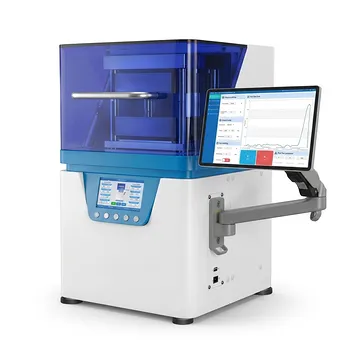
The necessity of high pressure stems from the inherent challenge of achieving seamless contact between solid materials. In all-solid-state fluoride-ion battery assembly, a laboratory hydraulic press applies pressures often exceeding 300–400 megapascals (MPa) to force the cathode composite and solid electrolyte into a single, dense structure. This extreme force is required to create mechanical interlocking and eliminate the microscopic gaps that would otherwise block the flow of fluoride ions.
Core Takeaway: High pressure is the primary mechanism for transforming loose powder particles into a cohesive electrochemical system. By forcing plastic deformation at the interfaces, the press establishes the continuous ion-conduction pathways and low interfacial resistance essential for battery functionality.
Overcoming the Solid-Solid Interface Challenge
Achieving Mechanical Interlocking
Unlike liquid electrolytes that naturally wet an electrode, solid components must be physically forced together. High pressure creates tight mechanical interlocking between the cathode composite layer and the solid electrolyte layer.
Eliminating Internal Voids
Powdered materials contain significant air gaps and internal pores that act as insulators. A hydraulic press compacts these layers to maximize their relative density, effectively removing the voids that hinder ion transport.
Inducing Plastic Deformation
Under pressures reaching 360 MPa or higher, solid particles undergo plastic deformation. This allows the particles to "flow" and fill microscopic irregularities, establishing atom-level contact across the solid-solid interface.
Enhancing Electrochemical Performance
Reducing Interfacial Contact Resistance
High-pressure molding significantly reduces interfacial contact resistance by increasing the physical surface area where the electrolyte and electrode meet. Lower resistance is critical for maintaining high efficiency and preventing energy loss during operation.
Establishing Continuous Ion Pathways
For fluoride ions to migrate effectively, they require a continuous transport network. The densification provided by the press ensures that fluoride ions can move smoothly across the interface between the solid electrolyte and the active material.
Managing Volume Expansion
Batteries naturally expand and contract during charge-discharge cycles. A highly dense, pressed structure helps prevent contact failure by maintaining the integrity of the layers despite these internal mechanical stresses.
Understanding the Trade-offs
Mechanical Limits of Materials
While higher pressure generally improves density, exceeding the material's structural limits can lead to particle fracturing. If the pressure is too high, it may cause micro-cracks in the electrolyte layer, potentially leading to short circuits or structural failure.
Equipment and Mold Durability
The use of ultra-high pressures requires specialized, high-strength molds and precise pressure control. Excessive force can lead to mold deformation or catastrophic failure of the laboratory press if the safety margins are not strictly observed.
Complexity of "Cold-Pressing"
Relying solely on high-pressure "cold-pressing" may not reach the theoretical density of a sintered material. While it is the standard for test cell assembly, it remains a mechanical approximation of a perfectly fused interface.
Optimizing Pressure for Your Assembly Goal
When assembling test cells, the target pressure should be calibrated based on the specific materials and desired performance outcomes.
- If your primary focus is maximizing ionic conductivity: Target the upper range of the material's tolerance (e.g., 400 MPa) to ensure the highest possible relative density and a continuous transport network.
- If your primary focus is preventing internal short circuits: Use moderate, stable pressure (e.g., 80–250 MPa) to avoid over-compressing thin electrolyte layers or causing particle penetration.
- If your primary focus is cycling stability: Ensure a high-pressure holding step to facilitate deep mechanical interlocking, which better withstands the volume changes of the active materials.
By mastering the application of pressure, you bridge the gap between individual powder particles and a high-performance electrochemical system.
Summary Table:
| Key Mechanism | Impact on Battery Performance |
|---|---|
| Mechanical Interlocking | Creates seamless contact between high-density solid components. |
| Void Elimination | Removes insulating air gaps to facilitate smooth ion transport. |
| Plastic Deformation | Forces particles to 'flow', establishing atom-level interface contact. |
| Resistance Reduction | Minimizes interfacial contact resistance for higher efficiency. |
| Structural Stability | Maintains layer integrity during battery volume expansion cycles. |
Optimize Your Battery Research with KINTEK Precision
To achieve the extreme pressures and mechanical interlocking vital for all-solid-state fluoride-ion batteries, you need equipment designed for high-performance material science. KINTEK specializes in comprehensive laboratory pressing solutions, offering the precision and force necessary to bridge the gap from powder to a functional electrochemical system.
Our specialized lineup includes:
- Manual & Automatic Presses for high-repeatability test cell assembly.
- Heated & Multifunctional Models to explore advanced material properties.
- Glovebox-Compatible Designs for air-sensitive fluoride-ion chemistry.
- Cold & Warm Isostatic Presses (CIP/WIP) for maximum theoretical density.
Ensure your research achieves the continuous ion pathways and low interfacial resistance required for success. Contact our laboratory specialists today to find the ideal pressing solution for your battery application!
References
- Tommi Hendrik Aalto, Jonas Jacobs. Gas evolution in Ruddlesden–Popper-type intercalation cathodes in all-solid-state fluoride-ion-batteries: implications on battery performance and synthesis of highly oxidized oxyfluorides. DOI: 10.1039/d5ta07033c
This article is also based on technical information from Kintek Solution Knowledge Base .
Related Products
- Laboratory Hydraulic Press Lab Pellet Press Machine for Glove Box
- Laboratory Hydraulic Press 2T Lab Pellet Press for KBR FTIR
- 24T 30T 60T Heated Hydraulic Lab Press Machine with Hot Plates for Laboratory
- Laboratory Hydraulic Press Lab Pellet Press Button Battery Press
- Laboratory Hydraulic Pellet Press for XRF KBR FTIR Lab Press
People Also Ask
- How does a laboratory hydraulic press contribute to the preparation of Li3-3xScxSb samples? Optimize Ionic Conductivity
- What is the function of a laboratory hydraulic press in FT-IR of curcumin-coated MWCNTs? Achieve Optical Clarity.
- Why is a laboratory hydraulic press required for compression molding boron-siloxane? Solve High-Loading Density Challenges
- What role does a laboratory hydraulic press play in the preparation of piezoelectric ceramic discs for DC-PG? | KINTEK
- What role does a laboratory hydraulic press play in reaction pellets? Optimizing Lunar Soil and Metal Fuel Density