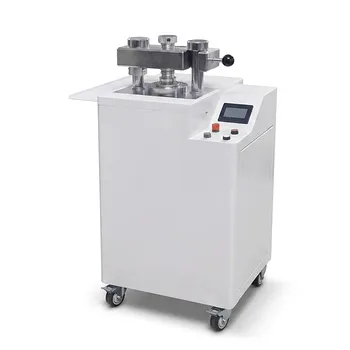
Pressure control is the master variable in composite fabrication. A laboratory hydraulic press optimizes material performance by applying constant, precise force during the critical curing and solidification stages. This process eliminates trapped air, ensures complete resin infiltration into the fiber network, and maintains the structural alignment necessary for superior mechanical properties.
The central takeaway is that precise pressure control transforms loose fibers and resins into a high-performance material by minimizing porosity and maximizing the interfacial bond between the plant fibers and the polymer matrix.
Eliminating Porosity and Internal Defects
Expelling Trapped Air Bubbles
During the preparation of prepreg layers, air frequently becomes trapped between the sheets of material. A hydraulic press applies constant pressure to force these bubbles out before the matrix cures, significantly reducing the final porosity of the finished composite.
Ensuring Full Resin Infiltration
For a composite to be effective, the resin matrix must fully saturate the plant fiber fabric. Precise pressure control facilitates this infiltration, ensuring there are no dry spots or voids that could act as failure points under stress.
Promoting Uniform Cross-Linking
Consistent pressure ensures that the resin and fibers remain in intimate contact throughout the heating cycle. This leads to uniform cross-linking and solidification of the matrix, resulting in a stable fiber volume content across the entire sample.
Enhancing Mechanical and Structural Properties
Optimizing Fiber-Matrix Bonding
The strength of a plant fiber composite, such as flax-epoxy, depends on the quality of the bond at the interface. High-precision pressure maintains a tight bond between the natural fibers and the resin, which maximizes the specific strength and stiffness of the material.
Maintaining Fiber Alignment
Mechanical performance is highly dependent on the orientation of the fibers. The controlled closing of the press prevents fibers from shifting or buckling during the molding process, ensuring the reinforcement stays exactly where it is needed for load-bearing.
Inducing Directional Alignment
In certain composites, such as those using expanded graphite, unidirectional pressure can be used to induce the directional alignment of particles. This alignment creates efficient pathways for phonon transmission, which significantly increases the thermal conductivity of the material.
Understanding the Trade-offs
The Risk of Fiber Damage
While high pressure reduces porosity, excessive force can crush or damage delicate natural plant fibers. This degradation of the reinforcement phase can lead to a decrease in overall tensile strength, negating the benefits of a denser matrix.
Resin Starvation
Applying too much pressure too early in the curing cycle can force too much resin out of the mold. This results in a "resin-starved" composite that lacks the necessary matrix to protect the fibers and transfer loads effectively.
Heat and Pressure Synchronization
The relationship between temperature and pressure is complex; pressure must be adjusted as the resin viscosity changes. Failing to synchronize these variables can lead to uneven shrinkage, internal stresses, or surface defects like cracking.
How to Apply Pressure Control to Your Composite Research
Selecting the right pressure profile depends entirely on the specific goals of your material study and the nature of your components.
- If your primary focus is maximizing specific strength: Use constant, moderate pressure throughout the curing cycle to maintain fiber alignment while ensuring a dense, void-free matrix bond.
- If your primary focus is thermal management: Apply unidirectional pressure to compact particles and induce directional alignment, which shortens heat conduction channels within the material.
- If your primary focus is powder-based composites: Utilize precise high-pressure compaction (e.g., 30 MPa) to rearrange particles and achieve high green strength, preventing deformation during the sintering phase.
By mastering the nuances of pressure control, you turn a laboratory press from a simple tool into a high-precision instrument for material innovation.
Summary Table:
| Optimization Mechanism | Key Action | Impact on Material Performance |
|---|---|---|
| Porosity Control | Expels trapped air bubbles | Reduces internal defects and failure points |
| Resin Infiltration | Forces matrix into fiber network | Ensures full saturation and uniform cross-linking |
| Interfacial Bonding | Maintains tight fiber-matrix contact | Maximizes specific strength and stiffness |
| Fiber Alignment | Prevents shift during molding | Preserves structural integrity for load-bearing |
| Thermal Management | Induces directional particle alignment | Increases thermal conductivity and phonon transmission |
Elevate Your Composite Research with Precision Pressing Solutions
Achieving the perfect balance of pressure and temperature is critical for high-performance material innovation. KINTEK specializes in comprehensive laboratory pressing solutions tailored to your specific research needs. Whether you are developing advanced plant fiber composites or conducting cutting-edge battery research, our equipment provides the stability and control required for superior results.
Our Versatile Range Includes:
- Manual & Automatic Presses: For reliable, repeatable sample preparation.
- Heated & Multifunctional Models: To synchronize thermal and pressure profiles perfectly.
- Glovebox-Compatible Systems: Ideal for sensitive moisture-free environments.
- Cold & Warm Isostatic Presses (CIP/WIP): Perfect for high-density powder compaction.
Don't let porosity or fiber damage compromise your data. Contact a KINTEK expert today to find the ideal pressing solution for your laboratory and optimize your material performance!
References
- Constantin Stochioiu, Benoît Piezel. Mechanical Response of Epoxy Resin—Flax Fiber Composites Subjected to Repeated Loading and Creep Recovery Tests. DOI: 10.3390/polym15030766
This article is also based on technical information from Kintek Solution Knowledge Base .
Related Products
- 24T 30T 60T Heated Hydraulic Lab Press Machine with Hot Plates for Laboratory
- Automatic Laboratory Hydraulic Press for XRF and KBR Pellet Pressing
- Laboratory Hydraulic Press 2T Lab Pellet Press for KBR FTIR
- Automatic Laboratory Hydraulic Press Lab Pellet Press Machine
- Laboratory Hydraulic Pellet Press for XRF KBR FTIR Lab Press
People Also Ask
- Function of a Laboratory Hydraulic Press with Heated Platens in SSE? Enhance Battery Density & Conductivity
- Why is a laboratory hydraulic press with heating plates required for PLA/TEC films? Achieve Precise Sample Integrity
- What role does a laboratory heated hydraulic press play in LTCC? Essential for High-Density Ceramic Lamination
- Why Use a Laboratory Heated Hydraulic Press for SSAB CCM? Optimize Solid-State Battery Interfacial Bonding
- Why is a laboratory heated hydraulic press utilized during the lamination stage of NASICON green tapes?