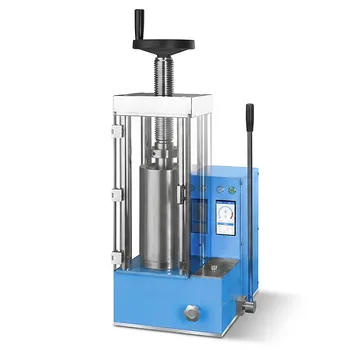
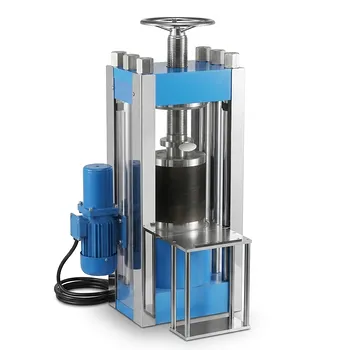
The industrial laboratory press is the critical bridge between raw metal powders and a solid, processable alloy.
In the preparation of TiPtHf shape memory alloys, the laboratory press performs cold pressing on high-purity titanium, platinum, and hafnium powders using approximately 50 bar of pressure within precision molds. This process transforms loose, unstable powder into a green body with a defined geometric shape and sufficient structural integrity to serve as a stable foundation for the subsequent arc melting stage.
The core role of the laboratory press is to ensure tight contact between powder particles through mechanical consolidation. This creates a dense "green compact" that prevents material loss and ensures chemical uniformity during the high-temperature melting process.
Transforming Powder into a Functional Solid
Mechanisms of Particle Consolidation
The laboratory press applies axial force to trigger particle rearrangement and mechanical interlocking. By forcing the high-purity Ti, Pt, and Hf powders into close proximity, the press establishes the physical contact necessary for efficient energy transfer during later processing.
Creation of the Green Body
Using precision molds, the press produces a "green body"—a compact that maintains its shape without being fully fused. This compact possesses the specific strength required for safe handling and transport within the laboratory, preventing the sample from crumbling before it reaches the furnace.
Enhancing Efficiency in the Melting Stage
Providing a Stable Foundation for Arc Melting
Loose powders are difficult to melt uniformly and can be easily disturbed by the vacuum systems or gas flows inside an arc melter. The consolidated green body provides a concentrated, solid mass that allows the electric arc to strike and distribute heat more predictably across the entire sample.
Minimizing Material Loss and Contamination
Pressing reduces the surface area-to-volume ratio of the material, which helps prevent dust splashing or powder dispersal when the arc is ignited. This is vital for maintaining the precise stoichiometry (the exact ratio of elements) required for the alloy to exhibit its unique shape memory properties.
Understanding the Trade-offs
Pressure Sensitivity and Density Gradients
While 50 bar is the baseline for these alloys, achieving a uniform density throughout the compact can be challenging. Inadequate pressure leads to a fragile green body, while excessive pressure can cause internal stresses or "capping" cracks that may persist even after melting.
Geometry and Tooling Constraints
The shape of the final alloy is inherently limited by the mold design. While precision molds allow for high accuracy, complex shapes are difficult to achieve through pressing alone, often requiring secondary machining or specialized, expensive tooling.
Making the Right Choice for Your Project
The laboratory press is essential for creating a manageable material form from volatile or loose powders.
- If your primary focus is chemical precision: Ensure the press and molds are thoroughly cleaned to prevent cross-contamination, as the high contact pressure can embed impurities into the green body surface.
- If your primary focus is structural integrity: Focus on the "dwell time" (how long the pressure is held), as maintaining pressure briefly allows for better particle settling and a more stable compact.
- If your primary focus is process efficiency: Use precision molds that closely match the dimensions of your arc melting hearth to maximize heat transfer and reduce melting time.
Proper utilization of a laboratory press ensures that your TiPtHf alloy starts as a stable, high-density compact, directly determining the quality of the final shape memory material.
Summary Table:
| Process Phase | Key Function of Laboratory Press | Impact on Final Alloy Quality |
|---|---|---|
| Consolidation | Particle rearrangement & mechanical interlocking | Ensures uniform density & chemical stoichiometry |
| Compaction | Precision molding into stable "green bodies" | Prevents material loss & ensures safe handling |
| Melting Prep | Minimizing surface area-to-volume ratio | Stable arc striking & predictable heat distribution |
| Efficiency | Controlled dwell time & pressure application | Reduced internal stresses & optimized melting cycles |
Optimize Your Alloy Development with KINTEK Precision
Elevate your material science research with KINTEK’s comprehensive laboratory pressing solutions. Whether you are developing complex TiPtHf shape memory alloys or pioneering new battery technologies, our range of manual, automatic, heated, multifunctional, and glovebox-compatible models provides the precision your workflow demands.
We also specialize in cold and warm isostatic presses designed to eliminate density gradients and maximize structural integrity. Partner with us to ensure your samples maintain perfect stoichiometry and superior quality from powder to solid.
Contact our experts today to find the perfect pressing solution for your lab!
References
- Elija Moletsane, Chris Machio. The effect of increasing hafnium on the microstructure, phase transformation temperatures and hardness of TiPtHf potential shape memory alloys. DOI: 10.1051/matecconf/202338803008
This article is also based on technical information from Kintek Solution Knowledge Base .
Related Products
- Electric Isostatic Pressing Machine 40 Tons Automatic Laboratory Powder Compacting Press
- Lab Round Bidirectional Press Mold
- XRF KBR Steel Ring Lab Powder Pellet Pressing Mold for FTIR
- Lab Polygon Press Mold
- XRF KBR Plastic Ring Lab Powder Pellet Pressing Mold for FTIR
People Also Ask
- What are the key characteristics of the isostatic pressing process? Unlock Uniform Density and Complex Geometries
- Why is vacuum-sealed packaging necessary before isostatic pressing of CuPc thin films? Protect Integrity & Uniformity
- How is pressure applied to the material during isostatic pressing? Master Uniform Density and Complex Geometries
- How does pressure distribute during isostatic pressing of aluminum? Achieve Uniform Density for Your Lab Materials
- What are the applications of isostatic pressing in the automotive industry? Precision Manufacturing for High-Performance Parts