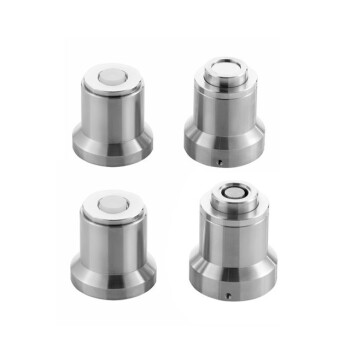
Selecting high-strength stainless steel dies requires a focus on structural rigidity and surface morphology.
Technical factors for selection include a high resistance to plastic deformation under extreme pressures (up to 140 atm or several hundred MPa) and the presence of ultra-smooth internal walls. These characteristics ensure that fluoride powder samples maintain consistent geometric dimensions, achieve uniform densification, and remain free of surface defects during the ejection process.
The core takeaway for selecting dies is the synchronization of mechanical hardness and surface finish. This combination prevents die distortion under high tonnage and minimizes demolding friction, which is essential for the structural integrity and reproducibility of experimental samples.
Structural Integrity and Deformation Resistance
Resisting Plastic Deformation
High-strength stainless steel is specifically chosen for its ability to withstand the high-tonnage pressure generated by laboratory hydraulic presses. Without sufficient yield strength, the die can undergo permanent deformation, leading to inconsistent sample diameters and compromised experimental results.
Ensuring Precise Densification
During uniaxial pressing, the mold must provide absolute confinement to ensure the fluoride powder densifies into a stable green compact. This structural stability allows for precise control over the final diameter (e.g., 8 mm) and thickness, which are critical for calculating material properties.
Surface Quality and Friction Management
Facilitating Smooth Ejection
The internal surfaces of the die must be polished to a high finish to reduce frictional resistance during the demolding phase. Minimizing friction ensures that the sample is ejected smoothly, preventing the uneven force distribution that often leads to chipping or delamination.
Preventing Surface Micro-cracks
A low-friction environment is vital for preventing the formation of surface micro-cracks during ejection. Maintaining a pristine surface ensures uniform electrode contact in subsequent testing, which is a fundamental requirement for experimental reproducibility.
Understanding the Trade-offs and Potential Pitfalls
Material Hardness vs. Toughness
While high hardness is necessary to prevent deformation, an excessively hard material may become brittle. Selecting a grade that balances yield strength with toughness is essential to ensure the die can handle repeated loading cycles without cracking or catastrophic failure.
Chemical Reactivity and Maintenance
Although stainless steel offers significant corrosion resistance, fluoride powders and specific environments can still cause surface degradation over time. Failure to maintain the smooth internal finish through regular cleaning and occasional polishing can lead to increased friction and the eventual failure of the molding process.
How to Select the Right Die for Your Project
When choosing a die for fluoride powder molding, align the technical specifications with your specific research objectives:
- If your primary focus is dimensional precision: Prioritize a die material with the highest rated yield strength to ensure the diameter remains constant even under maximum hydraulic pressure.
- If your primary focus is surface integrity: Select dies with a mirror-polished or diamond-finished internal bore to eliminate the risk of micro-cracks and surface chipping.
- If your primary focus is long-term durability: Opt for high-chromium stainless steel alloys that offer superior resistance to the potentially corrosive nature of various powder additives.
Investing in high-performance die materials is the most effective way to ensure that your powder molding process yields reliable, high-quality specimens for analysis.
Summary Table:
| Technical Factor | Key Requirement | Impact on Research |
|---|---|---|
| Structural Rigidity | High yield strength to resist plastic deformation | Maintains consistent sample dimensions under high pressure |
| Surface Finish | Ultra-smooth, mirror-polished internal walls | Reduces ejection friction to prevent cracks and delamination |
| Material Balance | Optimal ratio of hardness to toughness | Ensures long-term durability and resistance to cyclic loading |
| Chemical Resistance | High-chromium alloy composition | Prevents surface degradation from corrosive fluoride additives |
Elevate Your Battery Research with KINTEK Precision
Achieve unmatched experimental reproducibility with KINTEK’s comprehensive laboratory pressing solutions. Whether you are working on advanced fluoride powder molding or complex material densification, our range of manual, automatic, heated, multifunctional, and glovebox-compatible models—along with cold and warm isostatic presses—are engineered to meet the highest technical standards.
Don't let die deformation or surface defects compromise your results. Partner with KINTEK to access tools specifically optimized for the rigorous demands of battery research and material science.
Ready to optimize your lab's workflow? Contact us today to find the perfect molding solution!
References
- Anton Nahornyi, А. А. Омельчук. СИНТЕЗ ТА ЕЛЕКТРОПРОВІДНІСТЬ ФТОРПРОВІДНИХ ФАЗ SrSnF4 ТА PbxSr1-xSnF4. DOI: 10.15421/jchemtech.v33i1.311813
This article is also based on technical information from Kintek Solution Knowledge Base .
Related Products
- XRF KBR Steel Ring Lab Powder Pellet Pressing Mold for FTIR
- XRF KBR Plastic Ring Lab Powder Pellet Pressing Mold for FTIR
- Square Bidirectional Pressure Mold for Lab
- Lab XRF Boric Acid Powder Pellet Pressing Mold for Laboratory Use
- Lab Ball Press Mold
People Also Ask
- What considerations are important regarding the die size of an XRF pellet press? Optimize for Your XRF Spectrometer and Sample
- Why are pellets used in XRF analysis, and what is their limitation? Boost Accuracy and Speed in Your Lab
- What is the general process for preparing a sample pellet for XRF? Master Consistency for Accurate Analysis
- What are the main methods for preparing XRF pellets? Boost Accuracy and Efficiency in Your Lab
- How should one choose between a manual and automatic XRF pellet press? Maximize Accuracy and Efficiency in Your Lab