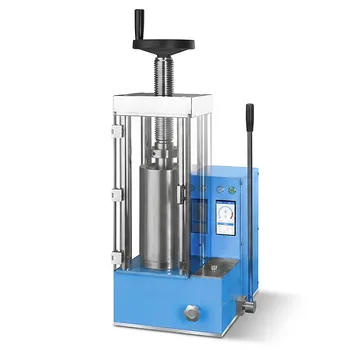
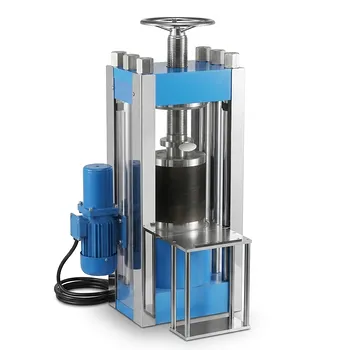
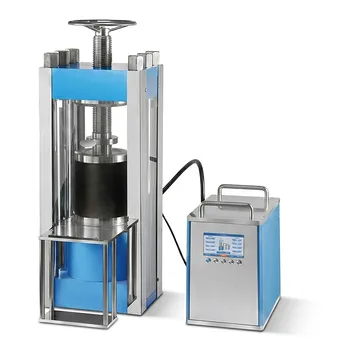
A laboratory cold isostatic press (CIP) serves as the critical densification tool for refractory alloys by applying uniform, omnidirectional pressure to powders sealed in flexible molds. This process ensures that complex mixtures, such as Nb-Mo-W-ZrC, achieve high density and structural uniformity at room temperature, which is essential for surviving the intense thermal stresses of subsequent sintering.
Core Takeaway: The primary function of a CIP in refractory alloy fabrication is the elimination of internal density gradients and pores. By providing isotropic compression, it creates a structurally stable "green body" that resists cracking and warping during high-temperature processing.
Mechanisms of Isotropic Compression
Achieving Omnidirectional Pressure
Unlike traditional uniaxial pressing, which applies force from one or two directions, a CIP uses a liquid medium to transmit pressure equally across the entire surface of the mold. This isotropic pressure ensures that the powder mass is compacted with the same intensity from every angle.
Overcoming Inter-particle Friction
High pressure—often reaching 300 MPa in laboratory settings—enables refractory powder particles to overcome internal friction and slide into a more efficient packing arrangement. In many cases, this pressure is sufficient to induce plastic deformation in the particles, further increasing the contact area between them.
Impact on Green Body Characteristics
Elimination of Internal Density Gradients
A major failure point in refractory components is the "density gradient" caused by wall friction in metal dies during uniaxial pressing. The CIP eliminates these gradients, ensuring that the internal structure of the green body is perfectly consistent from the core to the surface.
Enhancement of Green Strength and Density
By forcing particles into a tighter arrangement, the CIP significantly increases the relative density and physical strength of the unsintered (green) part. This improved green strength allows for easier handling and even pre-sintering machining without the risk of the part crumbling.
Optimization for the Sintering Phase
Mitigating Deformation and Cracking
Because the green body has a uniform density, it undergoes uniform shrinkage when placed in a high-temperature sintering furnace. This prevents the non-uniform internal stresses that typically lead to micro-cracks, warping, or catastrophic structural failure in refractory alloys.
Facilitating Chemical Diffusion
Refractory alloys often rely on the diffusion of elements (like ZrC into a Nb-Mo-W matrix) to achieve their final properties. The high-pressure environment of the CIP ensures tight physical contact between different powder species, which accelerates chemical diffusion and phase nucleation during the liquid-solid reactions in the furnace.
Understanding the Trade-offs
Dimensional Precision vs. Uniformity
While a CIP provides superior density, the use of flexible rubber or elastomer molds makes it more difficult to achieve precise final dimensions compared to rigid steel dies. The resulting green bodies often require near-net-shape processing or additional machining to meet tight tolerances.
Process Complexity and Cycle Time
Cold isostatic pressing is generally a slower, batch-oriented process because it requires vacuum-sealing the powder in a mold, loading the pressure vessel, and a controlled decompression cycle. This makes it a high-quality specialty process rather than a high-speed production method.
How to Apply This to Your Project
When integrating cold isostatic pressing into your refractory alloy workflow, consider your specific material goals to determine the optimal pressure and sequence.
- If your primary focus is maximizing final density: Use the CIP at its maximum rated pressure (typically 200–300 MPa) to ensure the highest possible green density before sintering.
- If your primary focus is preventing cracks in complex shapes: Use a two-stage process where you perform light axial pre-pressing followed by a CIP cycle to redistribute internal stresses.
- If your primary focus is achieving uniform chemical phases: Ensure the powders are meticulously mixed before CIPing to leverage the enhanced particle contact for better diffusion.
The cold isostatic press is the foundational step in transforming loose refractory powders into high-performance, high-strength engineered components.
Summary Table:
| Function | Mechanism | Key Benefit for Refractory Alloys |
|---|---|---|
| Isotropic Compression | Omnidirectional liquid pressure | Eliminates density gradients and internal pores |
| Particle Packing | Overcoming inter-particle friction | Increases relative density and green strength |
| Uniform Shrinkage | Consistent internal structure | Prevents warping or cracking during sintering |
| Diffusion Enhancement | Maximized particle contact | Accelerates chemical reactions and phase nucleation |
Optimize Your Material Research with KINTEK Precision Pressing
Achieve unmatched structural integrity and density in your refractory alloys and battery research. KINTEK specializes in comprehensive laboratory pressing solutions designed to meet the rigorous demands of modern material science.
Our extensive range includes:
- Isostatic Solutions: Cold (CIP) and Warm (WIP) isostatic presses for uniform compaction.
- Laboratory Presses: Manual, automatic, heated, and multifunctional models.
- Specialized Applications: Glovebox-compatible units for sensitive research environments.
Don't let density gradients or structural flaws compromise your results. Contact KINTEK today to discover how our advanced pressing technology can enhance your lab's performance and product quality.
References
- Yi Tan, Jin‐Mo Yang. High Temperature Deformation of ZrC Particulate-Reinforced Nb-Mo-W Composites. DOI: 10.2320/matertrans.47.1527
This article is also based on technical information from Kintek Solution Knowledge Base .
Related Products
- Electric Lab Cold Isostatic Press CIP Machine
- Electric Split Lab Cold Isostatic Pressing CIP Machine
- Automatic Lab Cold Isostatic Pressing CIP Machine
- Manual Cold Isostatic Pressing CIP Machine Pellet Press
- Electric Isostatic Pressing Machine 40 Tons Automatic Laboratory Powder Compacting Press
People Also Ask
- What role do electric lab cold isostatic presses play in industrial contexts? Bridge R&D and Manufacturing with Precision
- What are the applications of electric lab cold isostatic presses in research settings? Advance Material R&D with High-Pressure CIPs
- How does electrical Cold Isostatic Pressing (CIP) contribute to cost savings? Unlock Efficiency and Reduce Expenses
- What are some research applications of electric lab CIPs? Unlock Uniform Powder Densification for Advanced Materials
- What are the characteristics of standard off-the-shelf electric lab CIP solutions? Achieve Immediate, Cost-Effective Processing