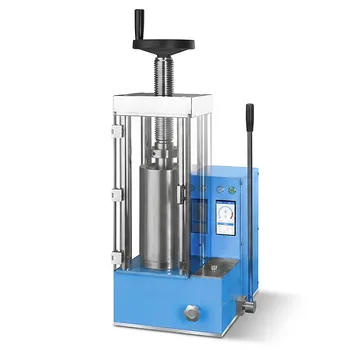
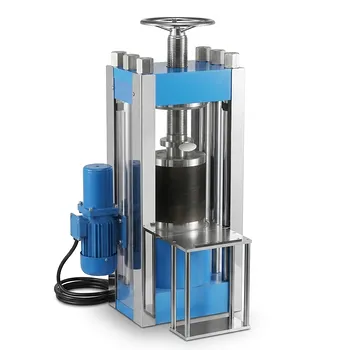
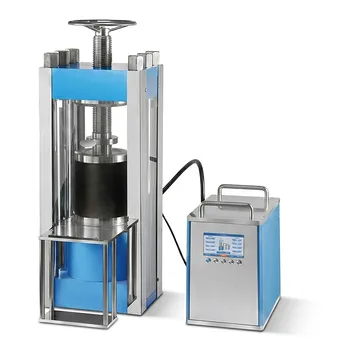
Cold Isostatic Pressing (CIP) serves as the critical secondary densification step for Aluminum Oxynitride (AlON) green bodies. It utilizes a liquid medium to apply omnidirectional high pressure—typically around 200 MPa—to compress residual micropores that remain after the initial warm pressing stage. This isotropic pressure environment eliminates internal stress gradients and density variations, ensuring the green body is structurally uniform. Consequently, the AlON material achieves a higher level of densification, which is mandatory for uniform, deformation-free shrinkage during subsequent pressureless sintering.
Core Takeaway: CIP transforms a non-uniform "green" part into a high-density, isotropic body by applying equal pressure from all directions. This process is essential for preventing cracking and warping during high-temperature sintering, directly ensuring the structural integrity of the final AlON ceramic.
The Mechanics of Isotropic Densification
Eliminating Residual Micropores
While warm pressing provides the initial shape, it often leaves behind residual micropores and small voids between powder particles. CIP applies immense pressure through a fluid medium to collapse these voids, forcing the AlON particles into a more compact arrangement. This secondary compaction significantly increases the "green density" of the part before it ever enters a furnace.
Equalizing Internal Stress Gradients
Standard uniaxial or warm pressing often creates "zones" of varying density because pressure is not distributed perfectly throughout the mold. CIP uses a liquid medium to ensure that pressure is applied omnidirectionally and equally to every surface. This eliminates internal stress gradients, creating a homogenous internal structure that is free from the "density shadows" common in traditional pressing.
Enhancing Inter-Particle Bonding
The high-pressure environment—sometimes exceeding 200 MPa—significantly increases the bonding force between powder particles. By tightening the contact points between the AlON matrix and any pore-forming agents, CIP prevents delamination or internal separation. This results in a high-strength green body that is robust enough to handle the thermal stresses of the next production phase.
Impact on Sintering and Final Quality
Ensuring Uniform Shrinkage
During the pressureless sintering stage, ceramic parts naturally shrink as particles fuse together. If the green body has density variations, it will shrink unevenly, leading to warping or geometric distortion. CIP ensures the density is uniform, which translates to predictable, isotropic shrinkage and a final product that matches the intended dimensions.
Preventing Structural Failures
Internal density gradients are the primary cause of stress cracks during the debinding and sintering of large AlON specimens. By equalizing the internal structure, CIP prevents these cracks from forming as the material undergoes high-temperature transformations. This is particularly vital for maintaining the structural integrity of complex or large-sized square specimens.
Understanding the Trade-offs
Process Complexity and Cost
While CIP provides superior uniformity, it adds a discrete processing step that requires specialized high-pressure equipment and maintenance. The green body must be vacuum-sealed in a flexible rubber or elastomer mold to prevent the liquid medium from contaminating the powder. This increases the total production cycle time and labor costs compared to simple uniaxial pressing.
Geometric Limitations
Because CIP applies pressure equally from all directions, it is excellent for maintaining proportions but can be challenging for parts requiring extremely tight tolerances directly out of the press. The flexible nature of the molds means that some post-CIP machining or finishing may be required to achieve precise final geometries, especially in complex AlON components.
How to Apply This to Your Project
Recommendations for Implementation
Selecting the right pressing strategy depends on the final performance requirements of your AlON component.
- If your primary focus is Geometric Precision: Use CIP to ensure uniform shrinkage, which allows you to more accurately calculate the "oversize" dimensions needed for the initial mold.
- If your primary focus is Structural Integrity: Prioritize CIP pressures of at least 200 MPa to eliminate the internal density gradients that cause micro-cracking during sintering.
- If your primary focus is High Optical Clarity: Ensure the CIP stage is maximized to remove all residual micropores, as even microscopic voids will scatter light and reduce the transparency of the final sintered AlON.
By integrating Cold Isostatic Pressing into your workflow, you ensure that your AlON green bodies possess the density and uniformity required to survive the rigors of high-temperature sintering.
Summary Table:
| Key CIP Function | Benefit for AlON Green Body | Final Quality Impact |
|---|---|---|
| Pore Compression | Collapses residual micropores | Higher density and optical clarity |
| Isotropic Pressure | Eliminates internal stress gradients | Uniform, deformation-free shrinkage |
| Particle Bonding | Increases inter-particle contact | Prevents delamination and cracking |
| Structural Homogeneity | Ensures uniform density distribution | Precise geometric tolerances |
Elevate Your Material Research with KINTEK Pressing Solutions
Achieving the perfect densification for AlON and advanced ceramics requires precision and reliability. KINTEK specializes in comprehensive laboratory pressing solutions tailored to your specific research needs. Whether you are focused on battery research or advanced ceramics, we offer a versatile range of equipment, including:
- Manual & Automatic Presses for routine lab tasks.
- Heated & Multifunctional Models for complex material synthesis.
- Glovebox-Compatible Systems for air-sensitive applications.
- Cold and Warm Isostatic Presses (CIP/WIP) for superior isotropic density.
Ready to eliminate structural defects and enhance your sintering results? Contact KINTEK today to find the ideal pressing solution for your laboratory!
References
- Feng Zhao, Tien‐Chang Lu. Highly-transparent AlON ceramic fabricated by tape-casting and pressureless sintering method. DOI: 10.1016/j.jeurceramsoc.2019.11.065
This article is also based on technical information from Kintek Solution Knowledge Base .
Related Products
- Electric Lab Cold Isostatic Press CIP Machine
- Automatic Lab Cold Isostatic Pressing CIP Machine
- Electric Split Lab Cold Isostatic Pressing CIP Machine
- Manual Cold Isostatic Pressing CIP Machine Pellet Press
- Electric Isostatic Pressing Machine 40 Tons Automatic Laboratory Powder Compacting Press
People Also Ask
- What are the applications of electric lab cold isostatic presses in research settings? Advance Material R&D with High-Pressure CIPs
- What role do electric lab cold isostatic presses play in industrial contexts? Bridge R&D and Manufacturing with Precision
- How does electrical Cold Isostatic Pressing (CIP) contribute to cost savings? Unlock Efficiency and Reduce Expenses
- What are some research applications of electric lab CIPs? Unlock Uniform Powder Densification for Advanced Materials
- What are the characteristics of standard off-the-shelf electric lab CIP solutions? Achieve Immediate, Cost-Effective Processing