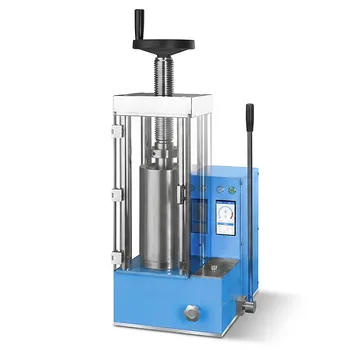
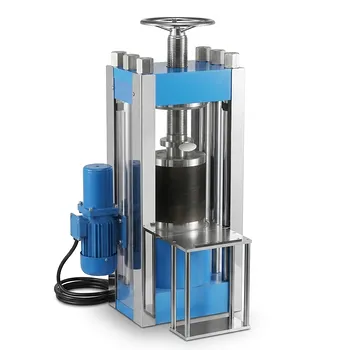
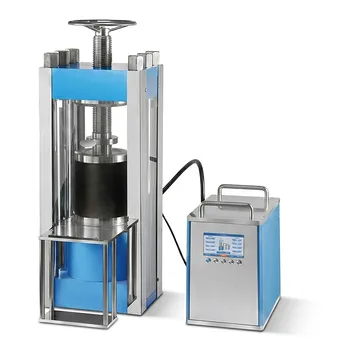
Cold isostatic pressing (CIP) is the critical mechanism for achieving isotropic density and high packing efficiency in alumina ceramic green bodies.
In a laboratory setting, the CIP applies uniform, omnidirectional pressure—typically ranging from 100 MPa to 300 MPa—to alumina powder sealed within a flexible mold. This process ensures that powder particles rearrange into the tightest possible configuration, creating a high-density green body with superior structural uniformity. By eliminating the internal density gradients common in traditional pressing, the CIP provides the necessary physical foundation to prevent cracking and deformation during subsequent high-temperature sintering.
The laboratory CIP serves as the primary tool for neutralizing internal stresses and density variations, ensuring that alumina ceramics maintain their structural integrity and geometric precision throughout the transition from powder to solid ceramic.
Achieving Extreme Particle Packing Density
The Role of Omnidirectional Pressure
A laboratory CIP utilizes a liquid medium to transmit pressure equally across every surface of the mold. This balanced force distribution ensures that the alumina powder is compacted with the same intensity from all directions simultaneously.
Maximizing Relative Density
Under ultra-high pressures, such as 300 MPa, alumina powder particles undergo significant rearrangement. This results in an extremely high packing density, sometimes reaching relative densities of up to 99%, which is essential for producing high-performance mechanical components.
Eliminating Internal Voids
The intense, multidirectional pressure effectively collapses internal voids and air pockets within the powder bed. Removing these defects at the green body stage is vital for creating a controlled pore structure and forming stable grain necks during sintering.
Solving the Density Gradient Problem
Overcoming Mold-Wall Friction
In traditional uniaxial (dry) pressing, friction between the powder and the rigid mold walls creates uneven pressure distribution. The CIP solves this by using flexible membranes, which allow the pressure to reach the core of the specimen without the "pressure drop" associated with friction.
Creating Isotropic Shrinkage
Because the density is uniform throughout the green body, the material shrinks at a consistent rate in all dimensions during the heating process. This uniformity is the primary factor in preventing the warping or "warpage" that often ruins complex or large-sized specimens.
Neutralizing Internal Stresses
By applying pressure equally, the CIP eliminates the internal stress gradients that lead to micro-cracks. This is particularly critical for large square specimens or spherical ceramic balls where structural symmetry is a requirement.
Understanding the Trade-offs
Process Speed vs. Performance
While CIP provides a vastly superior green body compared to uniaxial pressing, it is a slower, batch-oriented process. The requirement to seal parts in flexible molds and the time needed for the liquid pressure cycle make it more suitable for precision laboratory work than high-volume mass production.
Dimensional Accuracy Challenges
Because the molds used in CIP are flexible, achieving precise near-net shapes can be more difficult than with rigid steel dies. The mold itself deforms during the process, which may necessitate additional machining or "green machining" of the body before it is sintered.
How to Apply This to Your Project
To maximize the effectiveness of cold isostatic pressing in your alumina ceramic workflow, consider your final performance requirements:
- If your primary focus is maximum mechanical strength: Utilize pressures toward the higher end of the spectrum (300 MPa) to ensure the highest possible green density and minimal residual porosity.
- If your primary focus is geometric precision for large parts: Ensure the powder is pre-pressed uniaxially at low pressure before CIP to provide a stable initial shape, which helps maintain symmetry during isostatic compaction.
- If your primary focus is preventing sintering cracks: Prioritize the "dwell time" at peak pressure to allow for complete air evacuation and uniform particle settling across the entire cross-section of the part.
By mastering the application of uniform pressure, you ensure that your alumina ceramics possess the structural reliability required for advanced technical applications.
Summary Table:
| Key Role | Mechanism | Advantage for Alumina |
|---|---|---|
| Uniform Compaction | Omnidirectional Pressure | Eliminates internal voids and density gradients. |
| Structural Integrity | Isotropic Density | Ensures consistent shrinkage and prevents warping. |
| High Efficiency | Particle Rearrangement | Achieves up to 99% relative packing density. |
Optimize Your Material Research with KINTEK Pressing Solutions
Precise alumina fabrication requires superior pressure control and structural reliability. KINTEK specializes in comprehensive laboratory pressing solutions, offering manual, automatic, heated, multifunctional, and glovebox-compatible models, as well as high-performance cold (CIP) and warm isostatic presses (WIP) widely applied in cutting-edge battery research.
Contact KINTEK today to discover how our tailored pressing equipment can enhance your laboratory's efficiency and ensure the highest quality for your ceramic green bodies!
References
- Toshiki Nakamura, Atsusi Nakahira. Development of Rapid Debinding Treatment Using Superheated Steam and Debinding Behavior for Alumina Molded Bodies. DOI: 10.2497/jjspm.66.275
This article is also based on technical information from Kintek Solution Knowledge Base .
Related Products
- Automatic Lab Cold Isostatic Pressing CIP Machine
- Electric Split Lab Cold Isostatic Pressing CIP Machine
- Electric Lab Cold Isostatic Press CIP Machine
- Manual Cold Isostatic Pressing CIP Machine Pellet Press
- Electric Isostatic Pressing Machine 40 Tons Automatic Laboratory Powder Compacting Press
People Also Ask
- What are the key features of automated laboratory Cold Isostatic Press (CIP) systems? Achieve Precise, High-Pressure Powder Consolidation
- Why is an Isostatic Press (CIP) Necessary After Uniaxial Pressing? Achieve Transparency in Nd:Y2O3 Ceramics
- What is the primary function of a Cold Isostatic Press (CIP) in NASICON preparation? Achieve 96% Theoretical Density
- How does a Cold Isostatic Press (CIP) increase Bi-2223/Ag current density? Boost Superconductivity with Uniform Pressure
- How does a Cold Isostatic Press (CIP) facilitate the preparation of CaO-doped silicon carbide (SiC) green bodies?