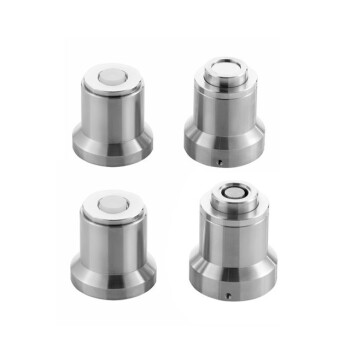
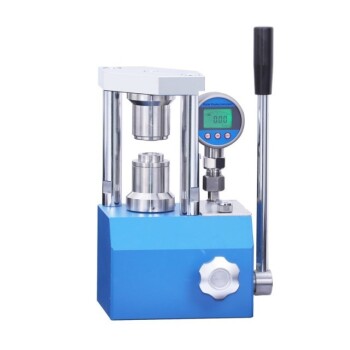
The preference for tungsten carbide (WC) dies over standard steel in oxysulfide electrolyte preparation is driven by their unmatched mechanical stability under extreme conditions. Unlike steel, tungsten carbide can withstand pressures exceeding 370 MPa and temperatures up to 300°C without undergoing plastic deformation. This ensures the dimensional precision, uniform density, and surface flatness required for high-performance solid-state battery research.
Tungsten carbide provides the extreme hardness and compressive strength required to transmit ultra-high loads while resisting the thermal and abrasive stresses of the pressing process. This results in electrolyte green bodies with superior structural integrity, minimal surface defects, and significantly lower risk of metallic contamination.
Superior Mechanical Performance Under Load
Resistance to Plastic Deformation
Oxysulfide and sulfide electrolytes often require ultra-high pressures, sometimes exceeding 1 GPa, to achieve the necessary "green density" for high ionic conductivity. Standard steel dies may reach their yield point under these loads, leading to permanent warping or barrel-shaped deformation of the die cavity. Tungsten carbide maintains its shape perfectly, ensuring that every pellet produced is dimensionally identical.
Optimized Pressure Transmission
The extreme hardness of tungsten carbide ensures that the force applied by the press is transmitted directly to the electrolyte powder rather than being absorbed by the elastic expansion of the die walls. This efficiency is critical for fabricating high-density green bodies that lack internal voids. Effective pressure transmission is the foundation for creating a robust, low-resistance interface within the solid-state stack.
Thermal Stability and Surface Precision
Maintaining Properties During Hot-Pressing
Many oxysulfide electrolytes are processed via hot-pressing at temperatures between 200°C and 300°C to enhance particle sintering. While steel can soften or oxidize at these temperatures, tungsten carbide retains its mechanical properties and compressive strength. This thermal stability prevents the die from seizing or deforming during the combined application of heat and pressure.
Reducing Friction and Material Breakage
Tungsten carbide allows for a superior high-polish finish on its inner walls, which significantly reduces the coefficient of friction during the demolding process. This is vital for fragile electrolyte flakes that are prone to cracking when ejected from the die. A smoother surface finish prevents the "stick-slip" phenomenon, ensuring the structural integrity and flatness of the final sample.
Material Purity and Wear Resistance
Mitigating Abrasive Wear
Even though some electrolytes are ductile, the precursor powders can be abrasive or contain hard particles that scratch standard stainless steel. The exceptional wear resistance of WC prevents surface abrasion, which would otherwise degrade the die’s tolerance over time. By resisting wear, WC ensures that the die remains a precision instrument through hundreds of pressing cycles.
Eliminating Elemental Contamination
Using tungsten carbide is a critical safeguard when the chemical purity of the electrolyte is paramount, particularly if the sample will be analyzed for iron content. Standard steel dies can shed microscopic iron particles into the green body under high pressure. Switching to a WC-lined mold eliminates this specific contamination vector, preserving the electrochemical signature of the oxysulfide material.
Understanding the Trade-offs
While tungsten carbide is technically superior, it is important to acknowledge its limitations. WC is significantly more brittle than steel; while it excels under compression, it has low tensile strength and can shatter if dropped or subjected to uneven side-loading. Additionally, the material and machining costs for tungsten carbide are substantially higher than for stainless steel, making it a specialized investment rather than a general-purpose solution.
Making the Right Choice for Your Research
How to Apply This to Your Project
- If your primary focus is high-pressure densification (>400 MPa): Always opt for tungsten carbide to prevent die deformation and ensure consistent pellet thickness.
- If your primary focus is hot-pressing or thermal sintering: Use WC dies to maintain structural tolerances at temperatures where standard steels begin to lose their temper.
- If your primary focus is preventing iron contamination: Select WC-lined tooling to ensure that your elemental analysis of the electrolyte remains untainted by the die material.
- If your primary focus is high-volume, low-pressure screening: High-strength stainless steel may be a more cost-effective choice, provided the pressures remain well below the steel's yield strength.
By prioritizing the mechanical rigidity and surface quality of tungsten carbide, researchers can eliminate physical variables and focus entirely on the electrochemical performance of their solid-state electrolytes.
Summary Table:
| Feature | Tungsten Carbide (WC) | Standard Steel |
|---|---|---|
| Pressure Limit | Exceeds 1 GPa (High Density) | Often deforms >370 MPa |
| Thermal Stability | Maintains strength up to 300°C | Softens/oxidizes at 200°C-300°C |
| Deformation | Minimal (High dimensional precision) | Prone to warping/barrel shapes |
| Contamination | Eliminates metallic iron transfer | Risk of microscopic iron particles |
| Surface Finish | High-polish (Easy demolding) | Higher friction/wear prone |
Elevate Your Solid-State Battery Research with KINTEK
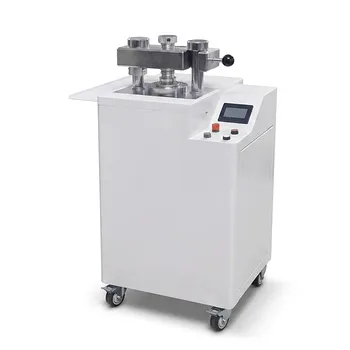
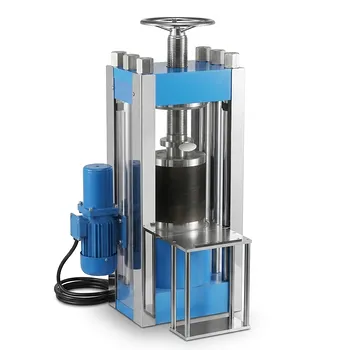
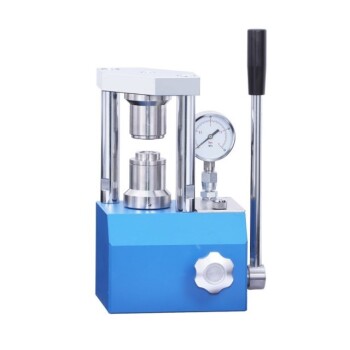
Precision is paramount when preparing high-performance oxysulfide electrolytes. KINTEK specializes in comprehensive laboratory pressing solutions tailored for advanced material science. We offer a diverse range of equipment, including:
- Manual & Automatic Presses: For consistent, repeatable loads.
- Heated & Multifunctional Dies: Perfect for hot-pressing applications.
- Glovebox-Compatible Models: Specifically designed for moisture-sensitive sulfide research.
- Cold & Warm Isostatic Presses: Ensuring uniform green density for complex samples.
Don't let die deformation or contamination compromise your results. Let our experts help you select the ideal tungsten carbide tooling for your high-pressure densification needs.
Contact KINTEK today to optimize your lab's pressing workflow!
References
- Hernando J. Gonzalez Malabet, Thomas A. Yersak. Improved Thermal Stability of Oxysulfide Glassy Solid-State Electrolytes. DOI: 10.1149/1945-7111/ad07ff
This article is also based on technical information from Kintek Solution Knowledge Base .
Related Products
- Warm Isostatic Press for Solid State Battery Research Warm Isostatic Press
- Lab Cylindrical Press Mold for Laboratory Use
- Lab XRF Boric Acid Powder Pellet Pressing Mold for Laboratory Use
- Lab Button Battery Disassembly and Sealing Mold
- Automatic XRF Pellet Press for Laboratory Spectrometry Sample Preparation
People Also Ask
- Why must composite cathodes be sealed in vacuum lamination bags for WIP? Ensure Battery Stability and Density
- What is the function of elastic molds in warm isostatic pressing? Achieve Uniform Density in Composite Particles
- How do sacrificial volume materials (SVM) maintain microchannels in isostatic pressing? Ensure Structural Integrity
- What are the advantages of using a Warm Isostatic Press (WIP) for batteries? Achieve Superior Interface Contact
- What is the role of the flexible material in warm isostatic pressing? Key to Uniform Density & Precision