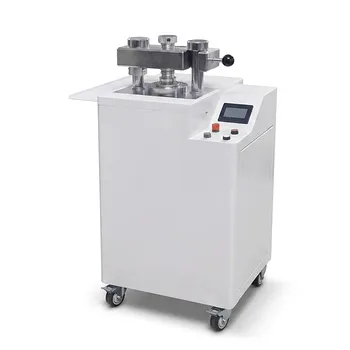
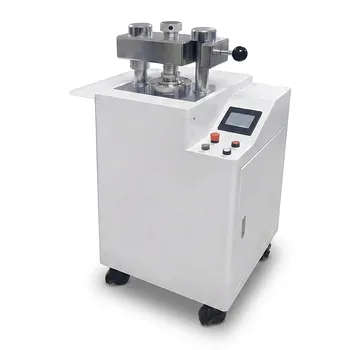
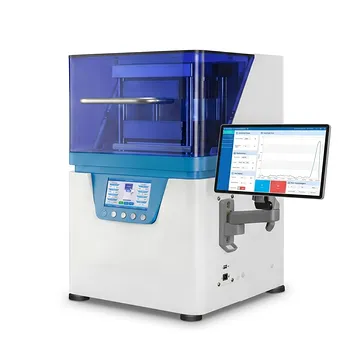
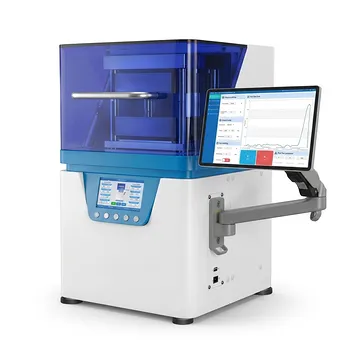
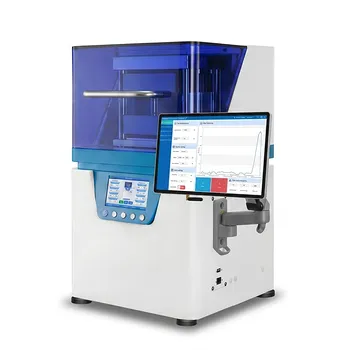
A laboratory hydraulic press is the critical tool for transforming opaque solid powders into transparent mediums suitable for infrared analysis.
When analyzing copper(II) complexes, the press is used to compress a mixture of the powdered sample and potassium bromide (KBr) into a thin, highly transparent pellet. This high-pressure molding process eliminates air pockets and reduces light scattering between particles, allowing the infrared beam to penetrate the sample effectively for accurate molecular characterization.
The hydraulic press overcomes the physical limitations of solid-state powders by eliminating internal voids and scattering interfaces. This process converts a refractive mixture into a uniform, transparent disc that permits the transmission of infrared light necessary for high-resolution spectroscopic data.
The Physics of Light Transmission in FT-IR
Overcoming Particle Scattering
Solid powders in their raw state naturally reflect and scatter infrared radiation, which results in a "noisy" spectrum with a rising baseline. The hydraulic press applies tons of force to merge the KBr matrix and the copper(II) complex into a single, dense solid phase.
Creating an IR-Transparent Matrix
Potassium bromide (KBr) is used because it is transparent to infrared light across most of the functional range. By diluting a small amount of the copper(II) complex into KBr and pressing it, the resulting pellet acts as a clear "window" that carries the sample’s vibrational information to the detector.
Enhancing the Signal-to-Noise Ratio
A well-pressed pellet ensures that the infrared beam passes through the material rather than reflecting off the surface. This results in high-resolution spectra with clear, identifiable characteristic peaks that are essential for distinguishing complex molecular structures.
Specific Benefits for Copper(II) Complex Analysis
Resolving Terpyridine Ligand Features
Copper(II) complexes often feature intricate terpyridine ligands whose coordination features are difficult to detect in cloudy samples. The uniform density provided by the hydraulic press allows for the precise identification of these specific ligand vibrations.
Identifying Anions and Coordination Sites
Stable baselines are required to determine the presence of anions and their specific interaction with the copper center. The elimination of scattering through high pressure ensures that these subtle absorption peaks are not masked by background noise or baseline drift.
Ensuring Uniform Sample Density
The hydraulic press provides adjustable and stable tonnage, ensuring that every pellet produced has a uniform thickness and density. This consistency is vital when comparing different copper(II) formulations or assessing the stability of a chemical interaction.
Understanding the Trade-offs and Pitfalls
The Risk of Hygroscopic Contamination
KBr is highly hygroscopic, meaning it rapidly absorbs moisture from the air. If the pressing process is delayed or performed in a humid environment, water peaks will appear in the spectrum, potentially overlapping with important copper(II) complex signals.
Consequences of Improper Pressure
Applying too little pressure results in an opaque or "cloudy" pellet that prevents the infrared beam from reaching the detector. Conversely, excessive pressure can damage the precision-ground steel dies or, in rare cases, alter the polymorphic form of the sample being studied.
Sample-to-Matrix Ratios
Achieving the right balance is a common challenge; too much sample will make the pellet too dark for the beam to penetrate. A standard ratio of 1 part sample to 100 parts KBr is typically required to ensure the pellet remains translucent while providing a strong enough signal for analysis.
How to Apply This to Your Sample Preparation
To achieve the highest quality results when preparing copper(II) complexes, follow these guidelines based on your specific analytical goals:
- If your primary focus is spectral clarity: Ensure the KBr is oven-dried before use and apply at least 5 to 10 tons of pressure to create a pellet that is glass-clear to the naked eye.
- If your primary focus is ligand characterization: Maintain a strictly controlled sample-to-KBr ratio to keep the absorption peaks within the linear range of the detector, preventing peak flattening.
- If your primary focus is identifying anions: Use a vacuum-equipped die during the pressing process to remove all air, ensuring the most stable baseline possible for detecting weak anionic signals.
Mastering the use of the hydraulic press is a fundamental requirement for obtaining the high-fidelity data needed to accurately characterize complex inorganic structures.
Summary Table:
| Aspect | Key Importance in FT-IR | Benefit for Copper(II) Analysis |
|---|---|---|
| Light Transmission | Eliminates air pockets and light scattering | Creates a transparent "window" for IR beams |
| Signal-to-Noise | Enhances peak clarity and reduces baseline noise | Resolves intricate terpyridine ligand features |
| Matrix Uniformity | Merges KBr and sample into a dense solid phase | Ensures stable detection of anions and coordination sites |
| Pressure Control | Provides adjustable and stable tonnage | Maintains consistent pellet density and thickness |
Elevate Your Spectroscopic Accuracy with KINTEK
Achieving the perfect KBr pellet is essential for high-fidelity FT-IR data. KINTEK specializes in comprehensive laboratory pressing solutions, providing the precision and stability needed to characterize complex inorganic structures like copper(II) complexes. Our range includes:
- Manual & Automatic Presses for reliable pellet consistency.
- Heated & Multifunctional Models for specialized material research.
- Glovebox-Compatible & Isostatic Presses ideal for advanced battery and sensitive material studies.
Don't let sample preparation compromise your results. Let our experts help you select the ideal pressing solution for your lab’s specific needs.
Contact KINTEK today to optimize your sample preparation!
References
- Katarzyna Choroba, Alexandra R. Fernandes. Copper(II) Complexes with 2,2′:6′,2″-Terpyridine Derivatives Displaying Dimeric Dichloro−μ–Bridged Crystal Structure: Biological Activities from 2D and 3D Tumor Spheroids to In Vivo Models. DOI: 10.1021/acs.jmedchem.4c00119
This article is also based on technical information from Kintek Solution Knowledge Base .
Related Products
- Laboratory Hydraulic Press 2T Lab Pellet Press for KBR FTIR
- Laboratory Hydraulic Pellet Press for XRF KBR FTIR Lab Press
- Automatic Laboratory Hydraulic Press for XRF and KBR Pellet Pressing
- Manual Laboratory Hydraulic Pellet Press Lab Hydraulic Press
- Automatic Laboratory Hydraulic Press Lab Pellet Press Machine
People Also Ask
- What is the role of a laboratory pressure machine and KBr in FTIR? Master Sample Preparation for Flame Retardants
- What is the role of a laboratory hydraulic press in high-loading NCM811 cathode prep for solid-state batteries?
- What role does a laboratory hydraulic press play in reaction pellets? Optimizing Lunar Soil and Metal Fuel Density
- Why is a laboratory hydraulic press necessary for sample preparation? Precise Pelleting for Spiro Heterocyclic Analysis
- Why is a laboratory hydraulic press necessary for the assembly of trilayer bipolar stacking pouch cells?