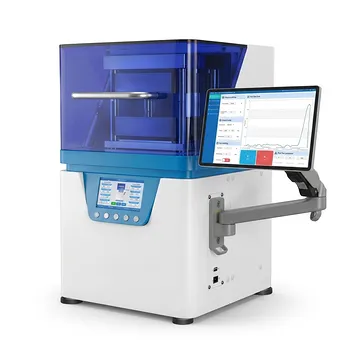
Applying 1 ton of pressure for 1 minute fuses the cathode and solid electrolyte powders into a single, dense, integrated structure. This compaction is critical for eliminating internal voids and establishing the tight, solid-to-solid physical contact necessary for low-resistance ionic transport within the battery cell.
The core purpose of this pressing step is to transform loose powders into a cohesive pellet with high density. By minimizing interfacial resistance and maximizing the contact area between particles, the press establishes the essential physical foundation for efficient lithium-ion movement.
Bridging the Interfacial Gap
Overcoming Point Contacts
Unlike liquid electrolytes that naturally wet electrode surfaces, solid materials initially only touch at microscopic "point contacts." This limited surface area creates high interfacial resistance, which can cripple battery performance.
Establishing Ionic Pathways
High pressure forces the electrolyte (such as LPSCl) and cathode (such as NMC955) particles together. This ensures that lithium-ion transport pathways are continuous throughout the solid-state architecture.
Eliminating Voids and Porosity
Any air gaps or voids between layers act as insulators that block ion flow. The application of pressure—often referred to as cold-pressing—minimizes porosity, sometimes reaching electrolyte densities with as little as 3.71% void space.
Structural Integrity and Mechanical Stability
Creating Integrated Multi-layers
A laboratory hydraulic press is used to compact the anode, electrolyte, and cathode into a dense, integrated multi-layer structure. This integration ensures that the battery remains mechanically stable during handling and subsequent testing.
Inducing Plastic Deformation
In many cases, the applied pressure causes the softer components of the battery to undergo plastic deformation. This allows the material to flow into the microscopic ridges and valleys of harder components, creating a more "intimate" and uniform interface.
Ensuring Rapid Ion Transport
By maximizing the physical contact area at the solid-solid interfaces, the press establishes the physical foundation required for rapid lithium-ion transport. Without this step, the internal impedance of the cell would be too high to function at practical discharge rates.
Understanding the Trade-offs
The Risk of Over-Compaction
While high pressure is necessary, exceeding the material's structural limits can lead to internal short circuits. Excessive force may cause the solid electrolyte to crack or lead to the formation of lithium dendrites during cycling if the separator layer is compromised.
Pressure vs. Time Variables
The duration of the press (e.g., 1 minute) allows the materials to settle and undergo necessary deformation. Shortening this time may result in elastic recovery, where the material "springs back" once pressure is released, re-introducing voids and increasing resistance.
Material Specificity
Different material sets require different pressure levels; for example, rigid garnet-type electrolytes may require significantly higher pressures or even simultaneous heat (hot-pressing) to achieve the same contact quality as softer sulfide-based electrolytes.
How to Apply This to Your Fabrication
Recommendations for Optimal Cell Assembly
- If your primary focus is sulfide-based electrolytes (like LPSCl): Use standard cold-pressing at moderate pressures to achieve high density without damaging the particles.
- If your primary focus is reducing interfacial impedance: Ensure the pressure is held long enough (at least 1 minute) to allow for plastic deformation and maximum contact area.
- If your primary focus is preventing mechanical failure: Gradually increase the pressure to the target "tonnage" to avoid sudden stress fractures in the pellet.
A controlled application of high pressure is the single most important factor in transforming disparate solid powders into a functional, high-performance battery cell.
Summary Table:
| Pressing Parameter | Impact on Fabrication | Benefit to Battery Performance |
|---|---|---|
| Void Elimination | Reduces porosity (e.g., to <4%) | Maximizes lithium-ion transport pathways |
| Interfacial Contact | Converts point contacts to surface contacts | Significantly lowers internal resistance |
| Dwell Time (1 min) | Allows for plastic deformation | Prevents elastic recovery and structural cracking |
| Multi-layer Integration | Fuses cathode, electrolyte, and anode | Ensures mechanical stability during testing |
Elevate Your Battery Research with Precision Pressing
Achieving the perfect pellet density and interfacial contact is the cornerstone of high-performance all-solid-state battery (ASSB) fabrication. KINTEK specializes in comprehensive laboratory pressing solutions designed to meet the rigorous demands of battery research.
Our versatile range includes:
- Manual & Automatic Hydraulic Presses: For consistent, repeatable pressure application.
- Heated & Multifunctional Models: Ideal for advanced materials requiring simultaneous thermal and mechanical treatment.
- Glovebox-Compatible Designs: Built for sensitive air/moisture-reactive materials.
- Cold & Warm Isostatic Presses (CIP/WIP): For uniform multi-directional compaction.
Don't let interfacial resistance hinder your results. Contact the KINTEK team today to find the ideal pressing solution for your lab and ensure the structural integrity of your cells.
Contact KINTEK Experts Gold Standard Pressing
References
- Beatriz M. Gomes, Maria Helena Braga. All-solid-state lithium batteries with NMC<sub>955</sub> cathodes: PVDF-free formulation with SBR and capacity recovery insights. DOI: 10.20517/energymater.2024.297
This article is also based on technical information from Kintek Solution Knowledge Base .
Related Products
- Laboratory Hydraulic Press Lab Pellet Press Button Battery Press
- Laboratory Hydraulic Press 2T Lab Pellet Press for KBR FTIR
- Laboratory Hydraulic Press Lab Pellet Press Machine for Glove Box
- 24T 30T 60T Heated Hydraulic Lab Press Machine with Hot Plates for Laboratory
- Automatic Laboratory Hydraulic Press Lab Pellet Press Machine
People Also Ask
- How is a laboratory hydraulic press used for HAP composite gels? Master Mineral Substrate Standardization
- What role does a laboratory hydraulic press play in reaction pellets? Optimizing Lunar Soil and Metal Fuel Density
- What role does a laboratory hydraulic press play in the preparation of piezoelectric ceramic discs for DC-PG? | KINTEK
- Why is a laboratory hydraulic press required for PBAT and PLA sample preparation? Achieve Flawless Characterization
- What role does a laboratory hydraulic press play in the assembly of all-solid-state battery test cells? Expert Guide