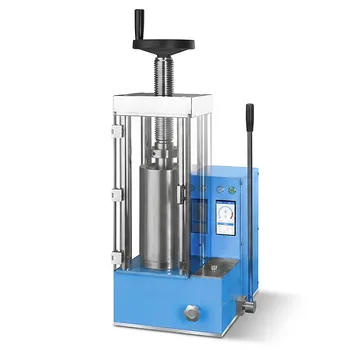
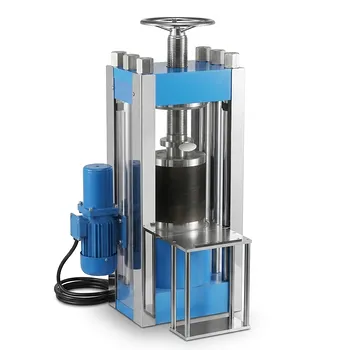
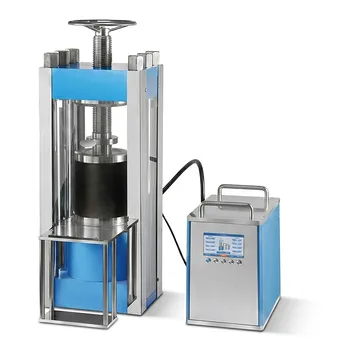
Laboratory Cold Isostatic Presses (CIP) fundamentally transform polycrystalline Copper Phthalocyanine (CuPc) thin films by applying uniform, isotropic pressure to eliminate internal voids and pores. This physical densification process promotes tighter grain packing and reduces film thickness without altering the film's overall geometric shape. As a result, the treated thin films exhibit a significantly higher elastic modulus, increased hardness, and a flexural strength enhancement of approximately 1.7 times.
The core advantage of CIP for CuPc thin films is its ability to use omnidirectional hydrostatic pressure to collapse internal defects and achieve high structural density. This creates a cohesive material with superior mechanical resilience and durability compared to untreated or uniaxially pressed films.
The Mechanism of Densification via Isostatic Pressure
Eliminating Spatial Voids and Pores
The primary function of a laboratory CIP is to apply omnidirectional, uniform hydrostatic pressure to the CuPc thin film. This pressure effectively "crushes" internal pores and eliminates spatial voids exist between the original polycrystalline grains.
By removing these air gaps and defects, the film undergoes a physical transformation that results in a much denser and more uniform material structure.
Maintaining Geometric Integrity
Unlike traditional uniaxial pressing, which applies force in a single direction and can distort the material, CIP ensures the film maintains geometric similarity.
Because the pressure is isotropic (equal from all directions), the thin film densifies while preserving its original proportions and substrate interface. This is critical for organic semiconductors where path lengths and interface contact are vital for performance.
Atomic Rearrangement and Bonding
At high pressures—often reaching 200 MPa or more—the intense friction between particles can generate localized frictional heat.
This heat, combined with extreme pressure, promotes the rearrangement and tight bonding of particles. In some cases, this can even lead to localized atomic diffusion, creating stronger "joints" between grains that reduce internal resistance.
Enhancements in Mechanical Performance
Increasing Elastic Modulus and Hardness
The reduction in film thickness and the move toward tighter grain packing directly influence the film’s stiffness.
A CIP-treated film exhibits a significantly higher elastic modulus, meaning it is more resistant to elastic deformation. Furthermore, the increased density translates to improved surface hardness and wear resistance, making the film more durable in high-stress environments.
Boosting Flexural Strength
One of the most measurable benefits of CIP treatment is the improvement in flexural strength, which research indicates can increase by roughly 1.7 times.
By eliminating the internal defects that act as stress concentrators, the film can withstand much higher bending forces before failure occurs. This enhancement is essential for applications requiring mechanical flexibility or structural integrity.
Preventing Undesirable Grain Growth
Because CIP is performed at ambient temperatures (unlike hot isostatic pressing), it prevents the growth of ultra-fine grains.
This allows researchers to achieve the benefits of high density and chemical bonding without the negative side effects of heat-induced grain coarsening. This process preserves the desirable characteristics of the original polycrystalline structure.
Understanding the Trade-offs
Equipment and Packaging Requirements
To undergo CIP, CuPc thin films must be sealed in flexible packaging or molds to prevent the liquid pressure medium from contaminating the sample.
This adds a preparation step that is not required in standard uniaxial pressing or vacuum deposition. If the seal fails, the sample is typically destroyed by the high-pressure fluid.
Material Limitations and Elastic Recovery
While CIP is excellent for densification, some materials may experience "spring-back" or elastic recovery once the pressure is released.
If the pressure is not applied and released at a controlled rate, internal stresses could potentially lead to micro-cracking. Additionally, the substrate must be capable of withstanding the uniform pressure without fracturing.
How to Apply This to Your Research
If you are considering Cold Isostatic Pressing to enhance your organic semiconductor thin films, align your parameters with your primary objective:
- If your primary focus is maximizing mechanical durability: Focus on higher pressures (above 200 MPa) to ensure the 1.7x flexural strength increase and maximum densification are achieved.
- If your primary focus is maintaining thin film geometry: Utilize a liquid medium with a laboratory CIP to ensure isotropic pressure, which prevents the "barrel" distortion common in mechanical presses.
- If your primary focus is avoiding thermal degradation: Ensure the CIP process is conducted at ambient temperature to leverage densification without triggering unwanted grain growth or organic decomposition.
By strategically applying Cold Isostatic Pressure, you can transform fragile CuPc thin films into robust, high-performance polycrystalline structures.
Summary Table:
| Feature | Effect of CIP Treatment | Impact on Performance |
|---|---|---|
| Flexural Strength | ~1.7x Increase | Higher resistance to mechanical failure and bending |
| Internal Structure | Void and pore elimination | Maximized material density and uniformity |
| Grain Growth | Controlled (Ambient Temp) | Prevents thermal degradation and grain coarsening |
| Geometry | Isotropic Densification | Maintains precise shape and substrate interface |
| Elastic Modulus | Significant Enhancement | Increased stiffness and resistance to deformation |
Elevate Your Thin Film Performance with KINTEK
Maximize the mechanical resilience and density of your materials with KINTEK’s precision laboratory pressing solutions. Specializing in high-performance equipment for battery research and material science, we offer a comprehensive range of manual, automatic, heated, multifunctional, and glovebox-compatible models, as well as advanced cold (CIP) and warm (WIP) isostatic presses.
Whether you need to eliminate internal defects or achieve a 1.7x boost in flexural strength, our experts are here to provide the perfect pressing solution tailored to your research goals.
Contact KINTEK today to find your ideal press!
References
- Anno Ide, Moriyasu Kanari. Mechanical properties of copper phthalocyanine thin films densified by cold and warm isostatic press processes. DOI: 10.1080/15421406.2017.1352464
This article is also based on technical information from Kintek Solution Knowledge Base .
Related Products
- Electric Lab Cold Isostatic Press CIP Machine
- Electric Split Lab Cold Isostatic Pressing CIP Machine
- Automatic Lab Cold Isostatic Pressing CIP Machine
- Manual Cold Isostatic Pressing CIP Machine Pellet Press
- Electric Isostatic Pressing Machine 40 Tons Automatic Laboratory Powder Compacting Press
People Also Ask
- What role do electric lab cold isostatic presses play in industrial contexts? Bridge R&D and Manufacturing with Precision
- What are the applications of electric lab cold isostatic presses in research settings? Advance Material R&D with High-Pressure CIPs
- How does electrical Cold Isostatic Pressing (CIP) contribute to cost savings? Unlock Efficiency and Reduce Expenses
- What are some research applications of electric lab CIPs? Unlock Uniform Powder Densification for Advanced Materials
- What are the characteristics of standard off-the-shelf electric lab CIP solutions? Achieve Immediate, Cost-Effective Processing