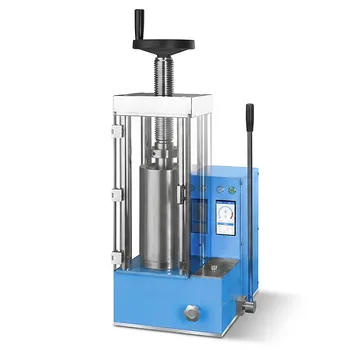
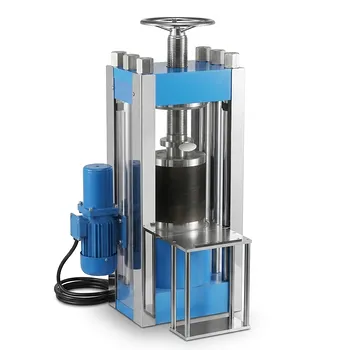
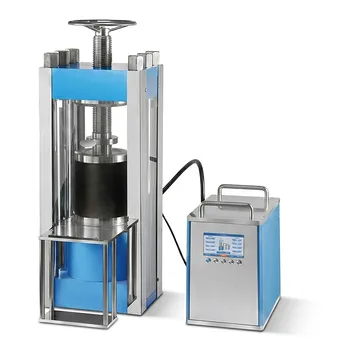
A laboratory cold isostatic press (CIP) regulates the final pore structure of Ti–35Zr alloys by applying uniform, omnidirectional pressure to a powder green body. By varying pressure parameters—typically between 250 MPa and 1000 MPa—researchers can precisely calibrate the alloy's volume porosity from over 20% down to approximately 7%. This level of control allows for the creation of customized biomaterials with specific densities and elastic moduli without relying on chemical space-holding agents.
The core function of a cold isostatic press is to manipulate powder packing density through uniform pre-compaction. This process establishes the initial pore architecture and mechanical interlocking of the green body, which directly dictates the final porosity and structural integrity of the alloy after the sintering stage.
The Mechanics of Uniform Compaction
The Role of Omnidirectional Pressure
Unlike uniaxial pressing, a cold isostatic press applies equal pressure from all directions using a fluid medium. This eliminates internal friction gradients within the powder mass, ensuring that the Ti–35Zr green body has a homogeneous density distribution throughout its entire volume.
Structural Integrity of the Green Body
The application of high pressure promotes the initial rearrangement and mechanical interlocking of the titanium and zirconium particles. By achieving a relative density of 71% to 81% during the pressing stage, the green body gains the structural strength necessary for handling and further processing.
Controlling the Porosity Gradient
Pressure as a Tuning Variable
The relationship between applied pressure and porosity is direct and measurable. Increasing the pressure from 250 MPa toward 1000 MPa increases the compaction density, which systematically reduces the void space available between particles before they are fused.
Eliminating Space-Holding Agents
One of the most significant advantages of using a CIP is the ability to achieve specific porosity levels without chemical additives. This avoids the risk of contamination and simplifies the manufacturing process, ensuring the Ti–35Zr alloy remains biocompatible and pure for medical applications.
Managing Sintering Shrinkage
The uniform pre-compaction provided by the cold isostatic press is vital for predicting shrinkage during the subsequent 850°C sintering stage. Because the green body is uniformly dense, the final alloy undergoes predictable dimensional changes, allowing for tighter tolerances in the final component.
Understanding the Trade-offs
Mechanical Strength vs. Bio-compatibility
While reducing porosity increases the compressive yield strength—potentially reaching up to 210 MPa—it also increases the material's elastic modulus. For bone implants, a modulus that is too high can lead to "stress shielding," where the metal carries the load instead of the bone, leading to bone resorption.
Pressure Limits and Energy Consumption
While pressing at 1000 MPa or higher results in lower porosity, it requires specialized high-pressure equipment and increases the mechanical stress on the press components. Conversely, lower pressures may result in a material that is too porous and lacks the required fatigue resistance for load-bearing applications.
How to Apply These Principles to Your Material Goal
The choice of pressure parameters should be dictated by the specific mechanical requirements of the alloy's intended application.
- If your primary focus is Matching Bone Modulus: Utilize lower pressure ranges (near 250 MPa) to maintain a higher volume porosity (approx. 20%), which lowers the material stiffness to closer match natural bone.
- If your primary focus is Maximum Load-Bearing Strength: Apply high pressure (700 MPa to 1000 MPa) to maximize mechanical interlocking and minimize final porosity, thereby boosting compressive yield strength.
- If your primary focus is Dimensional Precision: Ensure uniform pressure application to create a consistent green body density, which minimizes non-uniform shrinkage during the sintering process.
By mastering the pressure-density relationship within the cold isostatic press, you can transform Ti–35Zr from a simple powder mixture into a high-performance, purpose-built biomaterial.
Summary Table:
| Applied Pressure (MPa) | Approx. Porosity | Primary Benefit | Ideal Application |
|---|---|---|---|
| 250 MPa | ~20% | Matches Bone Modulus | Bone Implants & Tissue Scaffolds |
| 700 - 1000 MPa | ~7% | Max Compressive Strength | Heavy Load-Bearing Components |
| Omnidirectional | Uniform | Predictable Sintering | Precision Engineered Parts |
| No Additives | High Purity | Chemical-Free Processing | Biocompatible Medical Devices |
Elevate Your Material Research with KINTEK Precision
Achieving the perfect balance of porosity and strength requires hardware you can trust. KINTEK specializes in comprehensive laboratory pressing solutions, offering manual, automatic, heated, multifunctional, and glovebox-compatible models. Our industry-leading cold and warm isostatic presses are widely applied in battery research and advanced biomaterial development.
Whether you need to match bone modulus or maximize load-bearing performance, KINTEK provides the uniform, omnidirectional pressure necessary for consistent, high-quality results.
Ready to optimize your Ti–35Zr alloy production? Contact us today for a custom consultation!
References
- Izabela Matuła, Izabela Jendrzejewska. Microstructure and Porosity Evolution of the Ti–35Zr Biomedical Alloy Produced by Elemental Powder Metallurgy. DOI: 10.3390/ma13204539
This article is also based on technical information from Kintek Solution Knowledge Base .
Related Products
- Electric Lab Cold Isostatic Press CIP Machine
- Electric Split Lab Cold Isostatic Pressing CIP Machine
- Automatic Lab Cold Isostatic Pressing CIP Machine
- Manual Cold Isostatic Pressing CIP Machine Pellet Press
- Electric Isostatic Pressing Machine 40 Tons Automatic Laboratory Powder Compacting Press
People Also Ask
- What role do electric lab cold isostatic presses play in industrial contexts? Bridge R&D and Manufacturing with Precision
- What are the applications of electric lab cold isostatic presses in research settings? Advance Material R&D with High-Pressure CIPs
- How does electrical Cold Isostatic Pressing (CIP) contribute to cost savings? Unlock Efficiency and Reduce Expenses
- What are some research applications of electric lab CIPs? Unlock Uniform Powder Densification for Advanced Materials
- What are the characteristics of standard off-the-shelf electric lab CIP solutions? Achieve Immediate, Cost-Effective Processing