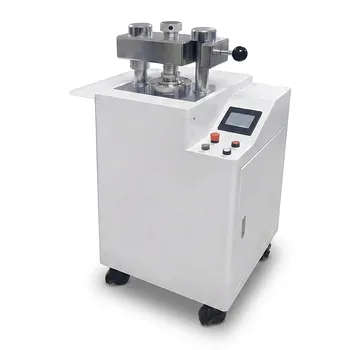
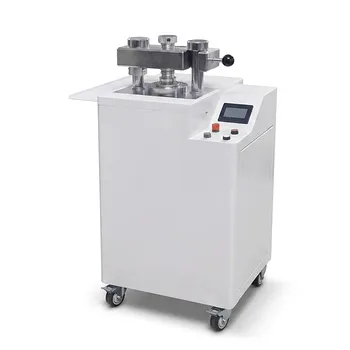
A laboratory pellet press serves as the critical bridge between raw carbon powders and quantifiable electrical data. By converting loose nitrogen-doped porous carbon into standardized, high-density discs, the press ensures that subsequent DC polarization testing measures the material's intrinsic bulk conductivity rather than the resistance caused by air gaps or poor particle contact.
The pellet press transforms irregular nitrogen-doped carbon powders into uniform geometries to minimize contact resistance, allowing DC polarization to accurately calculate bulk conductivity by applying precise low-voltage currents.
Standardizing Sample Geometry and Contact
Achieving Uniform Disk Shapes
For DC polarization testing to be mathematically valid, samples must possess a regular geometric shape. The laboratory pellet press re-presses carbonized powders into uniform discs, providing a consistent surface area and thickness across all tested specimens.
Minimizing Contact Resistance
Loose powders suffer from high contact resistance due to "loose" particle-to-particle interfaces. The press applies significant force to ensure dense particle-to-particle contact, which is essential for obtaining a clear signal during electrical stimulation.
Eliminating Structural Interference
Overcoming Porosity Gaps
Nitrogen-doped porous carbons naturally contain voids that can interfere with resistance measurements. By applying high pressures—often up to 1 GPa—and maintaining it for several minutes, the press eliminates the interference of macro-porosity on the final conductivity calculation.
Ensuring Consistent Density
Consistency in density is vital for revealing how structural evolution (such as carbonization time) affects electrical performance. The press allows researchers to standardize the density of every sample, ensuring that variations in conductivity are due to the material's chemistry rather than its physical packing.
The Mechanics of DC Polarization Testing
Applying Precise Low Voltage
Once the pellet is formed, it is placed in a circuit where a potentiometer applies a precise voltage, typically between 0.1 and 0.3 V. This low voltage is sufficient to trigger a current response without damaging the delicate nitrogen-doped structures.
Monitoring Current Response
The system monitors the resulting current to calculate the bulk conductivity of the material. This process yields repeatable data, with typical values for these materials ranging from 0.47 to 1.23 S cm⁻¹, which is critical for evaluating their potential in energy storage applications.
Understanding the Trade-offs
The Risk of Powder Deformation
While high pressure (1 GPa) is necessary to eliminate air gaps, excessive force can sometimes collapse the very micro-pores that nitrogen doping is intended to create. Finding the balance between "dense contact" and "structural integrity" is the primary challenge in sample preparation.
Limitations of DC vs. AC Testing
DC polarization provides a straightforward bulk conductivity measurement but may not capture the frequency-dependent behavior of the carbon. Using a pellet press prepares the sample for DC testing specifically, which focuses on steady-state electronic movement rather than ion dynamics.
Optimizing Your Conductivity Evaluation
The success of your evaluation depends on how well you align your pressing parameters with your analytical goals.
- If your primary focus is material benchmarking: Use a consistent pressure (e.g., 1 GPa) and hold time for every sample to ensure that your conductivity data (S cm⁻¹) is comparable across different nitrogen-doping levels.
- If your primary focus is power performance: Prioritize the elimination of contact resistance through the pellet press to simulate the dense environments found in actual battery or supercapacitor electrodes.
- If your primary focus is structural analysis: Correlate the conductivity results obtained from the pressed discs with carbonization times to understand how the internal nitrogen arrangement influences electron transport.
Standardizing the physical state of your carbon powder via a pellet press is the only way to ensure that your electrical measurements reflect the true potential of your material chemistry.
Summary Table:
| Stage | Function in Evaluation | Key Benefit |
|---|---|---|
| Pressing | Standardizes sample geometry and density | Ensures intrinsic bulk conductivity measurements |
| Compression | Minimizes contact resistance and air gaps | Eliminates signal interference from macro-porosity |
| Polarization | Applies low voltage (0.1 - 0.3 V) | Triggers repeatable current response without damage |
| Analysis | Calculates conductivity (S cm⁻¹) | Evaluates material potential for energy storage |
Optimize Your Material Analysis with KINTEK Precision
High-quality electrical data begins with perfect sample preparation. KINTEK specializes in comprehensive laboratory pressing solutions designed for the rigors of battery research and material science.
Whether you require manual, automatic, heated, multifunctional, or glovebox-compatible models, or advanced cold and warm isostatic presses, our equipment delivers the density and consistency needed for accurate conductivity evaluations.
Ready to enhance your lab’s efficiency and data accuracy?
Contact our experts today to find the ideal pressing solution for your nitrogen-doped carbon and energy storage research.
References
- Atsushi Nagai, Atsunori Matsuda. Synthesis and Electrical Property of Graphite Oxide-like Mesoporous <i>N</i>-Carbon Derived from Polyimide-Covalent Organic Framework Templates. DOI: 10.1021/acsomega.5c03968
This article is also based on technical information from Kintek Solution Knowledge Base .
Related Products
- Laboratory Hydraulic Pellet Press for XRF KBR FTIR Lab Press
- Automatic Laboratory Hydraulic Press Lab Pellet Press Machine
- Laboratory Hydraulic Press Lab Pellet Press Machine for Glove Box
- Manual Laboratory Hydraulic Pellet Press Lab Hydraulic Press
- Laboratory Hydraulic Split Electric Lab Pellet Press
People Also Ask
- Laboratory Pellet Press for Solar PV Recycling: Ensuring High-Precision Material Analysis and Purity
- Why is a professional laboratory pellet press required for XRF of silica sand? Achieve +/- 0.10% Precision
- Why is high consistency in holding pressure from a laboratory pellet press required when preparing multi-component alloy specimens?
- Why Use a Laboratory Pellet Press for PXRD Anode Material Prep? Standardize Samples for Precise Analysis
- What are the different types of pellet-making tools available for labs? Choose the Right Press for Your Sample