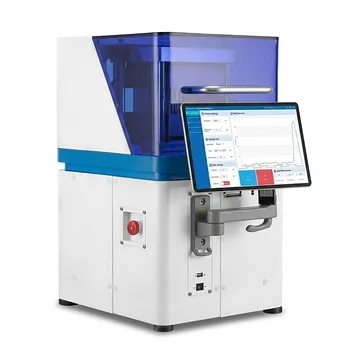
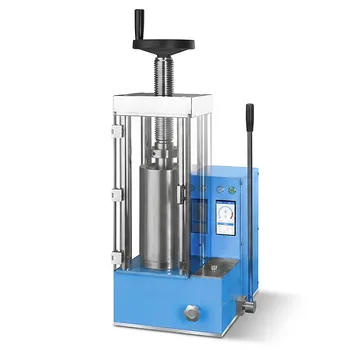
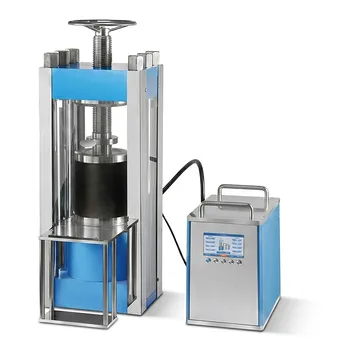
Laboratory pressing machines are vital for transforming raw lithium foil into high-precision electrodes with uniform thickness and a perfectly flat surface. By applying consistent vertical pressure, these machines eliminate surface protrusions and internal voids, ensuring the tight interfacial contact necessary for stable electrochemical performance and the suppression of lithium dendrites.
A laboratory pressing machine is the primary tool for engineering the interface between a lithium metal anode and its electrolyte. By controlling thickness and maximizing surface flatness, the press reduces interfacial resistance and prevents the localized current concentrations that lead to battery failure.
Structural Refinement of Lithium Metal
Achieving Precise Electrode Thickness
A laboratory press allows researchers to compress lithium sheets into thin-film electrodes with precise thickness and uniform density. This mechanical compression is necessary to reach specific volumetric energy density targets required for advanced battery testing.
Eliminating Surface Protrusions and Defects
Raw lithium metal often features irregular protrusions or surface defects that can disrupt battery operation. The application of uniform vertical pressure flattens these irregularities, creating a smooth surface that ensures consistent contact across the entire active area of the battery.
Optimizing Atomic Packing
High-precision pressing ensures the close packing of lithium atoms within their body-centered cubic (bcc) lattice structure. By eliminating internal voids, the press creates a physically consistent electrode that prevents the formation of non-uniform current densities during cycling.
Advancing Interfacial Engineering
Improving Contact with Solid Electrolytes
In all-solid-state battery research, the press is used to laminate the anode, cathode, and electrolyte into a single stacked structure. This process is critical for eliminating interface gaps and reducing interfacial impedance, which are common hurdles in solid-state energy storage.
Lamination with Current Collectors
Laboratory "hot presses" are frequently used to bond lithium metal foil onto copper foil current collectors. Through combined pressure and temperature control, the machine creates a strong mechanical bond and optimal electrical contact between the lithium and the copper substrate.
Enhancing Electrolyte Wetting
Beyond solid interfaces, uniform pressure is essential for ensuring thorough electrolyte wetting in specialized systems, such as those using Liquid Crystal Elastomer (LCE) electrolytes. This tight physical interface is the foundation for accurate and reproducible electrochemical test data.
Understanding the Trade-offs
Balancing Pressure and Structural Integrity
While high pressure (often reaching tens of thousands of Newtons) is necessary for density, excessive localized pressure can damage fragile solid electrolyte layers. Researchers must carefully calibrate the press to avoid cracking the electrolyte while still providing enough force to eliminate contact resistance.
Risks of Inadequate Pressure
Insufficient pressure leads to "poor contact zones" where the anode and electrolyte are not fully joined. These gaps act as bottlenecks for ion transport, increasing interfacial resistance and potentially accelerating the nucleation of lithium dendrites in the voids.
How to Apply Pressing Techniques to Your Research
Making the Right Choice for Your Goal
To maximize the efficacy of your lithium metal processing, consider the following technical priorities:
- If your primary focus is dendrite suppression: Utilize high-precision hydraulic pressing to achieve maximum surface flatness, which ensures a uniform current distribution.
- If your primary focus is all-solid-state batteries: Use a press to apply constant, simulated stack pressure during assembly to eliminate air gaps between the solid electrolyte and the lithium foil.
- If your primary focus is composite anode fabrication: Implement a hot-press technique to improve the mechanical adhesion and electrical conductivity between the lithium metal and the copper current collector.
The laboratory pressing machine is not merely a tool for shaping metal, but a critical instrument for engineering the microscopic interfaces that determine the safety and longevity of next-generation batteries.
Summary Table:
| Feature | Role in Lithium Anode Processing | Key Benefit |
|---|---|---|
| Mechanical Compression | Refines foil thickness and atomic packing | High volumetric energy density |
| Surface Flattening | Eliminates protrusions and surface defects | Suppresses lithium dendrite growth |
| Lamination / Bonding | Joins lithium foil to copper current collectors | Optimized electrical contact |
| Interfacial Engineering | Eliminates gaps in solid-state battery layers | Reduced interfacial resistance |
Optimize Your Battery Research with KINTEK Pressing Solutions
Precision is paramount when engineering lithium metal anodes and solid-state interfaces. KINTEK specializes in comprehensive laboratory pressing solutions tailored for cutting-edge energy storage research.
Our extensive range includes manual, automatic, heated, and multifunctional models, as well as glovebox-compatible systems and cold/warm isostatic presses—all widely applied in battery research to ensure the perfectly flat surfaces and uniform density required for stable performance.
Take the next step in enhancing electrode structural integrity and eliminating interfacial resistance.
Ready to elevate your lab's capabilities? Contact KINTEK today for a tailored solution!
References
- Weinan Xu. Harnessing anisotropy in liquid crystal elastomer based lithium-ion gel-polymer batteries. DOI: 10.1039/d5ra07527k
This article is also based on technical information from Kintek Solution Knowledge Base .
Related Products
- Laboratory Split Manual Heated Hydraulic Press Machine with Hot Plates
- 24T 30T 60T Heated Hydraulic Lab Press Machine with Hot Plates for Laboratory
- Laboratory Hydraulic Press Lab Pellet Press Machine for Glove Box
- Automatic Heated Hydraulic Lab Press Machine 200x200 Plate Size for Battery Research and Materials Science
- Automatic Laboratory Hydraulic Press Lab Pellet Press Machine
People Also Ask
- Why is a laboratory hydraulic press with heating plates required for PLA/TEC films? Achieve Precise Sample Integrity
- Why reduce load when applying composite strengthening tabs? Protect Specimen Integrity and Data Accuracy
- What role does a laboratory heated hydraulic press play in LTCC? Essential for High-Density Ceramic Lamination
- Why is a laboratory heated hydraulic press required? Ensure Precise Vulcanization for NBR/EPDM Nanocomposites
- Why is a laboratory heated hydraulic press utilized during the lamination stage of NASICON green tapes?