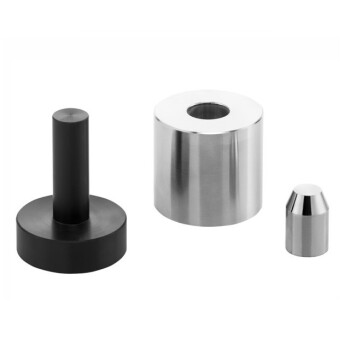
In battery recycling and material recovery, the lab press functions primarily as a high-precision sample preparation tool designed to transform recovered loose powders, such as black mass, into dense, standardized pellets. This consolidation is a critical prerequisite for analytical methods like X-ray fluorescence (XRF), creating the flat, consistent surface necessary to accurately quantify the yield of valuable metals like nickel, cobalt, and lithium.
Core Insight: The reliability of your chemical data is directly tied to the physical consistency of your sample. A lab press bridges the gap between raw, recovered waste and precision analysis by eliminating surface irregularities that distort spectroscopic readings.
The Critical Role in Chemical Analysis
To determine the value of recycled battery material, you must know its exact chemical composition. The lab press is the foundational tool that makes this characterization possible.
Handling Black Mass
In the recycling process, active materials are often reduced to a powder known as black mass. Loose powder is difficult to analyze because its irregular density and uneven surface scatter signal during testing.
Creating Standardized Pellets
A lab press applies high tonnage to compress this powder into a solid, stable disc. This ensures that every sample presented to the sensor has the same density and geometry.
Enabling Spectroscopic Accuracy
Techniques like X-ray fluorescence (XRF) require a perfectly flat surface for accurate measurement. By stabilizing the sample, the press allows researchers to determine the precise content of critical elements such as nickel, cobalt, and lithium without the noise caused by loose particles.
Expanding the Role: Physical and Safety Characterization
While the primary reference highlights chemical analysis, a lab press is also instrumental in characterizing the physical limits and recyclability of battery components.
Simulating Mechanical Stress
Beyond chemical composition, safety characterization is vital. A high-precision press can simulate extreme crushing conditions that occur during the recycling, sorting, or transportation of lithium-ion batteries.
Determining Failure Points
By applying controlled stress, researchers can identify the exact pressure at which a battery casing ruptures. This allows for the observation of critical failure modes, such as internal short circuits, electrolyte leakage, or thermal runaway, providing data essential for designing safer storage solutions.
Reprocessing Polymer Materials
For battery components involving polymers (such as vitrimers), the press serves as a reprocessing engine. By applying specific conditions—such as 180°C and 3 MPa—the press triggers bond exchange reactions, fusing waste fragments into new, transparent sample plates to verify mechanical performance and recyclability.
Understanding the Trade-offs
While the lab press is versatile, it requires precise operation to yield valid data.
Sample Integrity vs. Pressure
Applying too much pressure during pelletization can cause capping or lamination, where the sample breaks apart. Conversely, insufficient pressure results in a loose pellet that contaminates the analytical instrument.
Destructive Testing
When used for safety characterization (crushing), the process is inherently destructive. Once a cell is crushed to measure its rupture point, it cannot be used for subsequent chemical recovery analysis in the same state.
Parameter Sensitivity
In polymer reprocessing, the outcome is highly sensitive to temperature stability. A press without precise thermal control will fail to trigger the necessary covalent bond exchanges, resulting in a sample that lacks the mechanical properties of the original material.
Making the Right Choice for Your Goal
The specific application of a lab press depends heavily on which stage of the recovery cycle you are analyzing.
- If your primary focus is chemical valuation: Prioritize a press capable of high, consistent tonnage to create dense pellets for XRF analysis of nickel and cobalt recovery.
- If your primary focus is safety protocols: Utilize a press with high-precision force measurement to record the exact rupture pressures of battery cells during crush testing.
- If your primary focus is polymer sustainability: Ensure your press features precise temperature control to facilitate the chemical reprocessing of casings and binders.
The lab press is not just a crushing tool; it is a standardization instrument that turns variable waste into measurable, actionable data.
Summary Table:
| Application Category | Primary Role of Lab Press | Key Analytical Benefit |
|---|---|---|
| Chemical Analysis | Pelletizing black mass for XRF | High-precision quantification of Ni, Co, and Li |
| Safety Characterization | Simulating mechanical crushing stress | Identifying failure points and thermal runaway risks |
| Polymer Recovery | Hot pressing of binders and casings | Verifying recyclability through covalent bond exchange |
| Material Processing | Consolidating loose powders | Standardizing density for consistent spectroscopic data |
Maximize Your Battery Recovery Accuracy with KINTEK
Precise sample characterization is the cornerstone of profitable and safe battery recycling. KINTEK specializes in comprehensive laboratory pressing solutions, offering manual, automatic, heated, multifunctional, and glovebox-compatible models, as well as cold and warm isostatic presses widely applied in battery research.
Whether you need to create stable pellets for high-resolution XRF chemical analysis or simulate extreme mechanical stress for safety testing, our equipment delivers the repeatability your data demands.
Ready to elevate your lab's efficiency? Contact us today to find the perfect press for your material recovery research.
References
- Haimanot B. Atinkut. Breakthroughs in Hydrogen and Storage Technologies for a Resilient Grid. DOI: 10.21203/rs.3.rs-8255422/v1
This article is also based on technical information from Kintek Solution Knowledge Base .
Related Products
- Laboratory Hydraulic Press Lab Pellet Press Button Battery Press
- Lab Cylindrical Press Mold for Laboratory Use
- Automatic Laboratory Hydraulic Press for XRF and KBR Pellet Pressing
- Manual Laboratory Hydraulic Press Lab Pellet Press
- Lab Ring Press Mold for Sample Preparation
People Also Ask
- How is a laboratory hydraulic press used for HAP composite gels? Master Mineral Substrate Standardization
- What role does a laboratory hydraulic press play in reaction pellets? Optimizing Lunar Soil and Metal Fuel Density
- What role does a laboratory hydraulic press play in the preparation of piezoelectric ceramic discs for DC-PG? | KINTEK
- Why is a laboratory hydraulic press required for PBAT and PLA sample preparation? Achieve Flawless Characterization
- What role does a laboratory hydraulic press play in the assembly of all-solid-state battery test cells? Expert Guide