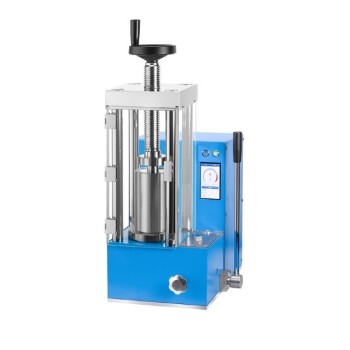
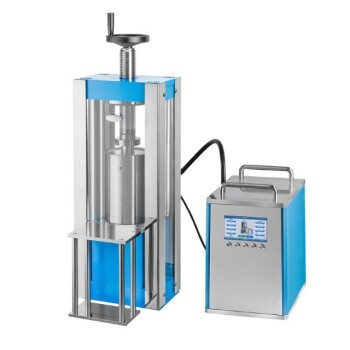
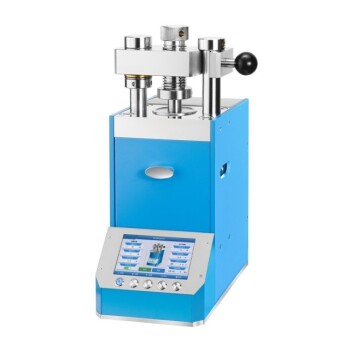
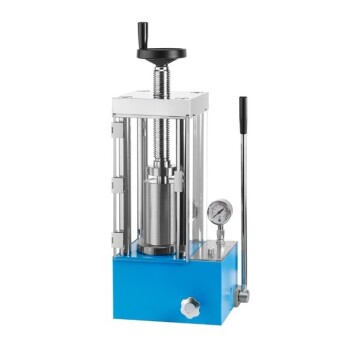
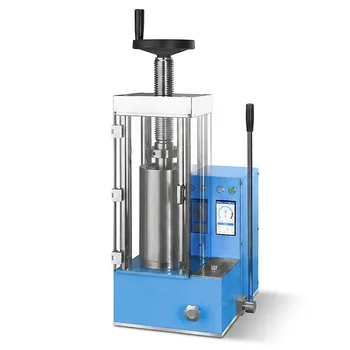
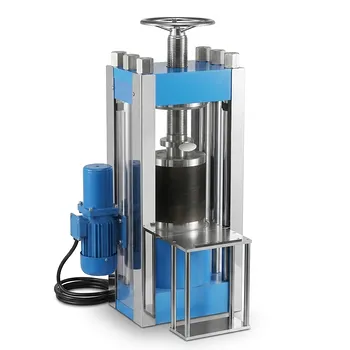
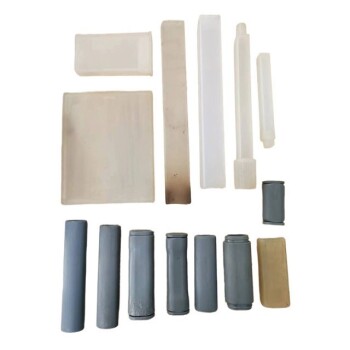
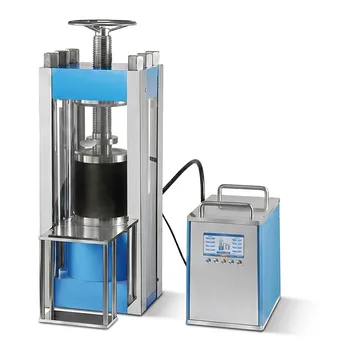
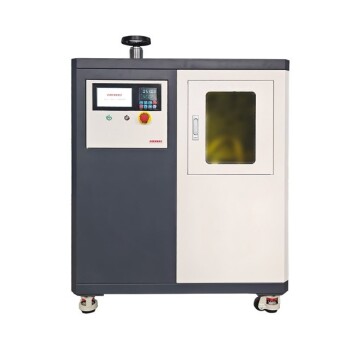
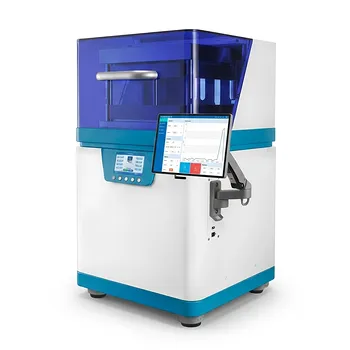
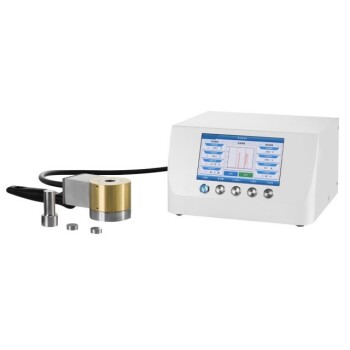
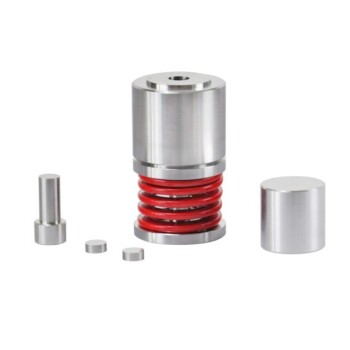
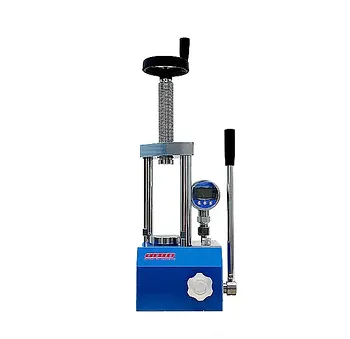
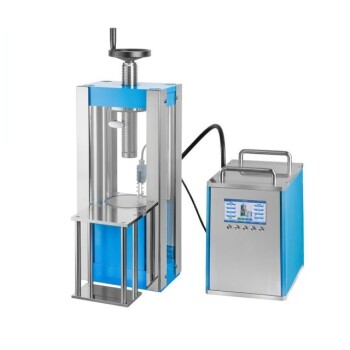
Cold isostatic pressing (CIP) provides superior structural integrity for rare-earth oxyapatite by applying uniform, omnidirectional pressure. Unlike uniaxial pressing, which applies force along a single axis, CIP utilizes a liquid medium to ensure equal pressure—often at levels such as 110 MPa—reaches every surface of the green body simultaneously. This results in a material with high density uniformity, fewer internal defects, and a significantly reduced risk of cracking or warping during the subsequent high-temperature sintering stage.
The primary advantage of a cold isostatic press lies in its ability to eliminate internal density gradients and mold friction. This produces a "green body" with isotropic properties, ensuring the material shrinks uniformly and sinters more efficiently than those prepared via traditional axial methods.
The Mechanics of Isotropic Uniformity
Omnidirectional vs. Unidirectional Force
In uniaxial pressing, force is applied from one or two directions, often leading to uneven compaction. Cold isostatic pressing submerges the sample in a liquid medium, applying isotropic pressure that ensures the powder reaches a uniform density from all angles.
Eliminating Mold Friction
Uniaxial pressing is frequently hindered by friction between the powder and the mold walls, which creates "dead zones" of low density. CIP removes this variable entirely, resulting in a homogeneous microstructure that is essential for the consistent performance of rare-earth oxyapatite.
Enhanced Particle Contact
The omnidirectional pressure significantly improves the close contact between powder particles. This tighter packing increases the pre-sintering density, providing a more stable foundation for the final ceramicization process.
Impact on Sintering and Final Quality
Prevention of Cracking and Warping
Because the green body density is uniform, the material undergoes equal shrinkage in all directions during sintering. This prevents the internal stresses that typically cause rare-earth oxyapatites to develop micro-cracks or undergo uneven deformation when heated.
Accelerated Sintering Kinetics
Improved particle contact through CIP can markedly accelerate reaction rates during processes like quench ultra-fast high-temperature sintering (qUHS). Research indicates that CIP-prepared samples can complete the ceramicization process in as little as 15 seconds, which is twice as fast as samples prepared by traditional axial pressing.
Consistency in Performance
For materials where optical or mechanical properties are critical, CIP ensures that the final ceramic is consistent throughout the bulk. By eliminating density gradients, the final product maintains its integrity and functional specifications across its entire geometry.
Understanding the Trade-offs
Complexity and Cycle Time
While CIP produces a superior green body, it is generally a slower process than uniaxial die pressing. The need to vacuum-seal the powder in flexible molds and submerge them in a pressure vessel adds steps to the production cycle.
Geometric Precision
CIP is excellent for achieving uniform density, but it is less precise for achieving complex "near-net" shapes compared to rigid-die uniaxial pressing. The flexible molds used in CIP can distort slightly under high pressure, often requiring post-sintering machining to reach exact dimensions.
Cost and Equipment
The specialized equipment and high-pressure vessels required for CIP represent a higher initial capital investment. However, this cost is often justified by the reduction in "scrap" rates caused by sintering defects like warping or internal cracking.
How to Apply This to Your Project
Recommendations for Material Processing
- If your primary focus is structural integrity and preventing cracks: Use cold isostatic pressing to ensure the absence of internal density gradients that lead to failure during sintering.
- If your primary focus is rapid production and simple geometries: Traditional uniaxial pressing may be sufficient, provided the material's sensitivity to density gradients is low.
- If your primary focus is maximizing sintering speed (e.g., qUHS): Utilize CIP to enhance particle contact, as this can reduce your required sintering time by up to 50%.
- If your primary focus is high-performance optical ceramics: Always opt for CIP to ensure the microstructural homogeneity required for consistent light transmission or mechanical strength.
Choosing cold isostatic pressing is a strategic move that prioritizes the internal structural health of the ceramic over the raw speed of the initial molding process.
Summary Table:
| Feature | Cold Isostatic Pressing (CIP) | Uniaxial Pressing |
|---|---|---|
| Pressure Direction | Omnidirectional (Liquid Medium) | Single or Dual Axis (Rigid Die) |
| Density Uniformity | High (Isotropic properties) | Low (Creates density gradients) |
| Mold Friction | Eliminated | High (Causes 'dead zones') |
| Sintering Outcome | Uniform shrinkage; no warping | High risk of cracking/deformation |
| Sintering Speed | Up to 2x faster (Enhanced contact) | Standard kinetics |
| Ideal Application | High-performance/Complex ceramics | Simple shapes/High-volume production |
Optimize Your Material Research with KINTEK Precision
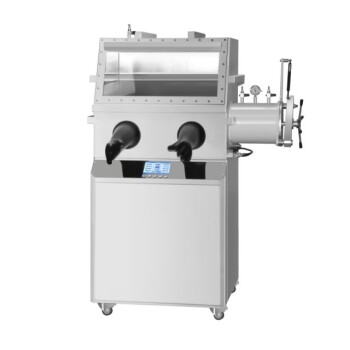
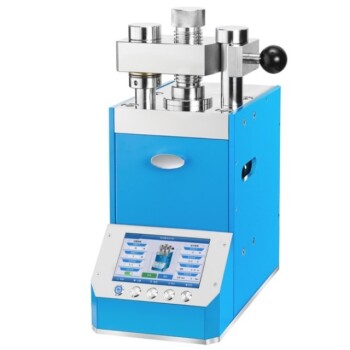
Achieving the perfect green body is critical for the success of high-performance ceramics and battery research. KINTEK specializes in comprehensive laboratory pressing solutions designed to eliminate defects and maximize sintering efficiency. Whether you need manual, automatic, heated, multifunctional, or glovebox-compatible models, or advanced cold and warm isostatic presses, our equipment ensures the structural integrity your project demands.
Ready to eliminate internal gradients and accelerate your sintering kinetics?
Contact KINTEK Experts Today to find the ideal pressing solution for your laboratory.
References
- Jarrod V. Crum, Brian J. Riley. Syntheses, crystal structures, and comparisons of rare-earth oxyapatites Ca<sub>2</sub> <i>RE</i> <sub>8</sub>(SiO<sub>4</sub>)<sub>6</sub>O<sub>2</sub> (<i>RE</i> = La, Nd, Sm, Eu, or Yb) and NaLa<sub>9</sub>(SiO<sub>4</sub>)<sub>6</sub>O<sub>2</sub>. DOI: 10.1107/s2056989019008442
This article is also based on technical information from Kintek Solution Knowledge Base .
Related Products
- Electric Lab Cold Isostatic Press CIP Machine
- Electric Split Lab Cold Isostatic Pressing CIP Machine
- Automatic Lab Cold Isostatic Pressing CIP Machine
- Manual Cold Isostatic Pressing CIP Machine Pellet Press
- Electric Isostatic Pressing Machine 40 Tons Automatic Laboratory Powder Compacting Press
People Also Ask
- What role do electric lab cold isostatic presses play in industrial contexts? Bridge R&D and Manufacturing with Precision
- What are the applications of electric lab cold isostatic presses in research settings? Advance Material R&D with High-Pressure CIPs
- How does electrical Cold Isostatic Pressing (CIP) contribute to cost savings? Unlock Efficiency and Reduce Expenses
- What are some research applications of electric lab CIPs? Unlock Uniform Powder Densification for Advanced Materials
- What are the characteristics of standard off-the-shelf electric lab CIP solutions? Achieve Immediate, Cost-Effective Processing