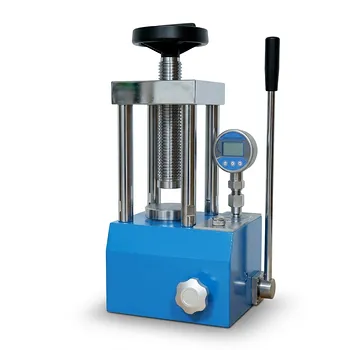
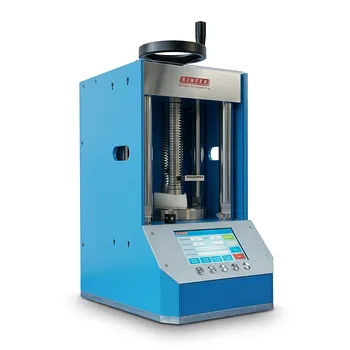
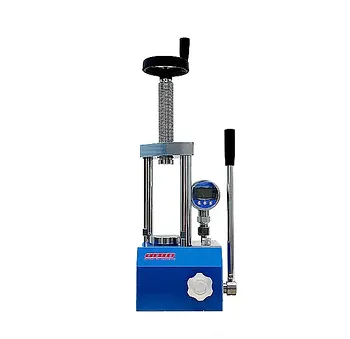
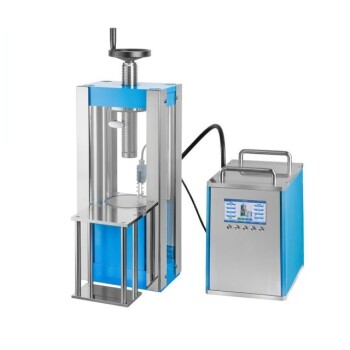
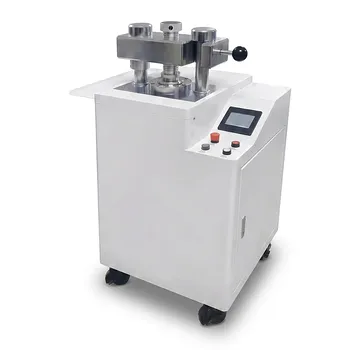
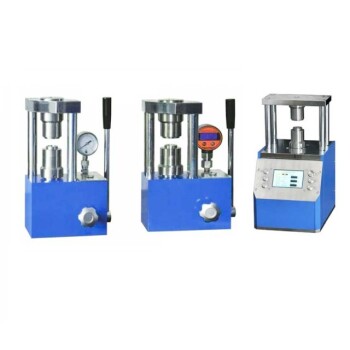
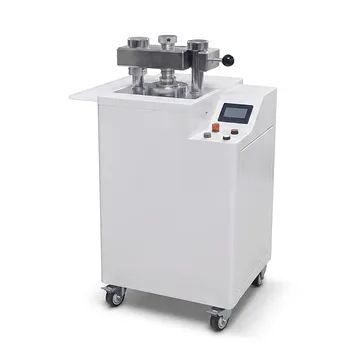
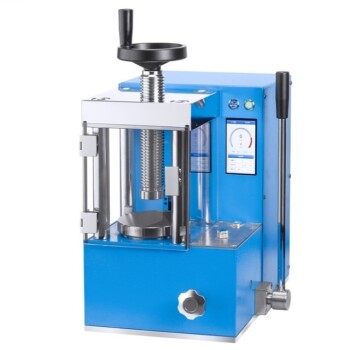
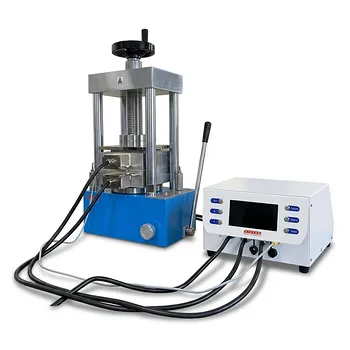
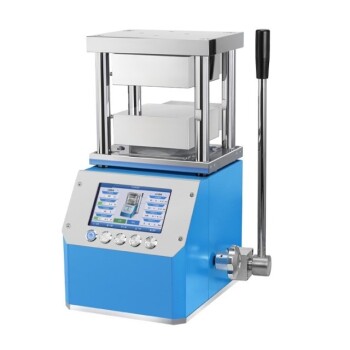
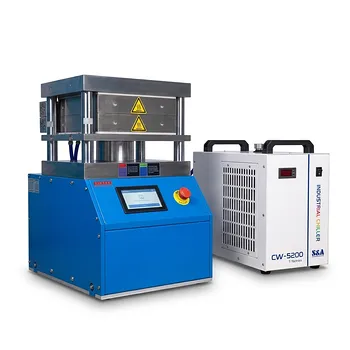
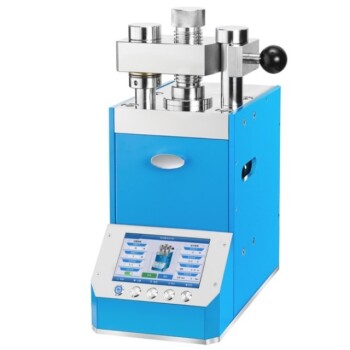
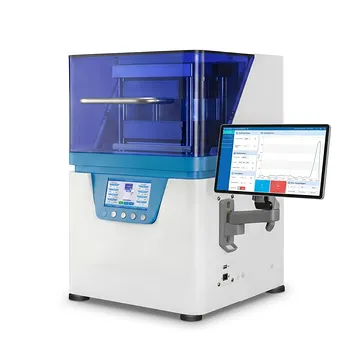
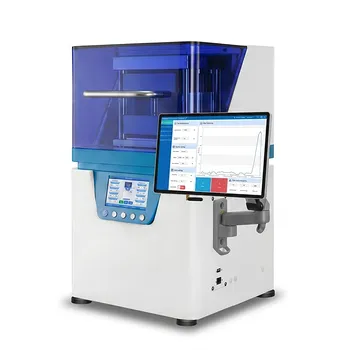
Processing sulfide electrolytes like $Li_6PS_5Cl$ necessitates a dual-stage pressure approach to ensure electrochemical stability and structural integrity. Specifically, the hydraulic press must deliver a high-compaction pressure of 370 MPa to densify the electrolyte powder into a pellet, followed by a lower pressure of approximately 80 MPa for the lamination of the anode layer.
Effective sulfide electrolyte processing relies on transitioning from extreme pressure for material densification to moderated pressure for component integration. This sequence eliminates internal porosity while preventing mechanical failure during the final battery assembly.
The Role of High Pressure in Powder Densification
Triggering Plastic Deformation
$Li_6PS_5Cl$ (Argyrodite) is characterized by its relatively soft and ductile physical nature compared to oxide electrolytes. Applying 370 MPa of static pressure forces these powder particles to undergo plastic deformation, effectively "cold welding" them into a solid sheet without the need for high-temperature sintering.
Eliminating Internal Porosity
High-pressure compaction is essential to minimize the voids and internal pores that naturally exist in loose powder. By reaching high densification levels, the hydraulic press creates a continuous path for ion transport, which significantly reduces the bulk impedance of the electrolyte layer.
Preventing Lithium Dendrite Penetration
A dense, void-free electrolyte pellet acts as a robust physical barrier between the electrodes. At 370 MPa, the resulting ceramic-like sheet achieves the mechanical strength necessary to resist the growth of lithium dendrites, which are a primary cause of short circuits in solid-state batteries.
Management of Electrode Interfacial Contact
The 80 MPa Lamination Threshold
Once the electrolyte pellet is formed (typically at a thickness of 700 μm), the pressure requirements shift during the lamination phase. Reducing the press to 80 MPa allows the anode to be pressed against the electrolyte with enough force to establish contact without cracking or damaging the pre-formed electrolyte layer.
Sustaining Mechanical Constraints
Sulfide-based materials undergo significant volume changes during electrochemical cycling (expansion and contraction). A hydraulic press with pressure-holding capabilities ensures a uniform mechanical constraint, preventing the electrolyte and electrodes from detaching as the material shifts during use.
Reducing Interfacial Resistance
The uniform application of pressure during the lamination stage ensures that the "grain-to-grain" contact between the electrolyte and the active material is seamless. This creates a low-resistance interface, which is critical for achieving high power output and efficient charging in the final battery cell.
Understanding the Trade-offs and Limitations
Tooling and Mold Fatigue
Applying pressures as high as 370 MPa puts extreme stress on the laboratory molds and the hydraulic press itself. This requires the use of specialized, high-strength steel or tungsten carbide components to prevent deformation of the pressing dies over repeated cycles.
Pressure Uniformity vs. Edge Cracking
While high pressure is necessary for density, non-uniform pressure distribution within the mold can lead to internal stresses. These stresses often manifest as edge cracking or "capping," where the pellet delaminates into thin layers upon release from the press.
The Limits of Cold Pressing
Although $Li_6PS_5Cl$ excels under cold pressing, pressure alone cannot always compensate for poor powder quality or moisture exposure. If the sulfide powder has been degraded by humidity, even 370 MPa of pressure will fail to restore the material's elective ionic conductivity.
How to Apply These Requirements to Your Project
Specific pressure settings should be dictated by the stage of assembly and the desired physical properties of the battery cell.
- If your primary focus is maximizing ionic conductivity: Utilize a high-pressure setting of 370 MPa to ensure the highest possible density and the elimination of grain boundary resistance.
- If your primary focus is electrode integration: Set the hydraulic press to a lower range of 80 MPa to maintain the stability of the interface without compromising the electrolyte's structural integrity.
- If your primary focus is cycle life stability: Opt for a hydraulic press equipped with an automatic pressure-holding function to provide continuous mechanical force during the entire assembly process.
By precisely calibrating these pressure stages, you ensure that the sulfide electrolyte functions as both an efficient ion conductor and a durable separator.
Summary Table:
| Processing Stage | Required Pressure | Primary Objective | Key Benefit |
|---|---|---|---|
| Densification | 370 MPa | Powder Compaction | Eliminates porosity & triggers "cold welding" |
| Lamination | 80 MPa | Electrode Integration | Establishes seamless interfacial contact |
| Cycle Stability | Sustained Force | Pressure Maintenance | Prevents detachment during volume changes |
Elevate Your Solid-State Battery Research with KINTEK
Precision is critical when processing sulfide electrolytes like $Li_6PS_5Cl$. KINTEK specializes in comprehensive laboratory pressing solutions designed to meet the rigorous demands of battery research. Our range includes:
- Manual & Automatic Presses: For precise control over the 370 MPa densification stage.
- Heated & Multifunctional Models: To explore advanced material properties.
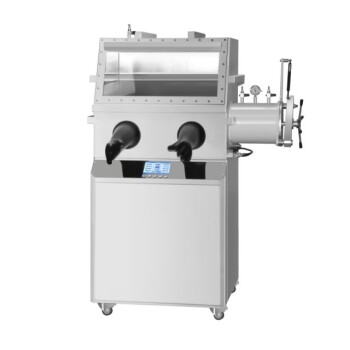
- Glovebox-Compatible Systems: Ensuring material integrity in inert environments.
- Cold & Warm Isostatic Presses (CIP/WIP): For uniform density and high-performance electrolyte layers.
Don't let mechanical failure or interfacial resistance hinder your breakthroughs. Contact KINTEK today to find the perfect pressing solution tailored to your laboratory's needs!
Related Products
- Manual Laboratory Hydraulic Pellet Press Lab Hydraulic Press
- Automatic Laboratory Hydraulic Press Lab Pellet Press Machine
- Manual Laboratory Hydraulic Press Lab Pellet Press
- Laboratory Hydraulic Split Electric Lab Pellet Press
- Automatic Fluorescence Sample Preparation Press 40 Ton Lab Pellet Press for XRF Analysis
People Also Ask
- What is the primary purpose of manual lab hydraulic pellet presses? Achieve High-Precision Sample Preparation for Spectroscopy
- What is the primary purpose of a manual lab hydraulic pellet press? Ensure Accurate Sample Prep for XRF and FTIR
- What role does a lab hydraulic press play in researching squishy granular matter? Expert Insights into Material Physics
- What is the primary function of a laboratory hydraulic press in evaluating the ionic conductivity of Li6PS5X (LMSX)?
- What is the purpose of initial axial molding using a lab hydraulic press? Optimizing Electrolyte Green Bodies