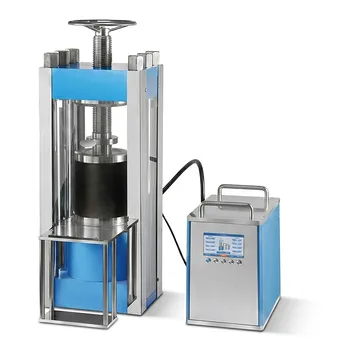
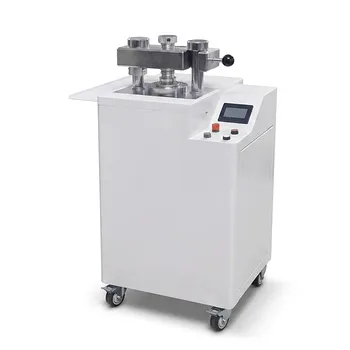
In the fabrication of Carbon Fiber Reinforced Polymer (CFRP) lugs, a laboratory heated press serves as the primary mechanism for curing the composite layup. By simultaneously applying precise thermal energy and mechanical pressure, the press transforms loose layers of pre-impregnated fiber into a dense, high-performance structural component. This dual-action process is essential for achieving uniform resin distribution, expelling trapped air, and ensuring the interlaminar bonding required for load-bearing mechanical applications.
The laboratory heated press is the critical tool for controlling the thermomechanical environment during CFRP lug production. Its ability to synchronize heat and pressure ensures that the resin matrix fully infiltrates the carbon fibers while eliminating structural defects like internal voids.
Managing the Resin Matrix and Curing Reaction
Triggering the Chemical Cure
The primary role of the heated press is to provide the staged thermal energy required to initiate the cross-linking of the epoxy resin matrix. By maintaining precise temperatures (often around 120 °C), the press ensures the resin reaches the necessary viscosity for flow before finalizing the chemical transition into a hardened solid.
Optimizing Resin Flow and Wet-Out
As the heat reduces the resin's viscosity, the press applies mechanical pressure to force the liquid resin into the microscopic gaps between carbon fiber bundles. This ensures thorough "wet-out," where every fiber is encapsulated by the matrix, preventing weak spots where the material could fail under load.
Controlling Resin Content and Distribution
The press maintains a stable pressure environment to regulate the resin-to-fiber ratio. By squeezing out excess resin and ensuring uniform distribution across the lug, the press allows manufacturers to achieve a specific fiber volume fraction, which is a key predictor of the component's final strength.
Ensuring Structural Integrity and Density
Elimination of Internal Voids
During the manual or automated layup of CFRP, air can become trapped between layers. The heated press uses high pressure (ranging from 100 psi to several tons depending on the specific application) to expel these internal air bubbles before the resin cures.
Promoting Interlaminar Bonding
For a lug to withstand complex stresses, the individual layers of carbon fiber must act as a single unit. The press provides the uniform compression necessary to create tight molecular-level contact between layers, resulting in superior interlaminar shear strength.
Achieving Dimensional Precision
Laboratory heated presses use precision-ground platens to ensure that the final CFRP lug has a uniform thickness and stable geometric dimensions. This level of control is vital for components like lugs, which often require tight tolerances for integration into larger mechanical assemblies.
Understanding the Trade-offs and Pitfalls
The Risk of Resin Starvation
While high pressure is necessary to eliminate voids, excessive pressure can lead to "resin starvation." This occurs when too much resin is forced out of the mold, leaving the fibers insufficiently supported and significantly reducing the material's impact resistance.
Thermal Gradients and Residual Stress
If the heating platens do not distribute heat evenly, different parts of the lug may cure at different rates. This creates internal residual stresses within the composite, which can lead to warping or premature cracking when the part is put into service.
Pressure Timing
Applying pressure too early can hinder the escape of volatiles, while applying it too late—after the resin has begun to "gel"—can result in poor consolidation. Precise synchronization of the temperature-pressure cycle is the most challenging aspect of using a laboratory press.
How to Optimize Your Pressing Process
If you are utilizing a laboratory heated press for CFRP fabrication, your approach should shift based on your specific engineering requirements:
- If your primary focus is maximum weight-to-strength ratio: Prioritize high-pressure settings and precise resin-content control to achieve a high fiber volume fraction.
- If your primary focus is dimensional accuracy for assembly: Utilize rigid metal molds within the press to ensure the part maintains exact geometric tolerances and uniform thickness.
- If your primary focus is avoiding delamination in thick sections: Implement a staged, "stepped" heating profile to ensure the core of the lug reaches the cure temperature at the same time as the surface.
Effective use of a heated press transforms a raw fiber-and-resin mixture into a predictable, high-performance engineering material through the rigorous control of thermomechanical variables.
Summary Table:
| Process Function | Impact on CFRP Lug | Technical Mechanism |
|---|---|---|
| Thermal Regulation | Resin Matrix Curing | Triggers cross-linking at staged temperatures (e.g., 120°C) |
| Mechanical Pressure | Void Elimination | Expels trapped air bubbles to ensure high density |
| Compression Control | Interlaminar Bonding | Ensures tight molecular contact between fiber layers |
| Platen Precision | Dimensional Accuracy | Maintains uniform thickness and stable geometric tolerances |
Elevate Your Materials Research with KINTEK
Precision is paramount when fabricating high-performance CFRP components. KINTEK specializes in comprehensive laboratory pressing solutions, offering manual, automatic, heated, multifunctional, and glovebox-compatible models, as well as cold and warm isostatic presses. Our equipment is widely applied in battery research and advanced composite manufacturing, providing the exact thermomechanical control needed to prevent resin starvation and minimize internal stress.
Ready to enhance your lab's capabilities and achieve superior structural integrity? Contact KINTEK today for a customized pressing solution!
References
- Mahdi Damghani, Joseph Suchecki. Experimental Investigation of Static Strength in CFRP and Aluminium Lugs Subjected to Uniaxial Tensile Loading. DOI: 10.1007/s10443-025-10338-0
This article is also based on technical information from Kintek Solution Knowledge Base .
Related Products
- 24T 30T 60T Heated Hydraulic Lab Press Machine with Hot Plates for Laboratory
- Automatic Large Format Laboratory Heated Hydraulic Press 400x400mm Plate Capacity
- Automatic Heated Hydraulic Lab Press with Programmable Touch Screen Controls and Precision Temperature Regulation
- Manual Heated Hydraulic Lab Press with Integrated Hot Plates Hydraulic Press Machine
- Automatic Heated Hydraulic Lab Press 120x120mm Plate Fully Automated Material Research Press
People Also Ask
- Function of a Laboratory Hydraulic Press with Heated Platens in SSE? Enhance Battery Density & Conductivity
- Why is a laboratory hydraulic press with heating plates required for PLA/TEC films? Achieve Precise Sample Integrity
- What role does a laboratory heated hydraulic press play in LTCC? Essential for High-Density Ceramic Lamination
- Why Use a Laboratory Heated Hydraulic Press for SSAB CCM? Optimize Solid-State Battery Interfacial Bonding
- Why is a laboratory heated hydraulic press utilized during the lamination stage of NASICON green tapes?