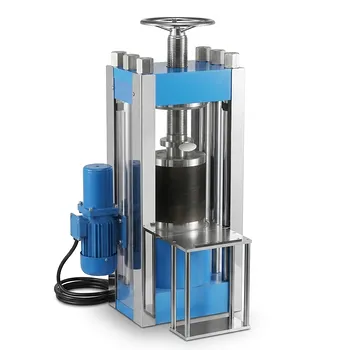
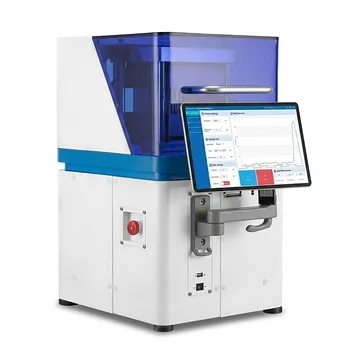
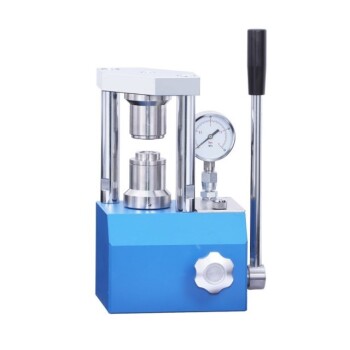
High-strength hardened steel die sets function as precision containment vessels that allow for the application of massive axial loads necessary to transform loose powders into dense, functional battery layers. These dies provide the structural rigidity required to withstand extreme hydraulic pressures without deforming, ensuring that the resulting solid-state battery pellets are uniform in thickness and free of structural defects.
Core Takeaway: Die sets are the mechanical foundation for solid-state battery assembly, converting external hydraulic force into uniform internal pressure to create the intimate, low-resistance interfaces required for electrochemical performance.
The Structural Role of High-Strength Die Sets
Resisting Plastic Deformation
The primary function of using hardened steel is its ability to bear massive axial loads, often exceeding 350 MPa, without undergoing plastic deformation. This rigidity ensures that the force applied by the hydraulic press is directed entirely into the material compression rather than warping the container.
Ensuring Dimensional Precision
High-quality die sets are engineered with precise tolerances and high surface finishes to ensure the thickness uniformity of the battery laminates. This precision is critical because even minor variations in layer thickness can lead to uneven current distribution and premature battery failure.
Protecting Structural Integrity During Ejection
The die set provides the mechanical support necessary to prevent the battery cell from cracking or collapsing during the ejection process. Because solid-state pellets are often brittle, the smooth internal surface of the hardened steel reduces friction as the finished component is pushed out.
Achieving Optimal Interface Quality
Uniform Pressure Transmission
A die set serves as the medium for uniformly transmitting pressure across the entire surface of the electrolyte and electrode powders. This uniform distribution is a prerequisite for creating a solid electrolyte pellet with high density and no macroscopic defects.
Eliminating Internal Voids
By facilitating high-pressure environments, these dies help eliminate internal voids and pores within the material layers. Removing these gaps is essential for establishing efficient lithium-ion transport pathways and reducing the internal resistance of the cell.
Establishing Atomic-Level Contact
The mechanical clamping force provided within the die ensures atomic-level contact between the solid electrolyte and the active materials. This intimate physical contact is necessary because solid-state materials do not "wet" surfaces like liquid electrolytes, making high-pressure bonding the only way to ensure low interfacial impedance.
Understanding the Trade-offs and Limitations
Friction and Wall Effects
Despite the high surface finish of hardened steel, internal wall friction can still lead to slight pressure gradients within the powder. If not managed, the center of the pellet may experience different compaction levels than the edges, potentially affecting the uniformity of ion transport.
Material Fatigue and Wear
While hardened steel is highly durable, the repeated application of extreme pressures—often between 75 MPa and 375 MPa—will eventually cause microscopic wear. Users must monitor the die surfaces for pitting or scratches, as any surface imperfection will be transferred directly to the battery layers.
Chemical Compatibility
Although steel is physically robust, some sulfide-based electrolytes or specialized battery chemistries may react with certain metal alloys. It is vital to ensure that the die material is chemically inert relative to the specific powders being compressed to avoid contamination.
How to Apply Detailed Pressing to Your Project
Recommendations for Battery Assembly
- If your primary focus is reducing interfacial resistance: Use a high-precision die set capable of sustaining at least 120-150 MPa to ensure the tight interlocking of active material particles.
- If your primary focus is silicon-based anodes: Utilize die sets that can handle extreme pressures up to 330 MPa to maintain contact during the significant volume expansion of silicon.
- If your primary focus is thickness uniformity: Prioritize die sets with ultra-high surface finishes and tight tolerances to ensure the mechanical strength of the electrolyte pellet during the subsequent assembly stages.
By selecting the appropriate die set and mastering the pressing process, you establish the physical foundation required for high-quality solid-solid interfaces and optimal electrochemical capacity.
Summary Table:
| Key Function | Advantage | Impact on Battery Performance |
|---|---|---|
| Resist Deformation | Sustains loads up to 375 MPa | Maintains pellet structural integrity |
| Uniform Pressure | Eliminates internal voids | Establishes efficient ion transport pathways |
| Precision Tolerances | High surface finish uniformity | Prevents current hotspots and cell failure |
| Atomic Contact | High clamping force | Lowers interfacial impedance for better capacity |
Optimize Your Battery Research with KINTEK
Precision is the foundation of high-performance all-solid-state batteries. KINTEK specializes in comprehensive laboratory pressing solutions tailored to the rigorous demands of battery research.
We offer a versatile range of equipment, including:
- Manual & Automatic Presses for consistent load application.
- Heated & Multifunctional Models to suit complex material chemistries.
- Glovebox-Compatible Systems for sensitive sulfide-based electrolytes.
- Cold & Warm Isostatic Presses for superior density and uniformity.
Our high-strength tools ensure the atomic-level contact and structural excellence required for next-generation energy storage. Ready to enhance your lab's efficiency? Contact KINTEK today to find the perfect pressing solution for your project!
References
- Tommi Hendrik Aalto, Jonas Jacobs. Gas evolution in Ruddlesden–Popper-type intercalation cathodes in all-solid-state fluoride-ion-batteries: implications on battery performance and synthesis of highly oxidized oxyfluorides. DOI: 10.1039/d5ta07033c
This article is also based on technical information from Kintek Solution Knowledge Base .
Related Products
- Lab Button Battery Tablet Press Sealing Mold
- Warm Isostatic Press for Solid State Battery Research Warm Isostatic Press
- Lab Button Battery Disassembly and Sealing Mold
- Button Battery Sealing Press Machine for Lab
- Lab Infrared Press Mold for No Demolding
People Also Ask
- What types of pressing dies are available for pellet presses? Choose the Right Die for Perfect Pellets
- What is the function of specialized battery molds and sealing consumables? Optimize Your In-situ XRD Testing Today
- What role do battery testing molds play in electrolyte performance? Exploring Pressure vs. Viscoelasticity
- What is the function of applying 5 MPa during battery assembly? Ensure Stability in Solid-State & Lithium Systems
- Why is a laboratory battery sealing press essential for desolvation energy testing? Ensure Reliable Kinetic Data