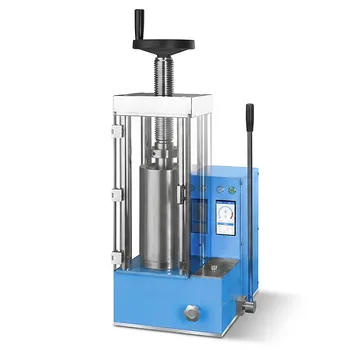
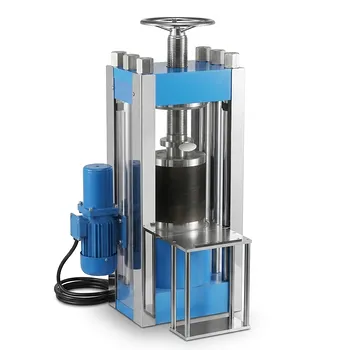
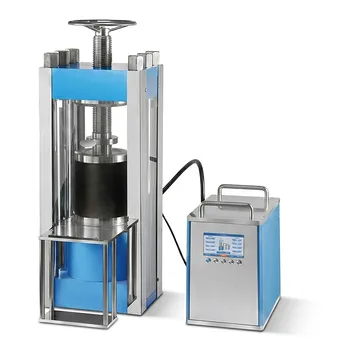
Cold Isostatic Pressing (CIP) is a critical secondary molding stage used to refine the density and structural uniformity of Ce,Y:SrHfO3 green bodies. By applying up to 250 MPa of omnidirectional pressure through a liquid medium, CIP eliminates internal density gradients and micro-pores that typically result from initial dry pressing. This process ensures the material possesses the mechanical strength and structural consistency required to survive high-temperature sintering without deforming or cracking.
Core Takeaway: CIP transforms a loosely compacted powder into a high-density green body by applying equal pressure from all directions. This uniformity is essential for Ce,Y:SrHfO3 ceramics to achieve full densification and structural integrity during the final sintering process.
Achieving Microstructural Uniformity
Eliminating Density Gradients
Traditional uniaxial or dry pressing often results in internal pressure gradients, where the center of the compact is less dense than the edges. CIP resolves this by submerging the green body in a high-pressure liquid, ensuring uniform force is applied to every surface simultaneously.
Filling Micro-Pores and Voids
High-pressure liquid medium forces ceramic particles to rearrange and bond more tightly at the microscopic level. This effectively fills micro-pores and eliminates internal defects that could otherwise become failure points during thermal processing.
Increasing Relative Density and Strength
By compressing the green body at pressures reaching 250 MPa, the relative density of the compact is significantly increased. This higher starting density is a prerequisite for reaching the full densification required for advanced ceramic applications.
Preparing for High-Temperature Sintering
Reducing Sintering Deformation
Non-uniform green bodies tend to shrink unevenly when exposed to temperatures exceeding 1600°C. Because CIP creates a homogeneous microstructure, the green body undergoes uniform linear shrinkage, which drastically reduces the risk of warping or deformation.
Preventing Stress-Induced Cracking
Internal stress concentrations in a green body are the primary cause of cracking during the cooling or heating phases of sintering. CIP minimizes these stress concentrations, providing a stable and structurally sound base that can withstand the rigors of the furnace.
Enabling Optical and Industrial Quality
For ceramics like Ce,Y:SrHfO3, achieving specific performance metrics often depends on microstructural homogeneity. CIP ensures that the final product lacks the structural "shadows" or density variations that could interfere with its functional properties.
Understanding the Trade-offs
Process Complexity and Cost
Unlike simple uniaxial pressing, CIP requires flexible rubber molds and specialized high-pressure equipment. This adds an additional step to the manufacturing workflow, increasing both the time and the specialized labor required for production.
Tooling Limitations
Because the pressure is isotropic and transmitted through a fluid, the molds must be hermetically sealed and flexible. This can make it more challenging to produce complex geometries compared to rigid-die pressing, often requiring post-process machining to reach final dimensions.
How to Apply This to Your Project
The decision to use CIP depends largely on your final performance requirements and the scale of your production.
- If your primary focus is maximizing transparency or density: CIP is mandatory, as it is the only way to ensure the pore-free microstructure necessary for high-performance optical ceramics.
- If your primary focus is preventing scrap in large batches: Implementing CIP will significantly reduce the number of parts lost to cracking or warping during the sintering phase.
- If your primary focus is rapid prototyping of simple shapes: You may start with uniaxial pressing, but recognize that the mechanical properties will be inferior to those treated with isostatic pressure.
By utilizing Cold Isostatic Pressing, you ensure that the Ce,Y:SrHfO3 ceramic begins the sintering process with the highest possible level of physical and structural consistency.
Summary Table:
| Feature | Mechanism | Impact on Sintering |
|---|---|---|
| Omnidirectional Pressure | Applies equal force (up to 250 MPa) from all sides | Eliminates density gradients & warping |
| Micro-pore Removal | Forces particle rearrangement at the microscopic level | Prevents internal stress-induced cracking |
| High Compaction | Increases relative density of the green body | Enables full densification & optical quality |
| Homogenization | Creates a uniform microstructural base | Reduces linear shrinkage variations |
Unlock High-Performance Ceramic Results with KINTEK
Is internal density inconsistency compromising your ceramic's structural integrity? KINTEK specializes in comprehensive laboratory pressing solutions designed for precision and reliability. Whether you are conducting advanced material synthesis or battery research, our range of equipment ensures your green bodies are optimized for perfect sintering.
Our Solutions Include:
- Manual & Automatic Presses: For versatile lab-scale operations.
- Heated & Multifunctional Models: To support complex material requirements.
- Isostatic Presses: High-performance Cold (CIP) and Warm Isostatic Presses for uniform densification.
- Glovebox-Compatible Designs: Perfect for air-sensitive research applications.
Don't let micro-pores or deformation hinder your progress. Contact KINTEK today to find the ideal pressing solution for your lab and ensure the highest quality for your Ce,Y:SrHfO3 ceramics and beyond!
References
- Danyang Zhu, Jiang Li. Fine-grained Ce,Y:SrHfO<sub>3</sub> Scintillation Ceramics Fabricated by Hot Isostatic Pressing. DOI: 10.15541/jim20210059
This article is also based on technical information from Kintek Solution Knowledge Base .
Related Products
- Electric Lab Cold Isostatic Press CIP Machine
- Electric Split Lab Cold Isostatic Pressing CIP Machine
- Automatic Lab Cold Isostatic Pressing CIP Machine
- Manual Cold Isostatic Pressing CIP Machine Pellet Press
- Electric Isostatic Pressing Machine 40 Tons Automatic Laboratory Powder Compacting Press
People Also Ask
- What are the applications of electric lab cold isostatic presses in research settings? Advance Material R&D with High-Pressure CIPs
- What role do electric lab cold isostatic presses play in industrial contexts? Bridge R&D and Manufacturing with Precision
- How does electrical Cold Isostatic Pressing (CIP) contribute to cost savings? Unlock Efficiency and Reduce Expenses
- What are some research applications of electric lab CIPs? Unlock Uniform Powder Densification for Advanced Materials
- What are the characteristics of standard off-the-shelf electric lab CIP solutions? Achieve Immediate, Cost-Effective Processing