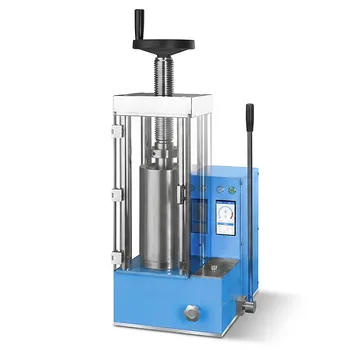
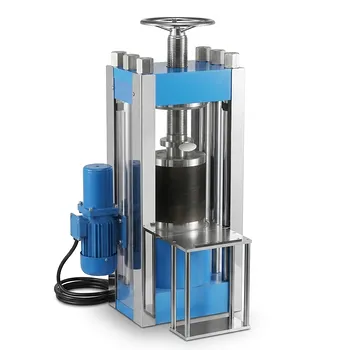
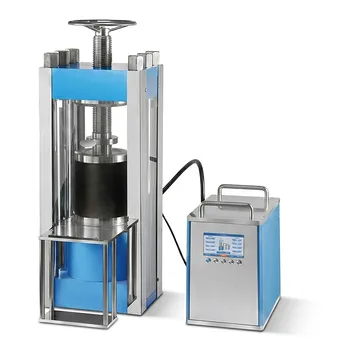
The Cold Isostatic Press (CIP) serves as the critical bridge between loose aluminum powder and a structural preform. It applies uniform, multi-directional pressure—typically ranging from 150 to 200 MPa—to consolidate loose particles into a "green compact." This essential step provides the necessary mechanical strength and preliminary density required for all subsequent thermal and mechanical processing stages.
Core Takeaway: The role of the cold isostatic press is to transform loose aluminum powder into a uniformly dense green body through isotropic compaction. This process eliminates density gradients and air pockets, establishing a stable physical foundation for high-performance downstream treatments like vacuum degassing, sintering, and hot forging.
The Mechanics of Isotropic Compaction
Achieving Uniform Density Distribution
Unlike traditional unidirectional pressing, a cold isostatic press applies equal pressure from all directions simultaneously. This isotropic force ensures that the internal density of the aluminum matrix remains consistent throughout the entire volume of the part. By minimizing density gradients, the CIP prevents the structural warping or internal stresses that often occur during subsequent heat treatments.
Physical Stacking and Interlocking
At this initial stage, the bonding between aluminum powder particles is primarily achieved through physical stacking and mechanical interlocking rather than metallurgical fusion. The high pressure forces the particles into tight contact, expelling entrapped air and increasing the contact surface area. This results in a "green compact" that is handleable and structurally stable enough for machining or transport.
Preparation for Thermal Evolution
The CIP process is vital for preparing the composite for vacuum degassing, a common requirement for aluminum alloys to remove moisture and gases. By creating a permeable but stable green body, the press allows for efficient gas removal before the material is fully densified at higher temperatures.
Enhancing Composite Material Integrity
Embedding Reinforcements and Additives
In the preparation of specialized materials like aluminum foams or reinforced composites, the CIP ensures that secondary phases—such as foaming agents (titanium hydride) or magnesium oxide—are tightly and uniformly embedded within the matrix. This "airtight" encapsulation is crucial for ensuring that foaming gases drive expansion effectively during later heating stages.
Eliminating Initial Porosity
High-pressure compaction effectively reduces the initial porosity of the loose powder mixture. By collapsing the large gaps between particles at room temperature, the CIP minimizes the risk of sintering defects. This preliminary densification is a prerequisite for achieving the near-theoretical density required in high-performance aerospace or automotive components.
Understanding the Trade-offs
Physical vs. Metallurgical Bonding
The most significant limitation of the CIP stage is that the resulting green compact lacks true metallurgical strength. Because the process occurs at room temperature, the particles are not fused; the component remains relatively fragile and cannot bear significant structural loads until it undergoes sintering or hot extrusion.
Processing Speed and Complexity
Compared to continuous methods or simple die pressing, cold isostatic pressing is a batch process that requires specialized flexible tooling (often rubber or elastomeric molds). While it provides superior uniformity, it involves longer cycle times and higher equipment costs, which must be weighed against the performance requirements of the final composite.
How to Apply This to Your Project
Making the Right Choice for Your Goal
- If your primary focus is high-performance structural AMCs: Utilize CIP at pressures of 200 MPa to ensure a zero-gradient density profile before hot forging or extrusion.
- If your primary focus is manufacturing aluminum foam: Use the CIP to tightly embed foaming agents like TiH2 into the matrix to ensure controlled gas release during the melt phase.
- If your primary focus is cost-sensitive rapid prototyping: Evaluate if unidirectional pressing can suffice, as the CIP is generally reserved for parts requiring high internal consistency and complex geometries.
By effectively utilizing cold isostatic pressing, you transform a volatile powder mixture into a stable, high-quality preform ready for the rigors of thermal densification.
Summary Table:
| Feature | Role in AMC Preparation |
|---|---|
| Pressure Range | 150 - 200 MPa applied multi-directionally |
| Primary Output | Transformation of loose powder into a "green compact" |
| Density Profile | Eliminates gradients through isotropic compaction |
| Pre-Thermal Prep | Enables efficient vacuum degassing and eliminates air pockets |
| Integrity | Ensures uniform embedding of reinforcements and additives |
Elevate Your Composite Research with KINTEK Precision
Unlock the full potential of your material science projects with KINTEK’s comprehensive laboratory pressing solutions. Whether you are developing high-performance aluminum matrix composites or advancing battery research, our state-of-the-art equipment ensures the structural integrity and uniform density your work demands.
Our versatile range includes:
- Manual & Automatic Models for flexible lab workflows.
- Heated & Multifunctional Presses for complex material requirements.
- Glovebox-Compatible Systems for air-sensitive materials.
- Cold & Warm Isostatic Presses to eliminate density gradients and porosity.
Ready to achieve near-theoretical density in your preforms? Contact our technical experts today to find the perfect pressing solution tailored to your specific application!
References
- Mario Moreno, Peter Krížik. Mechanical characterization of PM aluminum composites by small punch test. DOI: 10.1590/s1517-707620180002.0357
This article is also based on technical information from Kintek Solution Knowledge Base .
Related Products
- Electric Lab Cold Isostatic Press CIP Machine
- Electric Split Lab Cold Isostatic Pressing CIP Machine
- Automatic Lab Cold Isostatic Pressing CIP Machine
- Manual Cold Isostatic Pressing CIP Machine Pellet Press
- Electric Isostatic Pressing Machine 40 Tons Automatic Laboratory Powder Compacting Press
People Also Ask
- What are the applications of electric lab cold isostatic presses in research settings? Advance Material R&D with High-Pressure CIPs
- What role do electric lab cold isostatic presses play in industrial contexts? Bridge R&D and Manufacturing with Precision
- How does electrical Cold Isostatic Pressing (CIP) contribute to cost savings? Unlock Efficiency and Reduce Expenses
- What are some research applications of electric lab CIPs? Unlock Uniform Powder Densification for Advanced Materials
- What are the characteristics of standard off-the-shelf electric lab CIP solutions? Achieve Immediate, Cost-Effective Processing