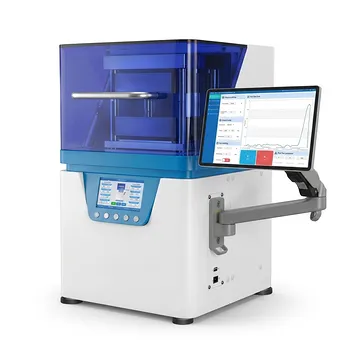
Boron Nitride (BN) coated steel plates function as a high-performance isolation barrier and release agent during heated pressing. These plates are positioned between the composite material stack and the press heads to prevent the workpiece from fusing to the mold or machinery. By leveraging the unique thermal and chemical properties of Boron Nitride, this setup ensures that consolidated components can be removed intact without surface damage or contamination.
Boron Nitride serves as a chemically inert, high-temperature lubricant that prevents adhesion and unwanted chemical reactions between the material and the press hardware. This ensures the structural integrity of the final part while protecting the mold from wear and degradation.
The Mechanics of Isolation and Release
Preventing Adhesion Under Extreme Conditions
During heated pressing, high temperatures and pressures can cause composite materials or metallic powders to bond physically with the press plates. Boron Nitride possesses exceptional high-temperature resistance, maintaining its integrity where standard lubricants would fail. The coating creates a non-stick surface that allows for the effortless removal of the finished part once the cycle is complete.
Functioning as a High-Temperature Lubricant
Beyond simple separation, BN acts as a dry lubricant that reduces friction during the compression phase. This lubricity is vital during the ejection process, as it allows the sintered or pressed sample to slide out of the mold without mechanical stress. This reduces the risk of micro-cracks or surface defects in the finished product.
Protecting Material Purity and Integrity
Chemical Inertness and Barrier Protection
In processes involving reactive materials, such as titanium alloys or phosphors, the BN coating acts as a chemical barrier. It prevents phenomena like carburization, where carbon from graphite dies might migrate into the workpiece. This inertness ensures that the chemical composition and purity of the material remain uncompromised during the heating cycle.
Ensuring Uniform Heat and Pressure Transfer
Steel plates coated with BN facilitate the effective transfer of heat and pressure from the press heads to the composite stack. Unlike thicker, uneven gaskets, a thin, uniform BN spray or coating ensures that the thermal energy is distributed evenly across the surface. This uniformity is critical for achieving high green density and consistent material properties across the entire part.
Understanding the Trade-offs
Coating Uniformity and Surface Texture
While BN is highly effective, the method of application significantly impacts the final result. An unevenly applied spray can lead to surface irregularities or "pitting" on the pressed part. Operators must ensure a consistent thickness to avoid localized sticking or dimensional inaccuracies.
Maintenance and Reapplication Needs
Boron Nitride coatings are generally sacrificial or require periodic replenishment. Over multiple press cycles, the coating can wear down or become embedded in the workpiece, potentially requiring the steel plates to be cleaned and re-coated. Failure to maintain the coating layer can lead to catastrophic "freeze-ups" where the part becomes permanently bonded to the press.
How to Apply This to Your Project
Choosing the Right Interface Strategy
The use of BN-coated plates should be tailored to the specific thermal and chemical requirements of your material.
- If your primary focus is material purity: Use BN-coated plates to provide a chemically inert interface that blocks carbon migration or oxidation from the mold.
- If your primary focus is high-volume throughput: Ensure a consistent re-application protocol for the BN coating to maintain quick ejection speeds and minimize downtime.
- If your primary focus is surface finish: Utilize finely atomized BN sprays on polished steel plates to ensure the smoothest possible transition between the plate and the composite.
By correctly utilizing Boron Nitride as a functional interface, you ensure the repeatable production of high-quality, high-purity components in any heated pressing environment.
Summary Table:
| Feature | Function | Benefit |
|---|---|---|
| Release Agent | Prevents physical bonding | Easy part removal without surface damage |
| Chemical Barrier | Inert interface | Prevents material contamination and carburization |
| Lubrication | Reduces friction | Minimizes micro-cracks and stress during ejection |
| Thermal Transfer | Uniform heat distribution | Ensures high green density and consistent properties |
Maximize Your Material Purity with KINTEK
Elevate your material processing with KINTEK’s expert laboratory pressing solutions. Whether you are focused on advanced battery research or high-performance composites, we offer a comprehensive range of equipment tailored to your needs—including manual, automatic, heated, multifunctional, and glovebox-compatible models, as well as cold and warm isostatic presses.
Our precision-engineered systems ensure superior structural integrity and repeatable results for your most demanding applications. Contact KINTEK today to learn how our specialized pressing solutions can enhance your laboratory's efficiency and output quality.
References
- Mohammad Sayyar, Parviz Soroushian. Energy absorption capacity of pseudoelastic fiber-reinforced composites. DOI: 10.1515/secm-2013-0021
This article is also based on technical information from Kintek Solution Knowledge Base .
Related Products
- Lab Double Plate Heating Mold for Laboratory Use
- Split Automatic Heated Hydraulic Press Machine with Heated Plates
- Warm Isostatic Press for Solid State Battery Research Warm Isostatic Press
- Automatic High Temperature Heated Hydraulic Press Machine with Heated Plates for Lab
- Infrared Heating Quantitative Flat Plate Mold for Precise Temperature Control
People Also Ask
- How does the geometry of laboratory molds influence mycelium-based composites? Optimize Density and Strength
- Why are precision laboratory molds essential for forming basalt-reinforced lightweight concrete specimens?
- Why are high-precision laboratory molds and specific compaction processes required? Ensure Data Integrity in Soil Research
- What is the purpose of using a laboratory hot plate and weight pressing? Mastering Cellulose Filament Bond Strength
- Why is low-temperature pre-drying on a laboratory hot plate necessary? Stabilize Silver Ink for Better Conductivity