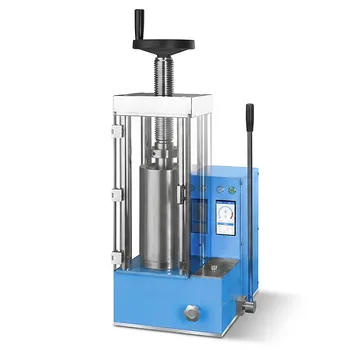
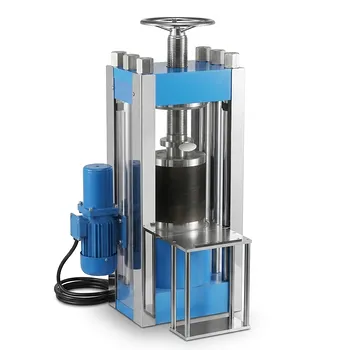
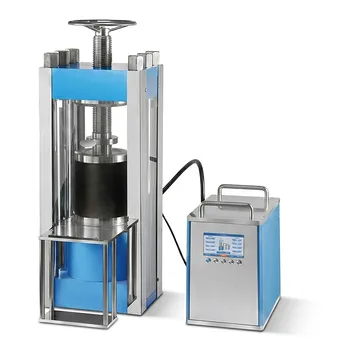
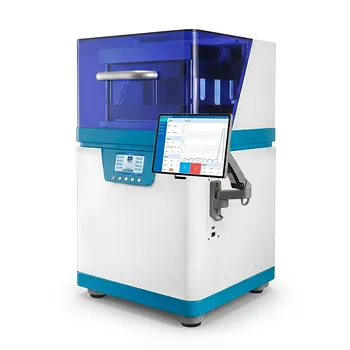
The Cold Isostatic Press (CIP) is the fundamental tool for "green body" fabrication in BCP bioceramic production. It uses a liquid medium to apply uniform, omnidirectional pressure to BCP powder within a flexible mold. This process creates a highly dense, isotropic material that precisely replicates complex micro-nano patterns while ensuring the structural integrity required to survive high-temperature sintering.
By applying equal pressure from all directions, the Cold Isostatic Press eliminates internal density gradients and voids, allowing BCP bioceramics to maintain delicate micro-nano surface architectures during the transition from powder to solid ceramic.
Achieving Uniform Isotropic Density
Eliminating Internal Pressure Gradients
Unlike traditional axial pressing, which applies force from a single direction, CIP uses a liquid medium to transmit equal pressure from all sides. This eliminates the internal friction and pressure gradients that often lead to cracks or weak spots in the ceramic structure.
Reducing Microporosity and Voids
The application of high pressure—often reaching 200 MPa—effectively forces BCP particles into the closest possible contact. This process removes internal voids and air pockets, resulting in a dense cylindrical green body with a high degree of internal consistency.
Enhancing Particle Bonding
When used with wetting solutions or binders like polyvinyl alcohol, CIP increases the bonding tightness between individual BCP granules. This provides the green body with the necessary mechanical strength to be handled and processed before it is permanently hardened in the furnace.
Preservation of Micro-Nano Topographies
Precise Pattern Replication
CIP is essential for bioceramics requiring specific surface textures, as it ensures the powder undergoes isotropic compression against templates with micro-patterns. Because the pressure is uniform, the powder conforms perfectly to the template, achieving precisely replicated micro-topographical structures.
Structural Integrity During Sintering
The uniform density achieved through isostatic pressing is a prerequisite for a successful sintering stage. By creating a homogenous internal structure, CIP minimizes the risk of deformation or warping, ensuring the micro-nano features remain intact as the ceramic grains grow and bond at high temperatures.
Improving Crystallinity and Grain Growth
High-density green bodies produced via CIP facilitate better crystal integrity and grain growth during high-temperature sintering. This results in BCP ceramics with higher crystallinity and superior mechanical properties compared to methods like spray drying or freeze drying.
Understanding the Trade-offs
Mold Limitations and Complexity
Because CIP requires elastic molds made of materials like rubber or polyurethane, achieving extremely complex geometries can be challenging. The flexibility of the mold means that while internal density is uniform, the final dimensions may require more significant post-sintering machining to reach exact tolerances.
Processing Time and Cost
Isostatic pressing is generally a slower, batch-oriented process compared to continuous dry pressing methods. The requirement for specialized high-pressure equipment and the manual steps involved in sealing powder in elastic bags can increase production costs and timelines.
Requirement for Post-Processing
While CIP provides a near-net-shape green body, the surface finish of the "as-pressed" part may reflect the texture of the elastic mold. This often necessitates additional finishing steps if a specific surface smoothness is required beyond the molded micro-nano structures.
Applying CIP to Your Bioceramic Project
How to Choose Your Pressing Strategy
Successful BCP preparation depends on aligning your pressing parameters with your final structural goals. The following recommendations provide a starting point for optimizing the molding stage.
- If your primary focus is mechanical strength: Utilize pressures near 200 MPa to ensure maximum particle contact and the elimination of all internal microporosity.
- If your primary focus is surface bioactivity: Prioritize isotropic compression against micro-patterned templates to ensure the high-fidelity replication of nano-topographies.
- If your primary focus is complex internal drug loading: Use CIP to ensure a uniform internal density that provides a stable physical foundation for subsequent gelation or drug-incorporation processes.
By leveraging the isotropic nature of cold isostatic pressing, researchers can produce BCP bioceramics that possess both the structural reliability and the intricate surface details necessary for advanced medical applications.
Summary Table:
| Feature of CIP | Benefit for BCP Bioceramics |
|---|---|
| Omnidirectional Pressure | Eliminates internal gradients and cracks for isotropic density. |
| High Pressure (200 MPa) | Removes microporosity and voids, creating a dense green body. |
| Isotropic Compression | Ensures high-fidelity replication of micro-nano surface patterns. |
| Uniform Density | Minimizes deformation and warping during high-temperature sintering. |
| Enhanced Bonding | Increases grain contact for superior crystallinity and strength. |
Elevate Your Material Research with KINTEK Precision
Take your bioceramic and battery research to the next level with KINTEK’s comprehensive laboratory pressing solutions. We specialize in providing the tools necessary for high-fidelity material fabrication, including:
- Cold and Warm Isostatic Presses for uniform isotropic density.
- Manual and Automatic Models tailored to your lab's workflow.
- Heated, Multifunctional, and Glovebox-Compatible units for specialized environments.
Whether you are refining BCP micro-nano structures or advancing battery technology, our equipment delivers the reliability and performance you need. Contact us today to find your perfect pressing solution!
References
- Mingyu Zhu, Fuzeng Ren. Topographical biointerface regulating cellular functions for bone tissue engineering. DOI: 10.1049/bsb2.12043
This article is also based on technical information from Kintek Solution Knowledge Base .
Related Products
- Electric Lab Cold Isostatic Press CIP Machine
- Electric Split Lab Cold Isostatic Pressing CIP Machine
- Automatic Lab Cold Isostatic Pressing CIP Machine
- Manual Cold Isostatic Pressing CIP Machine Pellet Press
- Electric Isostatic Pressing Machine 40 Tons Automatic Laboratory Powder Compacting Press
People Also Ask
- What are the applications of electric lab cold isostatic presses in research settings? Advance Material R&D with High-Pressure CIPs
- What role do electric lab cold isostatic presses play in industrial contexts? Bridge R&D and Manufacturing with Precision
- How does electrical Cold Isostatic Pressing (CIP) contribute to cost savings? Unlock Efficiency and Reduce Expenses
- What are some research applications of electric lab CIPs? Unlock Uniform Powder Densification for Advanced Materials
- What are the characteristics of standard off-the-shelf electric lab CIP solutions? Achieve Immediate, Cost-Effective Processing