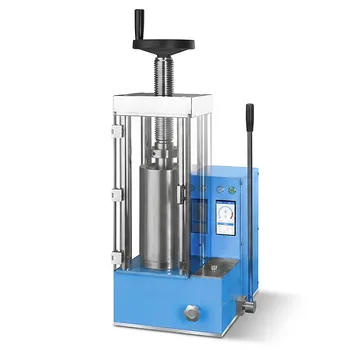
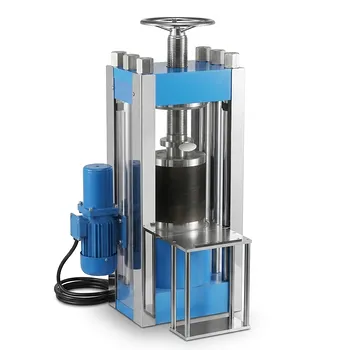
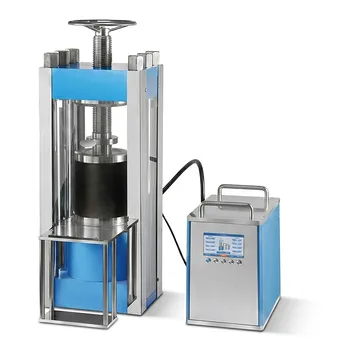
Cold isostatic presses (CIP) and laboratory pellet presses enable the fabrication of high-performance titanium dioxide ($TiO_2$) films at room temperature by replacing thermal sintering with high-pressure mechanical compression. By applying pressures of several hundred megapascals, these tools create essential "necking" connections and physical contact between nanoparticles. This process significantly improves mechanical strength and electrical conductivity without damaging heat-sensitive flexible plastic substrates.
Core Takeaway: The use of CIP or pellet presses allows for the creation of dense, highly conductive $TiO_2$ photoelectrodes on flexible materials by utilizing mechanical extrusion to achieve particle interconnectivity, effectively bypassing the need for high-temperature processing.
Overcoming the Thermal Barrier in Flexible Electronics
The Mechanism of Physical Necking
Traditional $TiO_2$ film preparation requires high-temperature sintering to fuse particles together, a process that would melt or degrade plastic substrates. Cold pressing technology uses extreme mechanical force to facilitate physical contact and necking connections between particles. This creates a cohesive network that mimics the results of thermal bonding at room temperature.
Enabling Heat-Sensitive Substrates
The primary advantage of this approach is its compatibility with flexible plastic substrates. Because the process occurs at low temperatures, engineers can develop lightweight, bendable electronics and solar cells. This expands the utility of $TiO_2$ films beyond rigid glass, allowing for the mass production of portable and wearable technology.
Improved Electron Transport Efficiency
Mechanical compression reduces the electron transport resistance within the film. By physically extruding the particles into a tighter packing arrangement, the press enhances the electrical contact between nanoparticles. This results in a high-performance photoelectrode that maintains high conductivity despite the absence of heat.
The Superiority of Isostatic vs. Axial Pressure
Eliminating Density Gradients
While a standard laboratory pellet press applies axial (unidirectional) pressure, a Cold Isostatic Press (CIP) applies uniform, omnidirectional pressure through a liquid medium. This isotropic environment ensures that the $TiO_2$ film achieves a uniform microstructure across the entire surface. It prevents the density gradients and "die wall friction" that often occur in rigid mold pressing.
Enhancing Microstructural Uniformity
CIP is particularly effective for large-scale or complex-shaped devices where uniformity is critical. The omnidirectional force ensures that every part of the thin film reaches a high relative density. This leads to superior mechanical properties and consistent electrical performance across the entire area of the flexible substrate.
Mechanical Interlocking of Particles
For irregular or non-spherical particles, the uniform pressure of CIP promotes better mechanical interlocking. This creates a more robust "green body" (the compacted film before any further processing). The result is a film with higher tensile strength and better adhesion to the underlying flexible substrate.
Understanding the Trade-offs and Limitations
Pressure-Induced Substrate Damage
While cold pressing protects substrates from heat, applying several hundred megapascals carries its own risks. If the pressure is not distributed evenly or if the substrate is too brittle, the mechanical stress can cause micro-fractures or deformations in the plastic base.
Equipment Complexity and Cost
A laboratory pellet press is relatively simple and cost-effective but is limited to small, flat samples and can produce uneven pressure distribution. In contrast, CIP systems provide superior uniformity but require specialized flexible molds and hydraulic systems, making them more complex and expensive to operate for rapid prototyping.
Limits of Mechanical Bonding
Mechanical necking, while effective, may not always reach the same level of atomic-level fusion achieved through high-temperature sintering. While conductivity is significantly improved compared to unpressed films, there may still be a slight performance gap when compared to films sintered on heat-resistant glass or ceramic.
How to Apply This to Your Project
When choosing between pressing methods for $TiO_2$ film preparation, your decision should be guided by the scale of your device and your performance requirements.
- If your primary focus is rapid prototyping of small, flat samples: Use a standard laboratory pellet press (axial) to quickly test material formulations at low cost.
- If your primary focus is large-scale uniformity or complex geometries: Utilize a Cold Isostatic Press (CIP) to ensure consistent density and eliminate electrical "dead zones" across the film.
- If your primary focus is maximizing conductivity on plastic: Prioritize higher pressures (several hundred MPa) to ensure the maximum possible physical necking between $TiO_2$ nanoparticles.
By leveraging mechanical pressure as a surrogate for heat, you can successfully bridge the gap between high-performance semiconductor properties and the physical requirements of flexible, low-temperature electronics.
Summary Table:
| Feature | Lab Pellet Press (Axial) | Cold Isostatic Press (CIP) |
|---|---|---|
| Pressure Direction | Unidirectional (Vertical) | Omnidirectional (Isotropic) |
| Microstructure | Potential density gradients | Uniform density & microstructure |
| Substrate Compatibility | Small, flat samples | Large-scale or complex shapes |
| Key Advantage | Cost-effective rapid prototyping | Eliminates "dead zones"/friction |
| Connectivity | Mechanical extrusion | Superior mechanical interlocking |
Elevate Your Flexible Semiconductor Research with KINTEK
Transitioning from brittle glass to flexible substrates requires precision and the right mechanical force. KINTEK specializes in comprehensive laboratory pressing solutions designed for cutting-edge materials science.
Whether you are developing high-efficiency $TiO_2$ photoelectrodes or advancing battery research, our range of equipment—including manual, automatic, heated, and multifunctional models, as well as cold and warm isostatic presses—provides the exact pressure needed to achieve particle necking without thermal damage.
Maximize your film conductivity and mechanical stability today. Contact our experts now to find your ideal pressing solution!
References
- Roberto C. Avilés-Betanzos, Dena Pourjafari. Low-Temperature Fabrication of Flexible Dye-Sensitized Solar Cells: Influence of Electrolyte Solution on Performance under Solar and Indoor Illumination. DOI: 10.3390/en16155617
This article is also based on technical information from Kintek Solution Knowledge Base .
Related Products
- Electric Lab Cold Isostatic Press CIP Machine
- Electric Split Lab Cold Isostatic Pressing CIP Machine
- Automatic Lab Cold Isostatic Pressing CIP Machine
- Manual Cold Isostatic Pressing CIP Machine Pellet Press
- Electric Isostatic Pressing Machine 40 Tons Automatic Laboratory Powder Compacting Press
People Also Ask
- What are the applications of electric lab cold isostatic presses in research settings? Advance Material R&D with High-Pressure CIPs
- What role do electric lab cold isostatic presses play in industrial contexts? Bridge R&D and Manufacturing with Precision
- How does electrical Cold Isostatic Pressing (CIP) contribute to cost savings? Unlock Efficiency and Reduce Expenses
- What are some research applications of electric lab CIPs? Unlock Uniform Powder Densification for Advanced Materials
- What are the characteristics of standard off-the-shelf electric lab CIP solutions? Achieve Immediate, Cost-Effective Processing