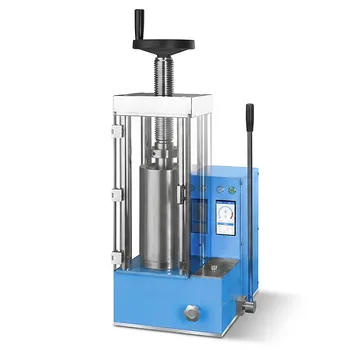
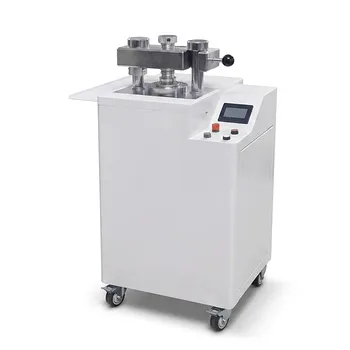
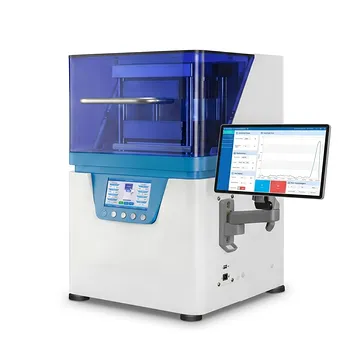
The precision pressing of 1.6 Ah pouch cells is a critical step to ensure electrochemical performance and safety. By applying a controlled, uniform force to the stacked electrode groups, a high-precision laboratory press eliminates internal air pockets and ensures tight interfacial contact between the active materials, separator, and current collectors. This mechanical optimization directly reduces internal resistance and is the foundation for achieving high energy density and long-term cycling stability.
Core Takeaway: High-precision laboratory pressing is essential because it transforms a loose stack of materials into a cohesive electrochemical unit. By ensuring uniform interfacial pressure, the machine minimizes impedance and prevents localized failures that lead to degradation.
Optimizing Interfacial Contact and Charge Transport
Reducing Interfacial Impedance
High-precision pressing ensures that the anode and cathode active materials are in tight physical contact with the separator and solid-state or liquid electrolyte interfaces. This close proximity is vital for lowering interfacial impedance, which allows electrons and ions to move more freely between layers. Without this precise pressure, microscopic gaps increase ohmic resistance and hinder the battery’s power delivery.
Enhancing Ion Transport Pathways
Uniform pressure optimizes the porosity of the electrode layers, creating consistent pathways for ion migration. By controlling the pressing force, you ensure that the ion transport paths are shortened and stabilized across the entire surface area of the 1.6 Ah cell. This uniformity prevents "bottlenecks" in charge transport that can limit the battery's rate performance.
Maintaining Structural Integrity and Safety
Eliminating Internal Voids and Air Pockets
During the stacking process, microscopic layers of air can become trapped between the electrodes and the separator. A precision press applies the exact force necessary to expel internal air, ensuring the cell volume is utilized entirely by active materials. This process not only increases energy density but also prevents the formation of "dead zones" where electrochemical reactions cannot occur.
Preventing Localized Overheating and Short Circuits
Uneven pressure can lead to localized electric field concentrations, which are primary drivers for lithium dendrite growth. By maintaining uniform interface pressure, a precision press ensures that current density is distributed evenly across the electrode film. This prevents hot spots and significantly reduces the risk of internal short circuits caused by material deformation or dendrite penetration.
Maximizing Electrochemical Efficiency
Ensuring Uniform Electrolyte Wetting
In "lean electrolyte" conditions typical of high-performance pouch cells, the electrolyte must be forced to uniformly wet the entire electrode surface. Constant stack pressure helps "wick" the electrolyte into the pores of the active materials. This ensures that every part of the 1.6 Ah capacity is utilized, preventing the heterogeneous degradation that occurs when sections of the electrode remain dry.
Achieving High Energy Density
To reach high energy densities, every millimeter of internal space must be optimized through controlled compaction. A high-precision press allows for the tightest possible assembly without damaging the delicate separator or current collectors. This precise mechanical calibration is the difference between a standard cell and one capable of high-density performance.
Evaluating Risks and Trade-offs
The Danger of Excessive Pressure
While high pressure reduces resistance, exceeding the material's mechanical limits can crush the separator or collapse the pore structure of the electrodes. If the pores are too compressed, electrolyte permeability drops, leading to a massive increase in ion transport resistance. Finding the "sweet spot" requires the accuracy that only a high-precision machine can provide.
Inconsistency in Manual or Low-Precision Equipment
Using low-precision equipment often results in non-uniform pressure distribution across the large surface area of a pouch cell. This inconsistency leads to some areas of the cell aging faster than others, causing premature capacity loss. Furthermore, burrs or edge misalignments during pressing can lead to immediate failure during the first charge cycle.
Implementing Precision Pressing in Your Assembly
Strategic Recommendations for Cell Development
Applying the right pressing strategy depends on your specific performance targets and material chemistry.
- If your primary focus is Maximizing Energy Density: Prioritize high-precision force control to achieve the thinnest possible stack while maintaining material integrity.
- If your primary focus is Long Cycle Life: Focus on pressure uniformity to prevent localized degradation and ensure consistent current distribution across all layers.
- If your primary focus is High Rate Performance: Calibrate the pressing force to optimize interfacial contact specifically to minimize ohmic and charge-transfer resistance.
Precision in the pressing stage is the fundamental bridge between theoretical material capacity and the practical performance of a 1.6 Ah pouch cell.
Summary Table:
| Key Feature | Functional Benefit | Impact on Pouch Cell Performance |
|---|---|---|
| Interfacial Contact | Reduces ohmic resistance | Enhances power delivery & efficiency |
| Void Elimination | Expels internal air pockets | Increases energy density & active volume |
| Pressure Uniformity | Even current distribution | Prevents lithium dendrites & short circuits |
| Porosity Control | Optimizes ion pathways | Improves charge/discharge rate performance |
| Electrolyte Wetting | Forces uniform distribution | Prevents heterogeneous degradation |
Elevate Your Battery Research with KINTEK Precision
Achieve unparalleled accuracy in your cell assembly with KINTEK, your partner in comprehensive laboratory pressing solutions. Whether you are developing 1.6 Ah pouch cells or next-generation solid-state batteries, our diverse range of manual, automatic, heated, and multifunctional models ensures the uniform pressure required for peak performance.
Our glovebox-compatible systems and cold/warm isostatic presses are specifically engineered to eliminate internal voids and minimize interfacial impedance. Don't let inconsistent equipment compromise your research data.
Contact KINTEK today to find the perfect press for your lab!
References
- Osman Goni Shovon, Junjie Niu. Designing Lithiophilic Lithium Metal Surface by a Hybrid Covalent Organic Framework and MXene Coating. DOI: 10.1002/smll.202501769
This article is also based on technical information from Kintek Solution Knowledge Base .
Related Products
- Lab Polygon Press Mold
- Automatic Lab Cold Isostatic Pressing CIP Machine
- Electric Isostatic Pressing Machine 40 Tons Automatic Laboratory Powder Compacting Press
- Lab Round Bidirectional Press Mold
- Button Battery Sealing Press Machine for Lab
People Also Ask
- What is the purpose of incorporating cartridge heaters into a lab press mold for MLCC block compression? Optimize Results
- How do the design and geometric precision of pressing molds and mandrels affect the quality of PTFE composite samples?
- What role do precision positioning and pressure molds play in single-lap joints? Ensure 100% Data Integrity
- What are the requirements for pressing molds when using SSCG? Key Materials for Complex Single Crystal Production
- How do industrial-grade pressure molds affect zinc metal pouch cells? Maximize Energy Density & Performance