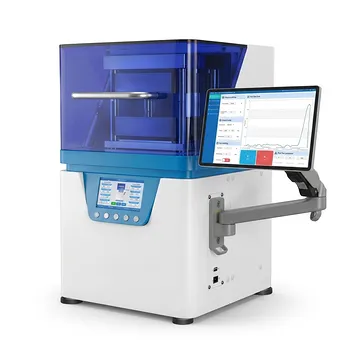
Multi-stage pressure cycles are the critical mechanism for removing entrapped air and ensuring structural homogeneity in PET test specimens. By applying sequential pressures of 20 bar and 40 bar following a 285°C preheating phase, the hydraulic press forces the polymer melt to fill the mold cavity completely. This process systematically eliminates microscopic air bubbles and internal voids, resulting in a dense internal structure and uniform thickness necessary for precise thermal analysis.
The use of multi-stage pressure cycles transforms raw PET into a standardized, pore-free medium. This eliminates physical inconsistencies that would otherwise cause erratic fluctuations in heat release rate (HRR) and total heat release (THR) measurements during cone calorimetry.
The Role of Sequential Pressure in Void Elimination
Driving Out Microscopic Air Bubbles
During the initial melting of PET granules at 285°C, air is frequently trapped between the flakes or within the viscous melt. The first stage of the cycle (20 bar) begins to compress these pockets, while the second, higher stage (40 bar) provides the force necessary to collapse microscopic bubbles entirely.
Achieving Uniform Material Density
Applying pressure in stages prevents the "crust" of the polymer from sealing off internal air pockets. A progressive increase in force ensures that the density remains consistent from the core of the 3 mm plate to its surface, preventing the density gradients that often plague single-stage compression.
Optimizing Cavity Fill and Thickness
Consistent hydraulic pressure ensures the polymer melt reaches every corner of the mold. This results in a specimen with a standardized 3 mm thickness, which is a fundamental requirement for the mathematical calculations used in cone calorimetry.
Impact on Thermal and Fire Simulation Data
Reducing Interfacial Thermal Resistance
In flame-retardant composites, air gaps at the interface of additives and the polymer matrix create thermal resistance. High, uniform pressure ensures tight bonding at these contact interfaces, allowing heat to flow predictably through the sample during testing.
Ensuring Repeatability of HRR and THR
Cone calorimetry relies on the precise measurement of oxygen consumption and heat output over time. Internal voids act as localized insulation or "fuel pockets," causing spikes or dips in data that do not reflect the material's actual properties; multi-stage pressing removes these variables.
Minimizing Internal Stress and Warping
Precise control over both the pressure stages and the subsequent cooling rate manages the crystallization process of the PET. This reduces internal residual stress, ensuring the plate remains flat and stable when exposed to the high radiant heat of the cone calorimeter.
Understanding the Trade-offs
The Risk of Thermal Degradation
Maintaining PET at 285°C for extended periods to ensure air removal can lead to polymer degradation. If the multi-stage cycle is too long, the molecular weight of the PET may decrease, potentially altering the fire behavior you are trying to measure.
Flash and Material Loss
Applying the high-pressure stage (40 bar) too early or without a properly sealed mold can cause "flash," where molten PET escapes the cavity. This not only creates a mess but can lead to a specimen that is thinner than the required 3 mm specification.
Equipment Calibration Dependencies
The success of a multi-stage cycle is entirely dependent on the precision of the hydraulic system. Even minor fluctuations in pressure or a failure to maintain the 285°C set point will result in a specimen with invisible internal flaws, undermining the reliability of the entire test series.
How to Apply This to Your Project
When preparing PET plates for thermal analysis, your protocol should prioritize the stabilization of the polymer melt before reaching peak pressure.
- If your primary focus is Data Accuracy: Strictly adhere to the 20 bar to 40 bar sequence to ensure the total elimination of microscopic voids that skew heat release data.
- If your primary focus is Specimen Repeatability: Focus on maintaining a constant cooling rate after the pressure cycle to ensure uniform crystallinity across all test batches.
- If your primary focus is Material Efficiency: Ensure your mold is perfectly sealed before the 40 bar stage to prevent material flash and maintain a precise 3 mm thickness.
By mastering the transition between these pressure stages, you ensure that your fire safety data reflects the true performance of the material rather than the flaws of its preparation.
Summary Table:
| Process Stage | Pressure/Action | Key Benefit for PET Plates |
|---|---|---|
| Preheating | 285°C | Stabilizes polymer melt for mold filling |
| Initial Stage | 20 bar | Compresses air pockets between granules |
| Final Stage | 40 bar | Eliminates microscopic bubbles & voids |
| Post-Pressing | Controlled Cooling | Minimizes internal stress and warping |
Elevate Your Material Testing Precision with KINTEK
Don't let internal voids and inconsistent density compromise your cone calorimetry data. KINTEK specializes in comprehensive laboratory pressing solutions designed for the rigorous demands of polymer and battery research.
From manual and automatic heated presses to multifunctional and glovebox-compatible models, our equipment ensures the structural homogeneity and precise 3mm thickness your project requires. We also offer advanced cold and warm isostatic presses for specialized material preparation.
Ready to optimize your specimen preparation? Contact our experts today to find the perfect hydraulic solution for your lab!
References
- Sara Villanueva, Alberto Sánchez. A Study on Phosphorous-Based Flame Retardants for Transparent PET Composites: Fire, Mechanical, and Optical Performance. DOI: 10.3390/polym17162191
This article is also based on technical information from Kintek Solution Knowledge Base .
Related Products
- Laboratory Hydraulic Press Lab Pellet Press Machine for Glove Box
- Laboratory Hydraulic Press 2T Lab Pellet Press for KBR FTIR
- 24T 30T 60T Heated Hydraulic Lab Press Machine with Hot Plates for Laboratory
- Laboratory Hydraulic Press Lab Pellet Press Button Battery Press
- Laboratory Hydraulic Pellet Press for XRF KBR FTIR Lab Press
People Also Ask
- How does a laboratory hydraulic press contribute to the preparation of Li3-3xScxSb samples? Optimize Ionic Conductivity
- What is the function of a laboratory hydraulic press in FT-IR of curcumin-coated MWCNTs? Achieve Optical Clarity.
- Why is a laboratory hydraulic press required for compression molding boron-siloxane? Solve High-Loading Density Challenges
- What role does a laboratory hydraulic press play in the preparation of piezoelectric ceramic discs for DC-PG? | KINTEK
- What role does a laboratory hydraulic press play in reaction pellets? Optimizing Lunar Soil and Metal Fuel Density