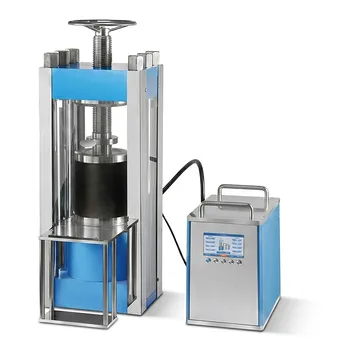
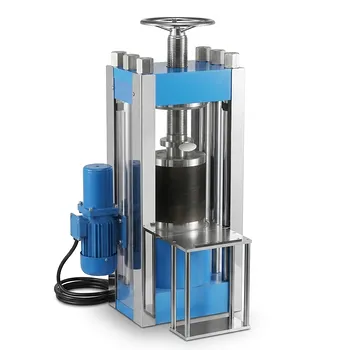
A heated laboratory press facilitates the thermal consolidation of all-keratin composites by providing synchronized temperature control and mechanical pressure to transform partially dissolved keratin. This process forces the liquefied or softened keratin to rearrange and fill the voids between undissolved wool fibers. During a specific holding time, the simultaneous application of heat and pressure promotes bonding between the regenerated keratin and the fibers, resulting in a dense bio-composite with superior mechanical strength.
Core Takeaway: The heated laboratory press is the critical tool for "thermal consolidation," a process that uses heat to soften keratin and pressure to fuse it into a pore-free, high-density structural matrix.
The Mechanism of Thermal Consolidation
Softening and Rearrangement of Keratin
The press utilizes integrated heating plates to raise the temperature of the keratin—often to approximately 60°C—which brings the material toward a state of partial dissolution or softening. This thermal energy increases the mobility of the keratin molecules, allowing them to flow more easily under load.
Mechanical Force and Gap Filling
While the keratin is in this softened state, the press applies mechanical pressure (typically between 2.2 and 3.3 bar). This force drives the regenerated keratin into the microscopic gaps between undissolved wool fibers, ensuring that the binder material is distributed evenly throughout the composite structure.
The Critical Role of Holding Time
Consolidation is not instantaneous; it requires a designated holding time under constant pressure and heat. This period allows for the diffusion of polymer chains across interfaces, strengthening the bond between the regenerated "matrix" and the fiber "reinforcement."
Enhancing Material Properties
Elimination of Internal Defects
A primary function of the heated press is to eliminate internal air bubbles and microscopic pores that can weaken a material. By applying pressure while the keratin is soft, the press expels trapped gases and volatiles, creating a significantly denser bulk sample.
Optimization of Interfacial Bonding
The simultaneous application of heat and pressure enhances the interfacial bonding strength between the different components of the composite. This ensures that when the final material is subjected to stress, the load is transferred efficiently from the matrix to the fibers, preventing premature failure.
Control Over Microscopic Morphology
By accurately adjusting the temperature and the cooling rate of the heating plates, researchers can control the crystallization behavior and microscopic morphology of the keratin. This precision is essential for achieving consistent density and predictable mechanical performance in the final bio-composite.
Understanding the Trade-offs
Thermal Degradation vs. Consolidation
While heat is necessary to soften the keratin, excessive temperatures can lead to thermal degradation of the organic fibers. Researchers must find the "sweet spot" where the temperature is high enough to facilitate flow but low enough to preserve the chemical integrity of the protein chains.
Pressure Sensitivity and Fiber Damage
Applying too much pressure can crush or deform the undissolved wool fibers, potentially reducing the composite's overall strength. Conversely, insufficient pressure leads to a porous structure with poor interfacial bonding, making the material brittle and prone to delamination.
The Complexity of Cooling Rates
The rate at which the press cools down after consolidation affects the internal stress within the sample. Rapid cooling can "lock in" stresses that lead to warping or cracking, while excessively slow cooling may lead to undesirable crystal growth or phase separation.
How to Apply This to Your Project
To achieve the best results with all-keratin composites, your processing strategy should align with your specific material requirements:
- If your primary focus is Maximum Mechanical Strength: Prioritize longer holding times at moderate pressures to ensure deep diffusion and robust interfacial bonding between the keratin phases.
- If your primary focus is Precision Testing (e.g., Thermal Conductivity): Focus on maximizing pressure during the molten phase to eliminate all microscopic pores and ensure a perfectly consistent sample density.
- If your primary focus is Material Stability: Implement a controlled, gradual cooling rate after the pressing cycle to minimize residual internal stresses and prevent structural warping.
Mastering the balance of heat, pressure, and time within a laboratory press allows for the creation of sustainable, high-performance keratin materials that rival synthetic alternatives.
Summary Table:
| Parameter | Function in Consolidation | Material Impact |
|---|---|---|
| Temperature (~60°C) | Softens and liquefies keratin molecules | Increases molecular mobility for easier flow |
| Pressure (2.2-3.3 bar) | Forces keratin into microscopic fiber gaps | Eliminates air bubbles and increases density |
| Holding Time | Facilitates polymer chain diffusion | Strengthens interfacial bonding between phases |
| Cooling Rate | Manages internal stress and morphology | Prevents warping and controls crystallization |
Unlock Precision in Your Material Research with KINTEK
Achieving the perfect balance of heat, pressure, and time is essential for high-performance bio-composites and advanced material science. KINTEK specializes in comprehensive laboratory pressing solutions tailored to your specific research needs.
Our extensive range includes:
- Manual & Automatic Heated Presses for precise thermal consolidation.
- Multifunctional & Glovebox-Compatible Models for sensitive environments.
- Cold and Warm Isostatic Presses widely applied in cutting-edge battery research.
Whether you are working on keratin composites or next-generation energy storage, KINTEK provides the reliability and control your lab demands. Contact KINTEK today to consult with our experts and find the ideal pressing solution for your application!
References
- Christa Fitz‐Binder, Thomas Bechtold. A second life for low‐grade wool through formation of all‐keratin composites in cystine reducing calcium chloride–water–ethanol solution. DOI: 10.1002/jctb.6151
This article is also based on technical information from Kintek Solution Knowledge Base .
Related Products
- 24T 30T 60T Heated Hydraulic Lab Press Machine with Hot Plates for Laboratory
- Automatic Large Format Laboratory Heated Hydraulic Press 400x400mm Plate Capacity
- Automatic Heated Hydraulic Lab Press Machine 200x200 Plate Size for Battery Research and Materials Science
- Automatic Heated Hydraulic Lab Press with Programmable Touch Screen Controls and Precision Temperature Regulation
- Heated Hydraulic Press Machine with Heated Plates for Vacuum Box Laboratory Hot Press
People Also Ask
- Why is a laboratory heated hydraulic press essential for PHB films? Achieve Flawless Material Characterization
- Why reduce load when applying composite strengthening tabs? Protect Specimen Integrity and Data Accuracy
- Function of a Laboratory Hydraulic Press with Heated Platens in SSE? Enhance Battery Density & Conductivity
- What is the critical role of a laboratory heated hydraulic press? Mastering PVC Sample Prep for Testing
- Why Use a Laboratory Heated Hydraulic Press for SSAB CCM? Optimize Solid-State Battery Interfacial Bonding