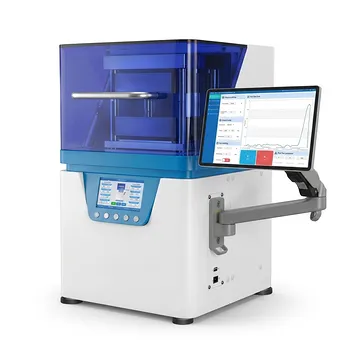
The performance of self-healing carbon fiber reinforced polymers (CFRP) depends entirely on the precision of the manufacturing environment. A laboratory hydraulic press ensures repair performance by providing uniform, constant pressure that integrates the resin matrix and carbon fibers while preventing the premature rupture of delicate self-healing microcapsules. By eliminating internal voids and maintaining structural density, the press preserves the material's latent healing potential for future damage events.
Core Takeaway: A laboratory hydraulic press acts as the critical gatekeeper of self-healing functionality by balancing high-pressure consolidation with the delicate handling of internal healing agents to ensure a defect-free, reactive composite structure.
Optimizing Internal Microstructure for Healing Efficiency
Achieving Uniform Resin Infiltration
The hydraulic press applies constant pressure to force the resin matrix to fully infiltrate the carbon fiber fabric. This ensures that the self-healing agents, whether stored in microcapsules or vascular channels, are distributed evenly throughout the laminate.
Eliminating Voids and Porosity
High-precision pressure management (often reaching up to 300 kN) effectively expels interlayer air bubbles and entrapped gases. Removing these internal voids is essential because air pockets can act as "sinks" that swallow healing agents, preventing them from reaching and sealing cracks.
Maintaining Fiber Alignment and Density
Precise directional pressure determines the packing density of the fibers and ensures they remain aligned during the curing phase. This creates a stable framework that allows healing chemistry, such as Diels-Alder reactions, to occur across consistent, well-defined interfaces.
Protecting the Self-Healing Mechanism
Preserving Healing Agent Integrity
The most critical role of the laboratory press is managing the load rate—sometimes as specific as 2.0 ± 0.5 MPa/s—to avoid crushing microcapsules. Controlled pressure ensures the capsules remain intact during molding so they are only "triggered" later by an actual structural failure.
Facilitating Chemical Re-crosslinking
For recyclable or repairable polymers, the press provides the uniform contact required for chemical bond re-crosslinking. By holding fracture surfaces in tight proximity under heat (e.g., 220°C), the equipment induces the molecular movement necessary to achieve repair efficiencies of up to 100%.
Ensuring Reproducible Experimental Data
Standardized pressure and temperature settings allow for the creation of plates with stable fiber volume content. This consistency is vital for quantitative evaluation, ensuring that any measured healing performance is due to the material's chemistry rather than manufacturing inconsistencies.
Understanding the Trade-offs
Pressure vs. Capsule Survival
Applying excessive pressure can maximize structural density but risks the premature rupture of healing capsules, rendering the self-healing property useless. Engineers must find the "sweet spot" where the pressure is high enough to eliminate voids but low enough to protect the internal healing architecture.
Thermal Management Constraints
While high temperatures facilitate resin flow and chemical bonding, excessive heat during the press cycle can degrade certain healing agents. The hydraulic press must offer precision-engineered thermal control to stay within the narrow window where the resin cures without neutralizing the healing chemistry.
Dimensional Stability vs. Internal Stress
Rapid cooling or uneven pressure distribution during the press cycle can introduce residual stresses into the CFRP. These internal stresses can cause micro-cracking, which might "exhaust" the self-healing agents before the material even enters service.
Making the Right Choice for Your Goal
To maximize the performance of self-healing CFRPs, the laboratory press parameters must be tailored to the specific healing chemistry being utilized.
- If your primary focus is maximizing healing efficiency: Use a press with high-precision load rate control to ensure self-healing microcapsules survive the consolidation process intact.
- If your primary focus is structural peak strength: Prioritize high-pressure settings (up to 140 kg/cm²) and vacuum-assisted heating plates to eliminate all internal porosity.
- If your primary focus is recyclability (Diels-Alder): Ensure the press can maintain consistent high temperatures and uniform surface contact to facilitate chemical bond re-crosslinking.
Precise control over the physical environment during molding is the only way to transform a high-performance polymer into a reliable, self-repairing structural component.
Summary Table:
| Key Feature | Impact on Self-Healing CFRP | Main Benefit |
|---|---|---|
| Uniform Pressure | High resin infiltration & density | Eliminates voids that trap healing agents |
| Load Rate Control | Prevents microcapsule crushing | Ensures healing agents remain reactive |
| Precision Heating | Facilitates molecular re-crosslinking | Achieves up to 100% repair efficiency |
| Fiber Alignment | Maintains stable internal framework | Enhances structural integrity & consistency |
Elevate Your Composite Research with KINTEK
Precision is the backbone of high-performance material science. KINTEK specializes in comprehensive laboratory pressing solutions designed to meet the rigorous demands of self-healing polymer and battery research. From manual and automatic heated presses to multifunctional glovebox-compatible models and isostatic presses (CIP/WIP), our equipment provides the exact pressure and thermal control needed to protect delicate internal structures while maximizing structural density.
Don't let manufacturing inconsistencies compromise your results. Contact our specialists today to discover how KINTEK can enhance your lab's efficiency and ensure the success of your next-generation material projects.
References
- Mahesh Yadlapati. Self-Healing Materials: A Breakthrough in Material Science. DOI: 10.37745/ejcsit.2013/vol13n125261
This article is also based on technical information from Kintek Solution Knowledge Base .
Related Products
- Laboratory Hydraulic Press Lab Pellet Press Button Battery Press
- Laboratory Hydraulic Press 2T Lab Pellet Press for KBR FTIR
- Laboratory Hydraulic Press Lab Pellet Press Machine for Glove Box
- 24T 30T 60T Heated Hydraulic Lab Press Machine with Hot Plates for Laboratory
- Automatic Laboratory Hydraulic Press Lab Pellet Press Machine
People Also Ask
- How is a laboratory hydraulic press used for HAP composite gels? Master Mineral Substrate Standardization
- What role does a laboratory hydraulic press play in the preparation of piezoelectric ceramic discs for DC-PG? | KINTEK
- What role does a laboratory hydraulic press play in reaction pellets? Optimizing Lunar Soil and Metal Fuel Density
- What role does a laboratory hydraulic press play in the assembly of all-solid-state battery test cells? Expert Guide
- Why is a laboratory hydraulic press required for PBAT and PLA sample preparation? Achieve Flawless Characterization