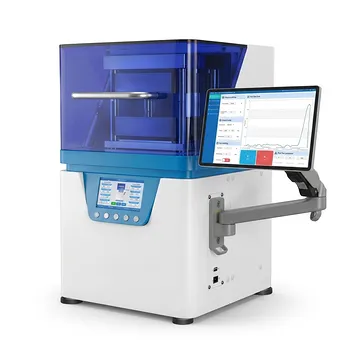
The structural integrity of cellulose-based actuators depends almost entirely on the initial compaction phase. A laboratory hydraulic press ensures quality by applying precise, uniform pressure to cellulose powders or fiber layers, effectively eliminating internal micro-voids and density gradients. This process facilitates the physical bonding of particles and aligns molecular chains, creating a stable "green body" that resists cracking or warping during subsequent swelling, drying, or electrochemical activation.
Core Takeaway: The laboratory hydraulic press serves as the foundational tool for actuator performance by transforming loose cellulose material into a dense, anisotropic preform through controlled mechanical force and stable pressure maintenance.
Engineering the Microstructure for Performance
Eliminating Internal Defects
The primary function of the press is to provide uniform and adjustable pressure that forces cellulose composite powders or fiber layers into a fully compacted state. By removing micro-voids, the press prevents the actuator from developing structural "weak points" that could lead to failure.
This compaction is essential because any remaining air pockets or density variations will cause non-uniform deformation. When the actuator is later subjected to electric fields or moisture, these defects often manifest as catastrophic cracks or unpredictable warping.
Facilitating Molecular Rearrangement
Beyond simple compaction, the vertical compressive force regulates the internal microstructure of cellulose gels. The pressure forces molecular chains to rearrange and pack closely along the direction of the applied force.
This force-guided action constructs an anisotropic physical network. This directional alignment is critical for actuators, as it enhances compressive strength and ensures the material responds predictably to external stimuli.
Ensuring Structural Stability and Precision
Mitigating Density Gradients
A laboratory press allows powder particles to overcome internal friction, enabling them to slide into a dense packing arrangement. This minimizes density gradients within the mold, ensuring the material is equally strong throughout its entire volume.
By achieving a uniform density, the manufacturer provides a foundation for uniform shrinkage during later sintering or drying processes. This precision ensures that the final dimensions of the actuator remain within strict experimental tolerances.
Enhancing Yield Through Pressure Holding
High-quality laboratory presses feature an automatic pressure-holding function that maintains a constant state of extrusion. This compensates for minor pressure losses that occur as particles undergo plastic deformation or air escapes the mold.
Stable pressure holding allows for the release of internal gases and prevents lamination, a common defect where layers separate. This function significantly increases the sample yield and ensures the structural integrity of the preform during the delicate demolding process.
Understanding the Trade-offs
Manual vs. Automatic Systems
While manual presses offer a lower entry cost, they often struggle with pressure consistency. Human error in pumping can lead to pressure fluctuations, which may cause internal stress and subsequent "layer cracking" when the pressure is released.
Over-Compaction Risks
Applying excessive pressure can be as detrimental as applying too little. Over-compaction can crush cellulose fibers or create a preform so dense that it inhibits the diffusion of ions or moisture, effectively "killing" the actuator's ability to move or respond to stimuli.
Pressure Release Velocity
The speed at which pressure is released is a critical variable. A rapid pressure release can cause the compressed air trapped within the particles to expand suddenly, leading to explosive decompression or fine surface fractures that compromise the actuator's longevity.
How to Apply This to Your Project
When utilizing a laboratory hydraulic press for cellulose-based actuator production, your approach should vary based on your specific material and intended use.
- If your primary focus is mechanical longevity: Prioritize the automatic pressure-holding feature to ensure maximum density and the complete elimination of internal micro-voids.
- If your primary focus is rapid response time: Use moderate pressure settings to maintain a degree of porosity, allowing for faster ion transport or moisture absorption during activation.
- If your primary focus is complex directional movement: Focus on the anisotropic alignment of molecular chains by using high-precision molds that allow for uniform vertical force distribution.
By mastering the precise application of hydraulic force, you transform raw cellulose into a high-performance material capable of reliable, repeatable actuation.
Summary Table:
| Feature/Function | Benefit to Preform | Impact on Actuator Performance |
|---|---|---|
| Uniform Pressure | Eliminates micro-voids & defects | Prevents cracking and unpredictable warping |
| Molecular Alignment | Creates an anisotropic network | Ensures predictable directional response |
| Pressure Holding | Minimizes density gradients | Guarantees uniform shrinkage and high yield |
| Controlled Release | Prevents internal lamination | Increases structural longevity and durability |
Elevate Your Material Research with KINTEK
Precision is the foundation of high-performance cellulose actuators. KINTEK specializes in comprehensive laboratory pressing solutions designed to meet the rigorous demands of battery research and material science.
From manual and automatic models to heated, multifunctional, and glovebox-compatible presses, our equipment provides the stability and control necessary for perfect preform compaction. We also offer advanced cold and warm isostatic presses for specialized applications requiring extreme density uniformity.
Ready to enhance your lab's output and ensure experimental consistency?
Contact KINTEK today to find the perfect pressing solution for your project.
References
- Francisco Elmano Marques de Sousa, Ana P. C. Almeida. When Cellulose Moves: Smart Sensors and Actuators. DOI: 10.1002/admt.202501426
This article is also based on technical information from Kintek Solution Knowledge Base .
Related Products
- Laboratory Hydraulic Press Lab Pellet Press Button Battery Press
- Laboratory Hydraulic Press 2T Lab Pellet Press for KBR FTIR
- Laboratory Hydraulic Press Lab Pellet Press Machine for Glove Box
- 24T 30T 60T Heated Hydraulic Lab Press Machine with Hot Plates for Laboratory
- Automatic Laboratory Hydraulic Press Lab Pellet Press Machine
People Also Ask
- How is a laboratory hydraulic press used for HAP composite gels? Master Mineral Substrate Standardization
- What role does a laboratory hydraulic press play in reaction pellets? Optimizing Lunar Soil and Metal Fuel Density
- What role does a laboratory hydraulic press play in the preparation of piezoelectric ceramic discs for DC-PG? | KINTEK
- Why is a laboratory hydraulic press required for PBAT and PLA sample preparation? Achieve Flawless Characterization
- What role does a laboratory hydraulic press play in the assembly of all-solid-state battery test cells? Expert Guide