Hot-pressing equipment transforms oxysulfide microstructures by shifting from simple mechanical compaction to thermal-mechanical fusion. This process utilizes a controlled thermal field to induce viscous flow and atomic-level diffusion, reducing internal porosity from approximately 16.5% to below 6.6%. By eliminating grain boundaries and creating a dense, "melt-like" cross-section, hot-pressing significantly enhances ionic conductivity and mechanical resistance to dendrite penetration.
Core Takeaway: While cold-pressing relies on physical particle deformation to create transport channels, hot-pressing uses heat to achieve a quasi-continuous solid state. This results in nearly halved interfacial resistance and a structural density that cold-pressing cannot achieve alone.
The Mechanism of Structural Transformation
Transition from Physical Contact to Viscous Flow
Hot-pressing equipment applies simultaneous heat (often up to 450°C) and pressure (e.g., 80 MPa) to the electrolyte powder.
Unlike cold-pressing, which simply deforms soft sulfide particles to fill voids, the thermal field allows the material to reach a viscous flow state.
This flow enables the electrolyte to migrate into microscopic gaps that mechanical pressure alone cannot reach, creating a seamless integration of particles.
Atomic-Level Bonding and Diffusion
The synergy of temperature and pressure facilitates atomic diffusion across particle interfaces.
This process transitions the material from a collection of compressed grains into a unified monolithic structure.
This fusion effectively eliminates grain boundaries, which are traditional bottlenecks for ion transport and potential sites for structural failure.
Quantifiable Improvements in Microstructure
Radical Reduction in Internal Porosity
One of the most critical advantages of hot-pressing is the dramatic reduction in internal void volume.
Research indicates that hot-pressing can reduce porosity from 16.5% in cold-pressed samples to less than 6.6%.
This high-density structure is essential for preventing the physical infiltration of metal dendrites during electrochemical cycling.
Optimization of Ion Transport Channels
By creating a "melt-like" cross-section, hot-pressing establishes quasi-continuous ion transport channels.
This structural refinement can lower interfacial resistance significantly—for instance, from 45.81 Ω down to 25.10 Ω.
Consequently, ionic conductivity is elevated to levels such as 1.15 × 10⁻³ S/cm, supporting higher power densities in the final battery cell.
Impact on Interfacial Integrity
Enhanced Mechanical Adhesion
Hot-pressing improves the mechanical interlocking force between the electrolyte and the electrode or current collector.
This creates a tighter interface contact that prevents delamination during the volume expansion and contraction of charge-discharge cycles.
The process also increases the mechanical toughness of the electrolyte layer, making the entire cell more resilient to bending and physical stress.
Integration of Polymer Binders
When electrolytes include polymer binders, hot-pressing allows these binders to reach their softening points.
The liquefied binder flows to fill remaining gaps between particles, further reducing interface impedance.
This results in a more robust electrolyte membrane that is less likely to crack or shed material during manufacturing or use.
Understanding the Trade-offs
Complexity and Energy Requirements
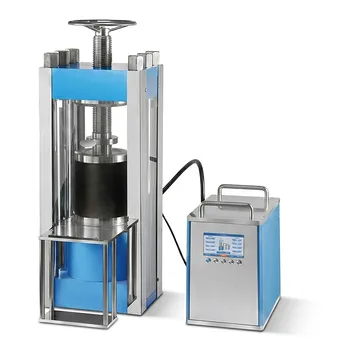
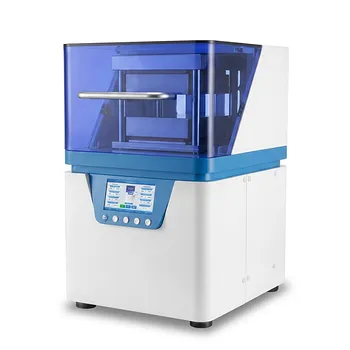
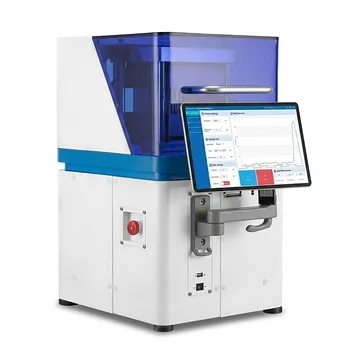
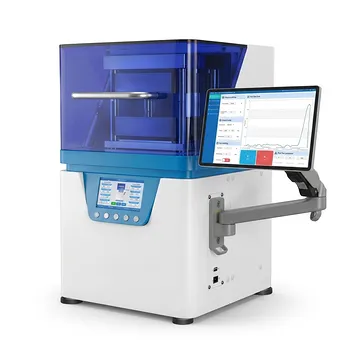
Hot-pressing requires specialized heated hydraulic presses and precise temperature control, increasing the complexity of the lab setup compared to standard room-temperature presses.
The process is more energy-intensive and requires longer cycle times to allow for the thermal equilibrium and subsequent cooling of the material.
Material Stability Concerns
Not all electrolyte chemistries are compatible with high-temperature processing; some oxysulfides may undergo phase transitions or decomposition if the thermal field is not strictly managed.
While cold-pressing is less effective at densification, its simplicity and low thermal footprint make it highly compatible with large-scale, high-speed production environments where "good enough" conductivity is acceptable.
How to Apply This to Your Project
Selecting the Right Process for Your Goal
- If your primary focus is maximizing ionic conductivity: Utilize hot-pressing at temperatures near 450°C to eliminate grain boundaries and achieve a "melt-like" microstructure.
- If your primary focus is preventing dendrite growth: Employ hot-pressing to ensure porosity remains below 7%, creating a dense physical barrier that inhibits metal penetration.
- If your primary focus is rapid prototyping or high-throughput assembly: Stick to cold-pressing with high-pressure hydraulic equipment to leverage the natural plasticity of sulfide materials without the delay of heating cycles.
- If your primary focus is improving interface mechanical stability: Use a heated press to allow polymer binders to flow, ensuring the electrolyte membrane adheres strongly to the electrode.
The choice between hot and cold pressing ultimately depends on whether your application demands the absolute theoretical limits of electrolyte density or the manufacturing simplicity of room-temperature processing.
Summary Table:
| Feature | Cold-Pressing Process | Hot-Pressing Process |
|---|---|---|
| Mechanism | Mechanical compaction & deformation | Viscous flow & atomic diffusion |
| Porosity | High (~16.5%) | Low (<6.6%) |
| Structure | Compressed grains | Unified monolithic/melt-like |
| Ionic Conductivity | Lower | Higher (e.g., 1.15 × 10⁻³ S/cm) |
| Interfacial Resistance | Higher (~45.81 Ω) | Significantly Lower (~25.10 Ω) |
| Dendrite Resistance | Moderate | Superior due to high density |
Elevate Your Battery Research with KINTEK
Unlock the full potential of your solid-state electrolytes with KINTEK’s precision laboratory pressing solutions. Whether your research demands the extreme density of hot-pressing to eliminate grain boundaries or the rapid throughput of manual and automatic cold-pressing, we provide the specialized equipment you need to succeed.
Our Comprehensive Range Includes:
- Manual, Automatic, and Heated Hydraulic Presses
- Multifunctional and Glovebox-Compatible Models
- Cold and Warm Isostatic Presses (CIP/WIP)
Don't settle for high porosity and low conductivity. Contact KINTEK today to find the perfect pressing solution for your battery material innovations!
References
- Hernando J. Gonzalez Malabet, Thomas A. Yersak. Improved Thermal Stability of Oxysulfide Glassy Solid-State Electrolytes. DOI: 10.1149/1945-7111/ad07ff
This article is also based on technical information from Kintek Solution Knowledge Base .
Related Products
- Warm Isostatic Press for Solid State Battery Research Warm Isostatic Press
- Automatic Laboratory Hydraulic Press for XRF and KBR Pellet Pressing
- Automatic High Temperature Heated Hydraulic Press Machine with Heated Plates for Lab
- Automatic Hydraulic Hot Press with Large Plate and Precision Temperature Control for Advanced Material Sample Preparation and Industrial Research
- Automatic Heated Hydraulic Press Machine with Hot Plates for Laboratory
People Also Ask
- Why must composite cathodes be sealed in vacuum lamination bags for WIP? Ensure Battery Stability and Density
- What is the function of elastic molds in warm isostatic pressing? Achieve Uniform Density in Composite Particles
- How do sacrificial volume materials (SVM) maintain microchannels in isostatic pressing? Ensure Structural Integrity
- What is the role of the flexible material in warm isostatic pressing? Key to Uniform Density & Precision
- What is the function of hydraulic pressure in warm isostatic pressing? Achieve Uniform Material Density