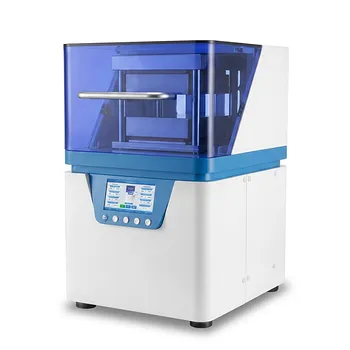
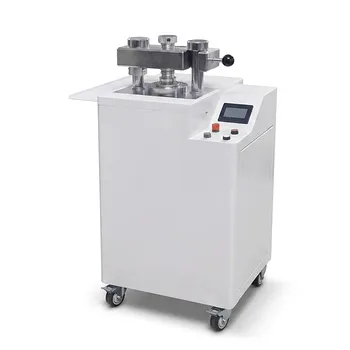
While often valued for their simplicity, the primary drawbacks of using hand presses stem from their manual operation and limited technical capabilities compared to hydraulic alternatives. Specifically, they are physically demanding to use frequently, lack the necessary air evacuation efficiency for high-quality results, and produce samples that are generally unsuitable for long-term preservation.
Hand presses are generally ill-suited for high-volume production or creating samples requiring long-term stability due to inferior air evacuation and the significant physical labor required for manual operation.
Operational Constraints
The Burden of Manual Labor
Because these devices rely entirely on manual operation, they demand physical effort from the operator for every cycle.
This reliance on human force makes the process physically intensive. It can lead to operator fatigue, making the tool impractical for continuous use.
Impact on Productivity
The labor-intensive nature of hand presses directly negatively impacts workflow efficiency.
If used frequently, the time and effort required to operate the press can create bottlenecks. This results in significantly lower productivity compared to automated or hydraulic systems.
Quality and Performance Limitations
Compromised Evacuation Efficiency
A critical technical limitation is the press's ability to remove air from the sample.
Evacuation efficiency in hand presses is often non-existent or significantly lower than that of hydraulic presses designed for similar tasks. This can result in trapped air pockets that compromise the sample's homogeneity.
Unsuitability for Long-Term Storage
Due to lower pressure capabilities and poor evacuation, the resulting samples often lack the density or integrity required for archival purposes.
Hand presses are explicitly unsuitable for creating samples intended for long-term storage. Samples produced this way may degrade or fail to maintain their structure over extended periods.
Understanding the Trade-offs
Hand Presses vs. Hydraulic Systems
When evaluating a hand press, it is crucial to understand what you are sacrificing for simplicity.
While hand presses avoid the complexity of hydraulic systems, they lack the force and consistency required for rigorous scientific or industrial applications.
If your application requires uniform density or high throughput, the manual limitations of a hand press become a significant liability rather than a cost-saving feature.
Making the Right Choice for Your Goal
To ensure your equipment matches your laboratory needs, consider the following regarding the use of hand presses:
- If your primary focus is sample longevity: You should use a hydraulic press, as hand presses are unsuitable for creating samples intended for long-term storage.
- If your primary focus is workflow efficiency: Avoid hand presses for frequent use, as their manual operation is labor-intensive and will lower overall productivity.
Selecting the correct press requires balancing your need for simplicity against the strict requirements for sample quality and throughput.
Summary Table:
| Feature | Hand Press Limitations | KINTEK Hydraulic Solutions |
|---|---|---|
| Operation | Physically demanding manual labor | Effortless automatic or hydraulic operation |
| Productivity | Low; prone to operator fatigue | High; optimized for frequent/continuous use |
| Air Evacuation | Non-existent or very low efficiency | Superior vacuum integration for homogeneity |
| Sample Quality | Poor; unsuitable for long-term storage | High-density results ideal for archival |
| Force Consistency | Variable based on human effort | Precise, repeatable pressure control |
Upgrade Your Lab with KINTEK Pressing Solutions
Don't let manual limitations compromise your research quality or workflow efficiency. KINTEK specializes in comprehensive laboratory pressing solutions designed to meet the rigorous demands of modern battery research and material science.
Whether you need manual, automatic, heated, or glovebox-compatible models, or advanced cold and warm isostatic presses, we provide the precision and power you need to ensure sample longevity and uniform density.
Ready to boost your productivity? Contact us today to find the perfect press for your laboratory applications!
Related Products
- Laboratory Manual Heated Hydraulic Press Machine with Hot Plates
- Manual Laboratory Hydraulic Press Lab Pellet Press
- Automatic Hydraulic Hot Press with Large Plate and Precision Temperature Control for Advanced Material Sample Preparation and Industrial Research
- Manual Heated Hydraulic Lab Press with Integrated Hot Plates Hydraulic Press Machine
- Automatic Hydraulic Heat Press Machine with Multi Stage Programmable Control and Integrated Water Cooling Plate Size 180x180mm
People Also Ask
- Why is a laboratory hydraulic press with heating plates required for PLA/TEC films? Achieve Precise Sample Integrity
- Function of a Laboratory Hydraulic Press with Heated Platens in SSE? Enhance Battery Density & Conductivity
- Why is a manual hydraulic heated lab press essential for compleximer materials? Unlock Advanced Material Synthesis
- What is the primary objective of using a laboratory manual hydraulic press at 20 MPa? Achieve Perfect Green Body Shaping
- How does a laboratory manual hydraulic press assist in powder canning? Maximize Density and Structural Integrity