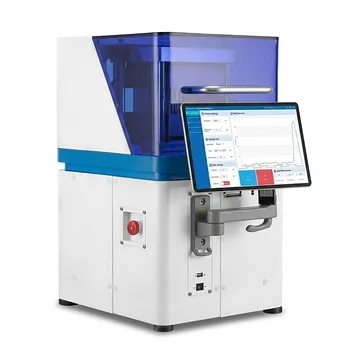
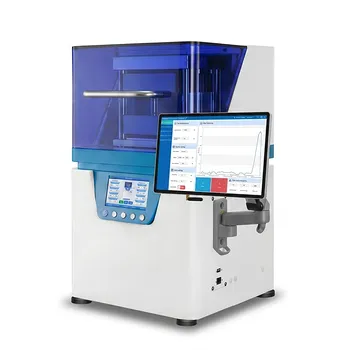
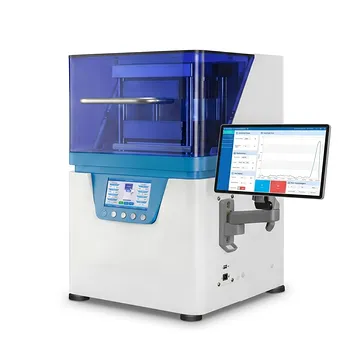
The laboratory press is a critical tool for the densification and structural refinement of chitin nanofiber films. Specifically, it is used as a post-treatment step after film formation to apply precisely controlled heat and pressure. This process eliminates internal voids, increases physical cross-linking between fibers, and transforms the material into a high-performance substrate suitable for advanced electronics and sensing applications.
Core Takeaway: Applying a laboratory press to chitin nanofiber films transitions them from porous, fragile mats into dense, transparent, and mechanically robust membranes by optimizing their internal microstructure.
Structural Refinement and Densification
Elimination of Internal Micropores
Chitin films formed via vacuum filtration often contain residual micropores and voids that can weaken the structure. The laboratory press applies mechanical force to collapse these gaps, creating a more continuous and uniform material.
Inducing Physical Cross-linking
By applying pressure at elevated temperatures, the press increases the physical cross-linking density between individual nanofibers. This reorganization of the fiber network is essential for achieving long-term structural stability and durability.
Fiber Flattening and Shrinkage
Controlled heating (often between 120°C and 160°C) induces physical shrinkage and flattens the nanofibers within the support layer. This flattening effect increases the surface density, making the film less permeable and more robust.
Enhancing Material Performance
Optimization of Optical Transparency
As the laboratory press eliminates light-scattering voids and cracks, the optical transparency of the chitin film increases significantly. This makes the films ideal for use as transparent substrates in optoelectronic devices or clear sensor windows.
Improving In-plane Mechanical Modulus
The densification process directly enhances the in-plane mechanical modulus, providing the stiffness required for bio-based electronics. It also strengthens the mechanical bonding between the nanofiber layer and any auxiliary substrates, such as non-woven fabrics.
Creating Bases for Selective Layers
For filtration applications, a laboratory press ensures a defect-free surface that is critical for the deposition of secondary layers. For example, a densified chitin support is necessary for forming a continuous polyamide (PA) ultra-thin selective layer.
Understanding the Trade-offs
Thermal Degradation Risks
While heat is necessary for fiber flattening, chitin is a biological polymer that can undergo thermal degradation if exposed to excessive temperatures for too long. Technical advisors must balance the need for densification with the material’s specific thermal stability limits.
Pressure-Induced Brittleness
Over-pressing a chitin film can lead to excessive densification, which may result in a loss of flexibility. Finding the "sweet spot" in pressure is vital to ensure the film remains pliable enough for flexible electronic applications without cracking.
Complexity in Scale-up
Laboratory presses are excellent for R&D and short production runs, but the batch nature of the process can be a bottleneck. Transitioning these specific heat and pressure parameters to a continuous roll-to-roll process requires significant engineering adjustments.
How to Apply This to Your Project
When integrating a laboratory press into your chitin film workflow, your parameters should be dictated by the final application of the material.
- If your primary focus is optical clarity: Prioritize higher temperatures (within the stability range) and moderate pressure to fully eliminate light-scattering micropores.
- If your primary focus is mechanical strength: Focus on maximizing pressure to increase the physical cross-linking density and fiber-to-fiber contact.
- If your primary focus is membrane filtration: Use the press specifically to reduce average pore size and create a smooth surface for the application of selective coatings.
By mastering the variables of pressure and temperature, you can tailor the fundamental properties of chitin nanofibers to meet the rigorous demands of modern bio-material engineering.
Summary Table:
| Application Category | Key Improvement | Technical Outcome |
|---|---|---|
| Structural Refinement | Pore Elimination | High surface density & continuous microstructure |
| Optical Performance | Increased Transparency | Clear substrates for optoelectronics & sensors |
| Mechanical Properties | Enhanced Strength | Higher in-plane modulus & physical cross-linking |
| Surface Engineering | Base Preparation | Defect-free surface for ultra-thin selective layers |
Elevate Your Bio-Material Research with KINTEK
Precision is paramount when transforming chitin nanofibers into high-performance membranes. KINTEK specializes in comprehensive laboratory pressing solutions tailored for demanding R&D environments.
Our extensive range includes manual, automatic, heated, multifunctional, and glovebox-compatible models, as well as cold and warm isostatic presses—versatile tools widely applied in battery research and advanced materials science. Whether you need to eliminate light-scattering voids or optimize mechanical modulus, our equipment provides the controlled heat and pressure essential for your success.
Contact KINTEK today to find the perfect press for your lab and experience the benefits of superior densification and material refinement.
References
- Jun‐ichi Kadokawa. A Mini-Review: Fabrication of Polysaccharide Composite Materials Based on Self-Assembled Chitin Nanofibers. DOI: 10.3390/ma17081898
This article is also based on technical information from Kintek Solution Knowledge Base .
Related Products
- Laboratory Hydraulic Press Lab Pellet Press Button Battery Press
- Laboratory Hydraulic Press Lab Pellet Press Machine for Glove Box
- Laboratory Hydraulic Pellet Press for XRF KBR FTIR Lab Press
- Laboratory Split Manual Heated Hydraulic Press Machine with Hot Plates
- Laboratory Hydraulic Split Electric Lab Pellet Press
People Also Ask
- How is a laboratory hydraulic press used for HAP composite gels? Master Mineral Substrate Standardization
- What role does a laboratory hydraulic press play in the preparation of piezoelectric ceramic discs for DC-PG? | KINTEK
- What role does a laboratory hydraulic press play in reaction pellets? Optimizing Lunar Soil and Metal Fuel Density
- Why is a laboratory hydraulic press required for PBAT and PLA sample preparation? Achieve Flawless Characterization
- What role does a laboratory hydraulic press play in the assembly of all-solid-state battery test cells? Expert Guide