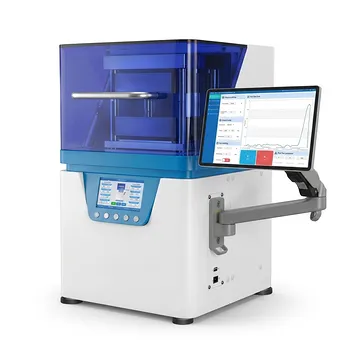
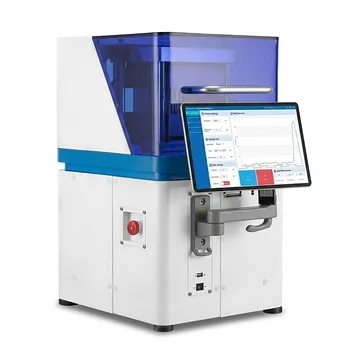
The primary function of a laboratory hydraulic press is to transform synthesized nanopowders into uniform, high-density "green bodies" or thin pellet samples. This compression process ensures that the material achieves a standardized physical form with uniform internal density and a surface free of micro-cracks or voids.
A laboratory hydraulic press provides the precise, stable pressure required to eliminate physical inconsistencies in nanopowders, creating standardized samples that yield reliable, repeatable data for electrical characterization and structural analysis.
Transforming Nanopowders into Structural Solids
Achieving Density Uniformity and Structural Integrity
At the nanoscale, powders are often loose and contain significant air pockets that can skew experimental results. A hydraulic press applies precise and stable pressure to consolidate these materials, ensuring a uniform internal density throughout the sample.
This consolidation is vital for preventing micro-cracks, which can compromise the mechanical strength of the sample. By eliminating internal voids, the press ensures that the resulting "green body" is structurally sound enough for handling and further testing.
Creating Standardized Geometries for Analysis
Precision in nano-electronic research requires that every sample have a fixed shape and smooth surface. The press allows researchers to produce pellets of consistent thickness and flatness, which is a prerequisite for accurate physical and chemical performance analysis.
Standardization effectively minimizes measurement errors that would otherwise arise from variations in the physical form of the samples. This consistency is particularly critical when generating high-quality datasets for training AI models used in materials discovery.
The Impact on Performance Characterization
Enhancing Electrical and Electrochemical Contact
For nano-electronic materials, the quality of the electrical interface is paramount. By compressing powders into high-density pellets, the press ensures tight physical contact between nanoparticles, which directly improves electrical conductivity and electrochemical stability.
This process is a critical precursor for solid-state electrochemical testing. Without the high-pressure consolidation provided by the press, the internal resistance of the material would be artificially high, leading to inaccurate performance data.
Optimizing Optical and Spectroscopic Clarity
In techniques such as FT-IR (Fourier-Transform Infrared Spectroscopy) and XRF (X-ray Fluorescence), sample uniformity is non-negotiable. The press creates thin, translucent flakes or pellets that allow for uniform light transmission.
By removing air pockets and ensuring a flat surface, the press prevents signal scattering. This results in cleaner spectra and more accurate identification of the material's chemical composition and surface morphology.
Understanding the Trade-offs
Balancing Pressure and Structural Fragility
Applying too much pressure can lead to lamination or "capping," where the pellet splits into layers upon release from the die. Conversely, insufficient pressure results in a fragile sample that lacks the density required for accurate electrical characterization.
Risks of Contamination and Deformation
The use of steel dies under high pressure introduces a risk of cross-contamination if the equipment is not meticulously cleaned between samples. Additionally, some soft nano-materials may undergo unintended phase changes or plastic deformation if the pressure is applied too rapidly or intensely.
Making the Right Choice for Your Research
To achieve the best results in sample preparation, align your pressing parameters with your specific analytical goals:
- If your primary focus is Electrical Characterization: Prioritize maximum density and nanoparticle contact to ensure accurate conductivity and electrochemical stability measurements.
- If your primary focus is Spectroscopic Analysis (FT-IR/XRF): Focus on achieving consistent pellet thickness and a mirror-like surface finish to ensure optimal signal-to-noise ratios.
- If your primary focus is AI-Driven Materials Discovery: Implement a highly standardized pressing protocol to ensure that all training data is derived from samples with identical physical geometries.
By mastering the precise application of pressure, you ensure that your research is built upon a foundation of structural integrity and data reliability.
Summary Table:
| Function | Objective | Research Impact |
|---|---|---|
| Powder Consolidation | Create high-density "green bodies" | Eliminates micro-cracks and internal voids |
| Geometric Standardization | Produce uniform pellet thickness/flatness | Minimizes measurement errors for AI and analysis |
| Electrical Enhancement | Improve nanoparticle physical contact | Ensures accurate conductivity and electrochemical data |
| Optical Optimization | Create translucent, smooth flakes | Prevents signal scattering in FT-IR and XRF testing |
Elevate Your Research with Precision Pressing Solutions
Unlock the full potential of your nano-electronic and battery research by ensuring superior sample integrity. KINTEK specializes in comprehensive laboratory pressing solutions tailored to your specific needs. Our diverse range includes:
- Manual & Automatic Presses for routine pelletizing.
- Heated & Multifunctional Models for complex material synthesis.
- Glovebox-Compatible Systems for air-sensitive research.
- Cold & Warm Isostatic Presses for uniform 360-degree consolidation.
Whether you are refining electrical characterization or training AI models for materials discovery, KINTEK provides the stable, precise pressure required for repeatable results.
Contact KINTEK today to find the perfect press for your laboratory.
References
- Santhosh Sivasubramani, Shiwei Wang. Reaching new frontiers in nanoelectronics through artificial intelligence. DOI: 10.3389/fnano.2025.1627210
This article is also based on technical information from Kintek Solution Knowledge Base .
Related Products
- Laboratory Hydraulic Press Lab Pellet Press Button Battery Press
- Laboratory Hydraulic Press 2T Lab Pellet Press for KBR FTIR
- Laboratory Hydraulic Press Lab Pellet Press Machine for Glove Box
- 24T 30T 60T Heated Hydraulic Lab Press Machine with Hot Plates for Laboratory
- Automatic Laboratory Hydraulic Press Lab Pellet Press Machine
People Also Ask
- How is a laboratory hydraulic press used for HAP composite gels? Master Mineral Substrate Standardization
- What role does a laboratory hydraulic press play in reaction pellets? Optimizing Lunar Soil and Metal Fuel Density
- What role does a laboratory hydraulic press play in the preparation of piezoelectric ceramic discs for DC-PG? | KINTEK
- Why is a laboratory hydraulic press required for PBAT and PLA sample preparation? Achieve Flawless Characterization
- What role does a laboratory hydraulic press play in the assembly of all-solid-state battery test cells? Expert Guide