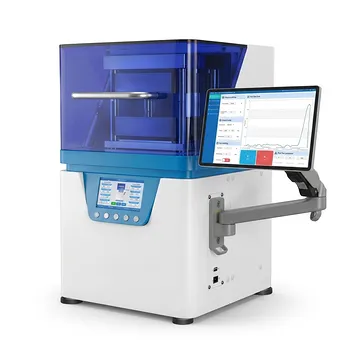
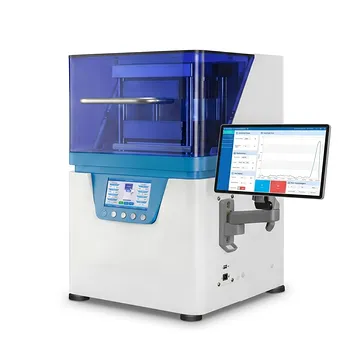
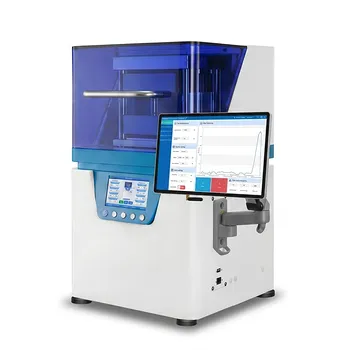
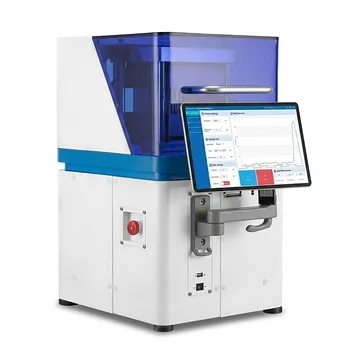
In the assembly of all-solid-state lithium metal batteries (ASLMBs), the laboratory hydraulic press serves as the critical tool for establishing intimate solid-solid contact. It provides the high, uniform, and controlled mechanical pressure necessary to force the solid electrolyte and the lithium metal anode together. By eliminating microscopic gaps at these interfaces, the press ensures efficient ion transport and prevents the mechanical failures typically associated with solid-state chemistry.
Core Takeaway: The laboratory hydraulic press is essential for reducing interfacial impedance and suppressing lithium dendrite growth by transforming loose or separate components into a dense, continuous electrochemical system.
Establishing the Interface for Ion Transport
Reducing Interfacial Impedance
In solid-state batteries, ions cannot travel through a liquid medium; they must hop between solid particles. The hydraulic press applies massive pressure—often ranging from 100 MPa to 300 MPa—to minimize the contact resistance between the electrode and the electrolyte.
Without this external force, the high resistance at the interface would severely hinder lithium-ion flux, leading to a sharp decline in battery performance and efficiency.
Eliminating Interfacial Micro-voids
Even seemingly smooth surfaces have microscopic irregularities that create gaps or micro-voids when joined. A laboratory hydraulic press forces these materials into tight physical contact, effectively "healing" the interface.
This step is vital because micro-voids serve as primary nucleation sites for lithium dendrites. By removing these gaps, the press helps ensure a uniform ion flux, which significantly improves the cycling stability of the battery.
Material Densification and Structural Integrity
Compacting Powder Components
Many solid-state designs begin as loose electrolyte or electrode powders. The hydraulic press is used for high-pressure granulation and powder pelletizing, which compresses these materials into high-density pellets with specific shapes.
This process can reduce material porosity from as high as 40% to levels lower than 4%. Lower porosity means a denser electrolyte layer, which provides better mechanical strength and a more reliable barrier against internal short circuits.
Managing Volume Fluctuations
Lithium metal is "active," meaning it expands and contracts during charge and discharge cycles. The uniform pressure provided by the press helps the battery architecture withstand these volume fluctuations.
By maintaining constant pressure, the press ensures that the solid-state layers do not delaminate or lose contact during the battery's lifespan, preventing mechanical failure and premature "death" of the cell.
Understanding the Trade-offs and Pitfalls
The Risk of Over-Pressurization
While high pressure is necessary for contact, excessive force can be destructive. Applying pressure beyond the mechanical limits of the solid electrolyte can cause micro-fractures or total structural failure, creating paths for lithium to bridge the cell and cause a short circuit.
Pressure Non-Uniformity
If the hydraulic press or the die set is not perfectly aligned, the pressure distribution will be uneven. This creates localized high-stress zones where the electrolyte may crack, while other areas remain poorly connected, leading to uneven current density and faster battery degradation.
How to Apply This to Your Battery Assembly
The application of pressure must be tailored to the specific materials and cell architecture you are utilizing.
- If your primary focus is maximizing ion conductivity: Prioritize high static pressure (200+ MPa) during the cold-pressing of powder electrolytes to achieve minimum porosity and maximum particle-to-particle contact.
- If your primary focus is preventing lithium dendrites: Ensure the press provides a perfectly uniform distribution of force during the encapsulation stage to eliminate all nucleation sites at the anode-electrolyte interface.
- If your primary focus is long-term cycling stability: Use the press to establish a robust mechanical "pre-load" that can accommodate the natural volume changes of the lithium metal anode during operation.
Properly calibrated hydraulic pressure is not merely a manufacturing step, but a fundamental requirement for the functional existence of a solid-state battery.
Summary Table:
| Key Function | Mechanism of Action | Impact on Battery Performance |
|---|---|---|
| Interfacial Contact | Minimizes micro-voids between solid layers | Reduces impedance & ensures efficient ion flux |
| Powder Densification | Compresses electrolytes to <4% porosity | Increases mechanical strength & blocks short circuits |
| Dendrite Suppression | Ensures uniform pressure distribution | Eliminates nucleation sites for lithium dendrites |
| Volume Management | Accommodates expansion/contraction | Prevents layer delamination during cycling |
Elevate Your Battery Research with KINTEK Precision
Achieving the perfect solid-solid interface is critical for the success of all-solid-state lithium metal batteries. KINTEK specializes in comprehensive laboratory pressing solutions designed to meet the rigorous demands of material science.
We offer a versatile range of equipment tailored for battery research, including:
- Manual & Automatic Presses for routine pelletizing.
- Heated & Multifunctional Models for complex material synthesis.
- Glovebox-Compatible Designs for air-sensitive lithium assembly.
- Cold & Warm Isostatic Presses (CIP/WIP) for ultimate material density.
Don't let interfacial resistance hinder your innovation. Contact KINTEK today to discover how our high-pressure solutions can enhance your lab's efficiency and battery performance!
References
- Qidong Li, Yan‐Bing He. Single-crystal orientation lithium for ultra-stable all-solid-state batteries. DOI: 10.1093/nsr/nwaf540
This article is also based on technical information from Kintek Solution Knowledge Base .
Related Products
- Laboratory Hydraulic Press Lab Pellet Press Machine for Glove Box
- Laboratory Hydraulic Press 2T Lab Pellet Press for KBR FTIR
- 24T 30T 60T Heated Hydraulic Lab Press Machine with Hot Plates for Laboratory
- Laboratory Hydraulic Press Lab Pellet Press Button Battery Press
- Laboratory Hydraulic Pellet Press for XRF KBR FTIR Lab Press
People Also Ask
- How does a laboratory hydraulic press contribute to the preparation of Li3-3xScxSb samples? Optimize Ionic Conductivity
- What is the function of a laboratory hydraulic press in FT-IR of curcumin-coated MWCNTs? Achieve Optical Clarity.
- Why is a laboratory hydraulic press required for compression molding boron-siloxane? Solve High-Loading Density Challenges
- What role does a laboratory hydraulic press play in the preparation of piezoelectric ceramic discs for DC-PG? | KINTEK
- What role does a laboratory hydraulic press play in reaction pellets? Optimizing Lunar Soil and Metal Fuel Density