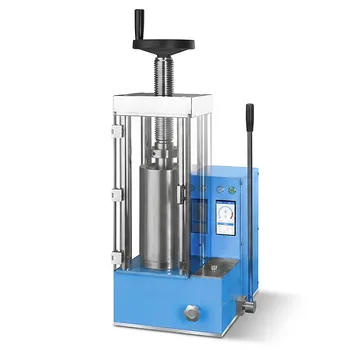
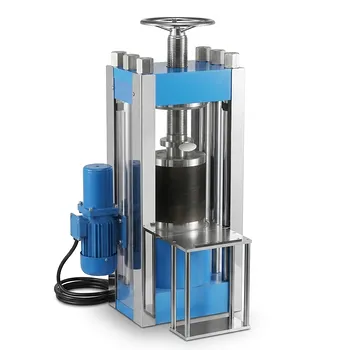
A specialized laboratory uniaxial compression device is the essential tool for quantifying the mechanical behavior of a fiber web during the wet pressing stage. It specifically measures the structural pressure of a saturated wet fiber web as it reacts to controlled pressure pulses. This empirical data is used to validate rheological models by quantifying how water flow resistance within the fiber walls influences structural pressure changes over time.
The device serves as the technical bridge between physical observation and mathematical simulation, providing the precise measurements of rate-dependent structural pressure needed to establish accurate, predictive wet pressing models in papermaking research.
The Mechanics of Structural Pressure Measurement
Capturing Rate-Dependent Responses
The primary role of the uniaxial compression device is to observe how a saturated wet fiber web reacts to sudden mechanical loads. Because the fiber web is saturated, the resistance of water moving within and between fiber walls creates a rate-dependent response.
The device captures these subtle changes in structural pressure, allowing researchers to see how the web "pushes back" under different speeds and intensities of compression.
Mapping Internal Flow Resistance
As pressure is applied, water within the fiber walls resists movement, which directly impacts the overall structural integrity of the web. The uniaxial device isolates this variable by applying force along a single axis within a controlled environment.
This quantification of flow resistance is vital because it determines how much water can be effectively removed during industrial pressing without damaging the paper structure.
Establishing the Foundation for Process Models
Validating Rheological Theory
In papermaking research, theoretical models are only as good as the data that supports them. The uniaxial compression device provides the empirical validation necessary to prove or disprove rheological theories regarding fiber behavior.
By comparing laboratory results with theoretical predictions, researchers can refine the equations that describe mass transfer and densification within the fiber matrix.
Simulating the Industrial Press Pulse
Industrial paper machines operate at high speeds, creating rapid pressure pulses as the paper passes through press rolls. The laboratory device mimics these pulses in a controlled setting, allowing for the study of the web's geometric foundation and coordination under load.
This simulation ensures that the resulting data is representative of the physical state the paper will encounter in a high-speed production environment.
Understanding the Trade-offs and Limitations
The Constraint of Single-Axis Testing
While uniaxial compression provides high precision, it is a simplified representation of reality. In a commercial press nip, the paper web may experience multi-axial stresses and shear forces that a strictly uniaxial device cannot fully replicate.
Researchers must be careful not to over-extrapolate uniaxial data when dealing with complex, multi-directional fiber orientations found in certain specialty papers.
Boundary Effects and Friction
Even with high-strength materials like thick galvanized steel used in laboratory containers, the interface between the fiber web and the device walls can introduce friction.
If not properly accounted for, these boundary effects can slightly distort the measurement of structural pressure, leading to an overestimation of the web's internal resistance.
How to Apply This to Your Research Project
Making the Right Choice for Your Goal
To get the most out of a laboratory uniaxial compression device, your experimental design must align with your specific research objectives:
- If your primary focus is improving industrial dewatering efficiency: Prioritize the measurement of rate-dependent structural pressure to identify the "choke points" of water flow within the fiber walls.
- If your primary focus is developing new paper grades: Use the device to establish the initial physical contact and coordination numbers of different fiber blends to predict their final structural strength.
- If your primary focus is computational modeling: Ensure your device is calibrated to provide the high-resolution displacement data required to validate complex rheological equations.
By precisely quantifying the interaction between water resistance and fiber structure, you create the definitive technical foundation for optimizing the papermaking process.
Summary Table:
| Feature | Primary Role in Papermaking Research |
|---|---|
| Structural Pressure | Quantifies the mechanical "push back" of saturated fiber webs. |
| Flow Resistance | Maps how water movement within fiber walls impacts web integrity. |
| Pulse Simulation | Mimics high-speed industrial press nips in a controlled lab setting. |
| Model Validation | Provides empirical data to verify rheological and mass transfer theories. |
Elevate Your Research with KINTEK Pressing Solutions
Precision is the foundation of breakthrough material science. KINTEK specializes in comprehensive laboratory pressing solutions designed to meet the rigorous demands of papermaking and battery research.
We offer a versatile range of equipment, including:
- Manual & Automatic Presses for consistent load application.
- Heated & Multifunctional Models for complex thermal-mechanical analysis.
- Glovebox-Compatible Units for sensitive material handling.
- Cold and Warm Isostatic Presses (CIP/WIP) widely utilized in advanced battery research.
Whether you are quantifying fiber web behavior or developing next-generation energy storage, KINTEK provides the technical bridge from observation to innovation.
Ready to optimize your lab's efficiency? Contact our experts today!
References
- Jan‐Erik Gustafsson, Vinicius Lobosco. Densification and Dewatering in High Temperature Wet Pressing. DOI: 10.15376/frc.2001.1.679
This article is also based on technical information from Kintek Solution Knowledge Base .
Related Products
- Electric Isostatic Pressing Machine 40 Tons Automatic Laboratory Powder Compacting Press
- Automatic Lab Cold Isostatic Pressing CIP Machine
- Electric Split Lab Cold Isostatic Pressing CIP Machine
- Electric Lab Cold Isostatic Press CIP Machine
- Lab Isostatic Pressing Molds for Isostatic Molding
People Also Ask
- What are the key characteristics of the isostatic pressing process? Unlock Uniform Density and Complex Geometries
- Why is vacuum-sealed packaging necessary before isostatic pressing of CuPc thin films? Protect Integrity & Uniformity
- How is pressure applied to the material during isostatic pressing? Master Uniform Density and Complex Geometries
- How does pressure distribute during isostatic pressing of aluminum? Achieve Uniform Density for Your Lab Materials
- What are the applications of isostatic pressing in the automotive industry? Precision Manufacturing for High-Performance Parts