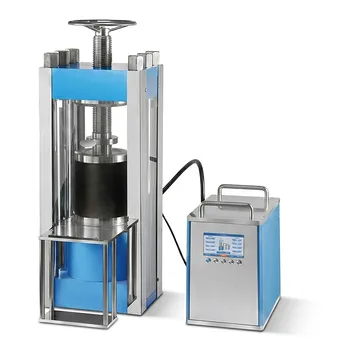
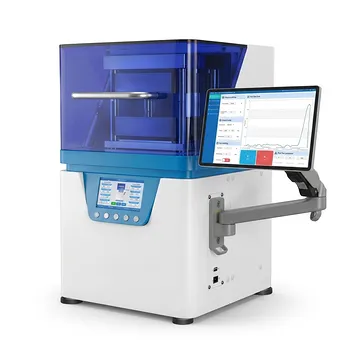
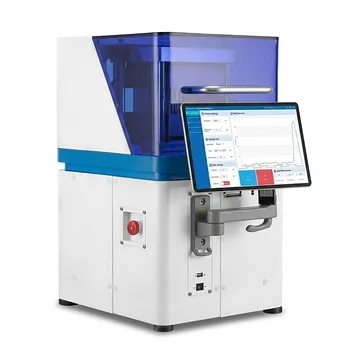
The primary purpose of using a laboratory hot press for warm pressing Aluminum Oxynitride (AlON) laminated green bodies is to transform organic binders into a thermoplastic state while applying axial pressure. This simultaneous application of heat and force ensures that individual tape layers fuse into a single, cohesive unit by promoting physical interlocking and particle rearrangement.
Warm pressing is a critical densification step that eliminates interlaminar interfaces and increases the initial green density of AlON tapes. By mobilizing internal binders, the process creates a microstructurally uniform green body that is essential for defect-free sintering.
Achieving Microstructural Integrity Through Lamination
Softening Binders for Thermoplastic Flow
A laboratory hot press applies controlled heat (typically around 100°C) to reach the glass transition temperature of the organic binders and plasticizers within the AlON green tapes. Once these additives reach a thermoplastic state, they act as a viscous medium that allows ceramic particles to move and reorient.
Eliminating Interlayer Interfaces
Applying axial pressure during this heated state induces physical interlocking and diffusion across the tape boundaries. This effectively "erases" the gaps between layers, turning a stack of discrete sheets into a monolithic green body with no internal voids or laminations.
Facilitating Particle Rearrangement
The combination of pressure and binder mobility encourages AlON particles to pack more efficiently within the matrix. This tighter packing eliminates microscopic gaps and pores that are often introduced during the initial tape casting or stacking processes.
The Role of Density in Final Ceramic Performance
Enhancing Initial Green Density
The laboratory hot press significantly increases the initial density of the green body compared to cold pressing or simple stacking. High green density is a prerequisite for achieving high theoretical density in the final sintered AlON component, which is vital for its optical transparency and mechanical strength.
Improving Contact Area for Sintering
By increasing the contact area between precursor particles, warm pressing facilitates more complete chemical reactions and mass transport during high-temperature sintering. This pre-sintering densification helps lower the total thermal energy required to reach full density and prevents excessive shrinkage.
Ensuring Structural Stability
A uniform green body is more resistant to the internal stresses generated during the cooling and heating cycles of a kiln. This structural integrity prevents common defects such as delamination, warping, or cracking that can occur when unevenly dense materials undergo significant shrinkage.
Understanding the Trade-offs and Technical Constraints
Temperature and Pressure Sensitivity
If the temperature is set too low, the binders will not reach a sufficient thermoplastic state, leading to poor bonding and potential delamination. Conversely, excessive heat can cause binder degradation or "squeeze out," where the organic phase escapes the mold, leaving the ceramic particles starved of support.
Pressure Distribution Limits
Laboratory hot presses provide precise axial pressure, but they can occasionally suffer from pressure gradients within thicker samples. If the green body is too deep, the center may not experience the same compaction as the surfaces, leading to microstructural variations that manifest as defects after sintering.
Mold Interaction and Contamination
Because the process involves heat and pressure, there is a risk of the green body adhering to the mold surfaces. It is essential to use appropriate release agents or liners to ensure the green body can be removed without inducing surface fractures or introducing chemical impurities into the AlON material.
How to Apply Warm Pressing to Your Project
When utilizing a laboratory hot press for AlON lamination, your specific process parameters should align with your ultimate material goals.
- If your primary focus is Optical Transparency: Prioritize a higher warm-pressing temperature and duration to ensure the absolute elimination of interlayer pores, as even microscopic voids will scatter light in the final AlON ceramic.
- If your primary focus is Mechanical Structural Integrity: Focus on optimizing the axial pressure to achieve maximum green density, which minimizes the shrinkage and internal stress gradients that lead to cracks during sintering.
- If your primary focus is Research and Process Development: Use the hot press to systematically vary pressure (e.g., 20 MPa to 100 MPa) and temperature to identify the specific "processing window" where your binder system achieves its peak thermoplastic flow.
Optimizing these warm-pressing parameters ensures that your AlON green body possesses the uniformity and density required to survive the rigors of high-temperature sintering.
Summary Table:
| Key Process Action | Benefit to AlON Green Body | Impact on Final Ceramic |
|---|---|---|
| Binder Softening | Enables thermoplastic flow and particle rearrangement | Increases initial green density |
| Axial Pressure | Eliminates interlaminar interfaces and voids | Prevents delamination and warping |
| Thermal Control | Mobilizes internal binders for cohesive bonding | Optimizes optical transparency |
| Particle Packing | Reduces microscopic gaps between ceramic particles | Enhances mechanical strength |
Elevate Your Material Research with KINTEK Precision Pressing
Achieving the perfect microstructural integrity for AlON ceramics or battery components requires precise control over heat and pressure. KINTEK specializes in comprehensive laboratory pressing solutions tailored to your specific research needs.
Our range includes:
- Manual & Automatic Models: For versatile and repeatable results.
- Heated & Multifunctional Presses: Perfect for warm pressing and binder mobilization.
- Isostatic Presses: Cold and warm models for uniform densification.
- Glovebox-Compatible Systems: Specialized solutions for sensitive battery research.
Don't let interlaminar defects compromise your results. Contact KINTEK today to find the ideal pressing solution for your lab!
References
- Feng Zhao, Tien‐Chang Lu. Highly-transparent AlON ceramic fabricated by tape-casting and pressureless sintering method. DOI: 10.1016/j.jeurceramsoc.2019.11.065
This article is also based on technical information from Kintek Solution Knowledge Base .
Related Products
- Lab Heat Press Special Mold
- Automatic Hydraulic Hot Press with Large Plate and Precision Temperature Control for Advanced Material Sample Preparation and Industrial Research
- Automatic High Temperature Heated Hydraulic Press Machine with Heated Plates for Lab
- 24T 30T 60T Heated Hydraulic Lab Press Machine with Hot Plates for Laboratory
- Automatic Heated Hydraulic Press Machine with Hot Plates for Laboratory
People Also Ask
- How is a laboratory heat press used to evaluate bio-based aliphatic polyesters? Prepare Reliable Samples for Analysis
- How is a laboratory heat press utilized in MEA preparation? Achieve High-Efficiency Iron-Chromium Redox Flow Batteries
- Why is a laboratory heat press necessary for biodegradable films? Unlock Precision Bonding and Barrier Performance
- What is the purpose of incorporating cartridge heaters into a lab press mold for MLCC block compression? Optimize Results
- How is a laboratory heated press used for XPP structural analysis? Expert Guide to Sample Preparation