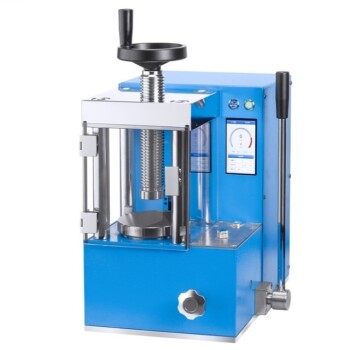
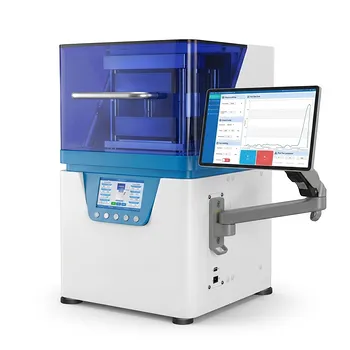
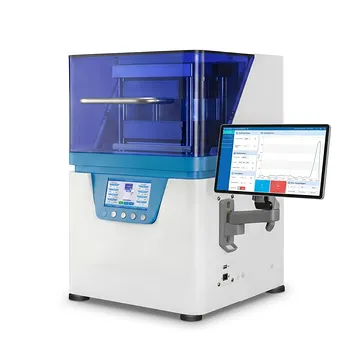
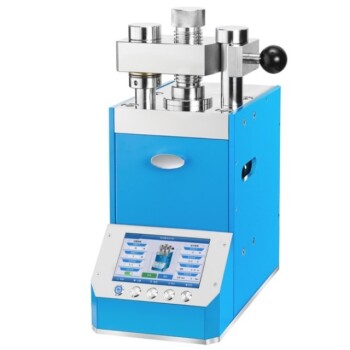
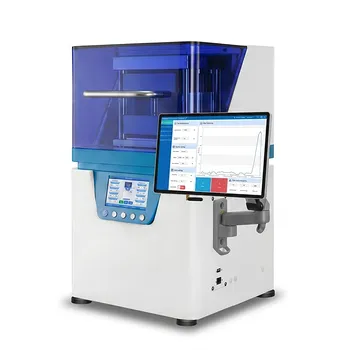
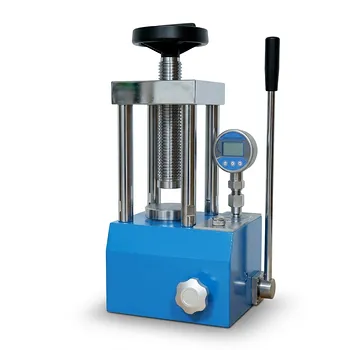
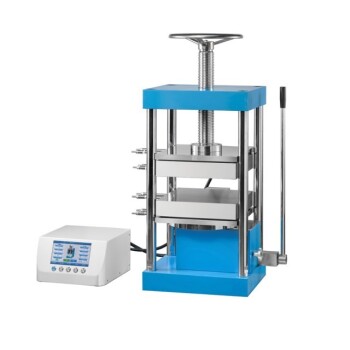
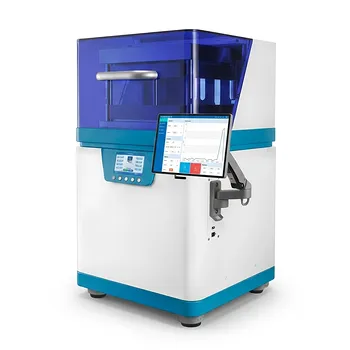
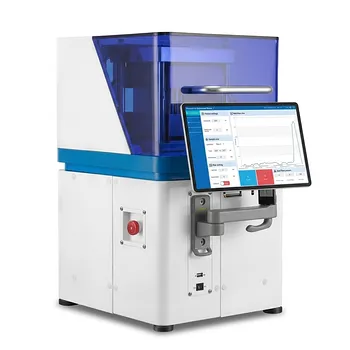
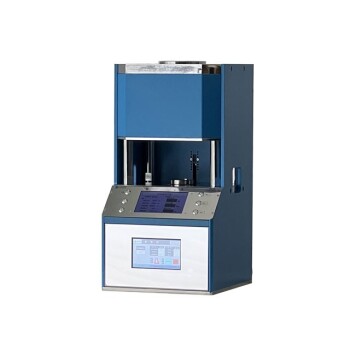
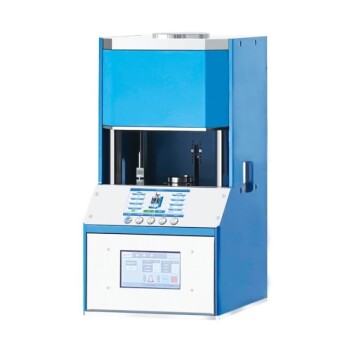
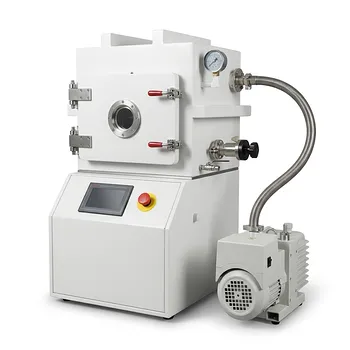
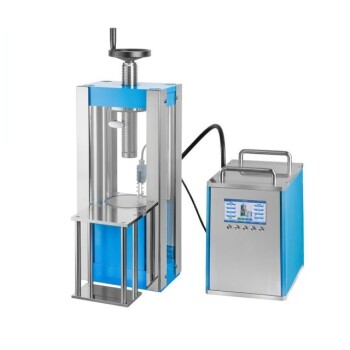
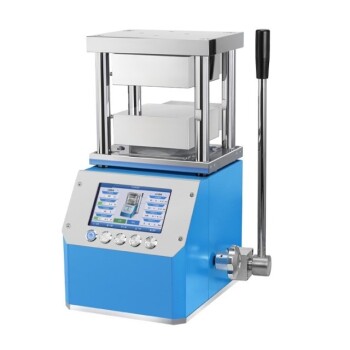
The laboratory hydraulic press is used to compress a mixture of erythritol and potassium bromide (KBr) into a thin, transparent pellet. This process applies several tons of force to eliminate air pockets and light scattering between powder particles. By creating a uniform, glass-like disc, the press ensures that the infrared beam can effectively penetrate the sample to provide an accurate spectral analysis of the molecular structure.
The hydraulic press is the critical tool for converting opaque powder mixtures into optically clear pellets. This transformation is essential for minimizing signal noise and ensuring the infrared beam captures the specific hydrogen bonding interactions and chemical characteristics of the erythritol sample.
Facilitating Infrared Light Transmission
Achieving Optical Transparency with KBr
Fourier Transform Infrared Spectroscopy (FTIR) requires the infrared beam to pass through the sample rather than reflecting off its surface. Because erythritol is a solid powder, it must be diluted in a medium like potassium bromide (KBr) that is "transparent" to infrared light.
The hydraulic press applies uniform pressure to this mixture, forcing the KBr to undergo plastic flow. This creates a solid, thin film that allows light to pass through the sample without being blocked by the physical mass of the powder.
Eliminating Light Scattering
Individual particles in a powder mixture act as tiny mirrors, scattering infrared light in all directions and obscuring the resulting data. The high pressure provided by the hydraulic press, often reaching 5 tons or more, eliminates the gaps between these particles.
By removing these air pockets, the press produces a pellet with a high signal-to-noise ratio. This clarity is necessary to obtain distinct vibrational spectra that represent the sample's molecular framework.
Analyzing Erythritol and Molecular Interactions
Detecting Hydrogen Bonding
In the study of erythritol, researchers often need to analyze how the substance interacts with other components, such as thickeners. The hydraulic press ensures the sample is thin and uniform enough to detect subtle shifts in energy levels.
These shifts are indicative of hydrogen bonding interactions between the erythritol and the surrounding matrix. Without the high-pressure pelletization process, these delicate chemical signatures would be lost in the "noise" of a poorly prepared sample.
Ensuring Formulation Stability
For pharmaceutical or food-grade applications, understanding the stability of an erythritol formulation is paramount. The hydraulic press allows for the creation of standardized pellets that produce repeatable results.
This consistency allows scientists to accurately assess the chemical interactions between active ingredients and excipients. This data is vital for determining the long-term stability and effectiveness of the final product.
Common Pitfalls to Avoid
Managing Hygroscopic Materials
Potassium bromide (KBr) is highly hygroscopic, meaning it absorbs moisture from the air very quickly. If the pellet is pressed in a humid environment or with damp KBr, the resulting spectrum will show large water peaks that can mask the erythritol signals.
Over-Compression and Pellet Cracking
While high pressure is necessary, exceeding the recommended tonnage for a specific die size can cause the pellet to become opaque or crack upon release. Achieving the "plastic flow" state requires a balanced, stable pressure rather than sheer force.
How to Apply This to Your Project
Optimizing Your Sample Preparation
- If your primary focus is high-resolution research: Use a manual or automatic hydraulic press to create KBr pellets, as this method typically provides the clearest spectral peaks for analyzing molecular bonding.
- If your primary focus is rapid screening or quality control: Ensure your press is calibrated to a specific tonnage (usually 5-10 tons) to maintain consistency across hundreds of different sample batches.
- If your primary focus is moisture-sensitive analysis: Consider using a vacuum-capable pellet die with your hydraulic press to remove air and moisture during the compression cycle.
Mastering the use of the hydraulic press transforms the physical state of your sample into a high-fidelity window through which the molecular secrets of erythritol can be clearly observed.
Summary Table:
| Feature of Pressing | Impact on FTIR Analysis | Key Benefit for Erythritol Study |
|---|---|---|
| KBr Pelletization | Achieves optical transparency | Allows IR beam penetration for molecular analysis |
| High Pressure (5-10T) | Eliminates air pockets & scattering | Produces high signal-to-noise ratio for clear data |
| Uniform Compression | Standardizes sample thickness | Enables repeatable hydrogen bonding detection |
| Vacuum Capability | Removes moisture & air | Prevents water peaks from masking chemical signals |
Elevate Your Sample Preparation with KINTEK
Precision in pelletizing is the foundation of accurate FTIR results. KINTEK specializes in comprehensive laboratory pressing solutions designed to meet the rigorous demands of material science and battery research.
Whether you need manual, automatic, heated, multifunctional, or glovebox-compatible models, our equipment ensures uniform pressure and high-fidelity samples. We also offer cold and warm isostatic presses for advanced applications.
Ready to optimize your lab’s efficiency and data accuracy?
Contact KINTEK Experts Today to find the perfect press for your research needs!
References
- Sheng Yang, Li‐Wu Fan. Supercooled erythritol for high-performance seasonal thermal energy storage. DOI: 10.1038/s41467-024-49333-7
This article is also based on technical information from Kintek Solution Knowledge Base .
Related Products
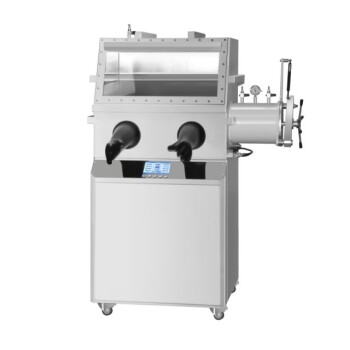
- Laboratory Hydraulic Press Lab Pellet Press Machine for Glove Box
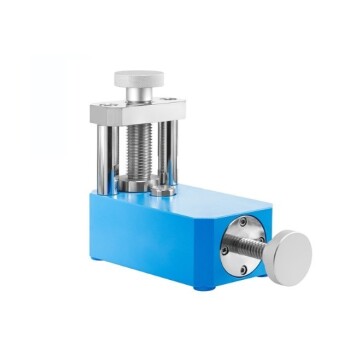
- Laboratory Hydraulic Press 2T Lab Pellet Press for KBR FTIR
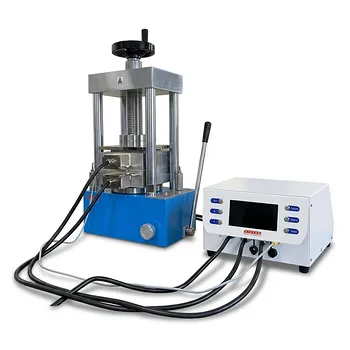
- 24T 30T 60T Heated Hydraulic Lab Press Machine with Hot Plates for Laboratory
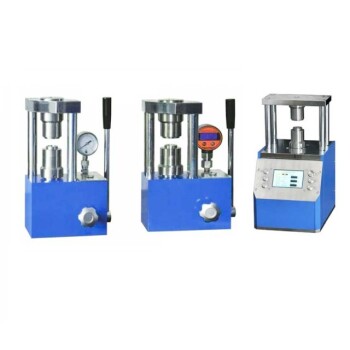
- Laboratory Hydraulic Press Lab Pellet Press Button Battery Press
- Laboratory Hydraulic Pellet Press for XRF KBR FTIR Lab Press
People Also Ask
- How does a laboratory hydraulic press contribute to the preparation of Li3-3xScxSb samples? Optimize Ionic Conductivity
- What is the function of a laboratory hydraulic press in FT-IR of curcumin-coated MWCNTs? Achieve Optical Clarity.
- Why is a laboratory hydraulic press required for compression molding boron-siloxane? Solve High-Loading Density Challenges
- What role does a laboratory hydraulic press play in reaction pellets? Optimizing Lunar Soil and Metal Fuel Density
- What role does a laboratory hydraulic press play in the preparation of piezoelectric ceramic discs for DC-PG? | KINTEK