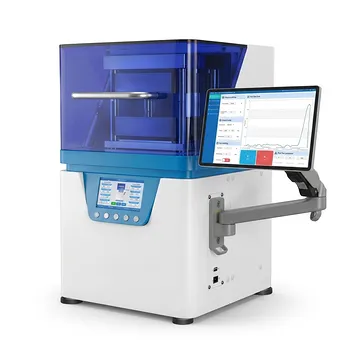
The precision of X-ray Absorption Fine Structure (XAFS) characterization relies heavily on the physical uniformity of the sample. A laboratory hydraulic press is used to transform loose Iron-doped Ceria powder into dense, 13 mm diameter pellets with a standardized thickness. This process eliminates local thickness variations and voids, which directly reduces signal errors and ensures the resulting data accurately reflects the oxidation states and coordination environments of the iron atoms.
The primary purpose of using a hydraulic press is to create a homogeneous, self-supporting pellet that provides a consistent optical path for X-rays. This standardization minimizes measurement artifacts and is essential for obtaining reliable, reproducible data on the catalyst’s electronic structure.
Optimizing the Optical Path for X-rays
Overcoming Local Thickness Variations
The most critical function of the press is to ensure a constant sample thickness across the entire area exposed to the X-ray beam. Variations in thickness can lead to "hole effects" or non-linear absorption, which severely distorts the XAFS spectrum and leads to incorrect structural models.
Eliminating Voids and Inhomogeneity
Compression removes the air gaps and voids naturally found in loose powders. By creating a continuous, dense analysis surface, the hydraulic press ensures that the X-ray beam interacts with a representative number of iron and ceria atoms, which is vital for calculating accurate coordination numbers.
Facilitating Effective Beam Interaction
A flat, dense pellet allows for precise optical path focusing during the experiment. This stability results in a higher signal-to-noise ratio and cleaner data, specifically regarding the subtle binding energy shifts and vibration peaks necessary to understand the catalyst's behavior.
Enhancing Structural Integrity and Reproducibility
Controlling Pressure and Holding Time
By precisely controlling the applied tonnage and holding time, the hydraulic press ensures the integrity of the sample’s internal structure. This consistency is what allows researchers to compare different batches of Iron-doped Ceria with confidence that the results are not influenced by preparation artifacts.
Preventing Sample Degradation in Vacuum
For characterization methods that require vacuum environments, such as certain XAFS setups or related XPS tests, pelletization prevents powder splashing. It also helps mitigate charge accumulation effects, which can otherwise shift spectral peaks and lead to misinterpretation of the iron atoms' oxidation states.
Standardizing Geometric Requirements
Using a press ensures that the catalyst meets the fixed geometric shapes required by specialized sample holders. This standardization is necessary for reproducible solid-state characterization and facilitates accurate quantitative compositional analysis.
Understanding the Trade-offs and Pitfalls
Risk of Pressure-Induced Phase Changes
While high pressure is necessary for density, excessive force can potentially alter the crystalline phase or surface morphology of sensitive Iron-doped Ceria nanomaterials. It is crucial to determine the minimum pressure required to achieve a stable pellet without inducing unwanted structural transitions.
Binder Selection and Interference
In many cases, a binder is mixed with the catalyst to improve pellet strength; however, the binder must be spectroscopically transparent. If the binder-to-catalyst ratio is too high or if the binder contains interfering elements, it may attenuate the X-ray signal and obscure the iron coordination data.
Pellet Fragility and Thickness Optimization
If the pellet is too thin, it may become extremely brittle and difficult to handle without breaking. Conversely, if the pellet is too thick, the X-ray beam may be completely absorbed (total attenuation), rendering the XAFS measurement impossible.
How to Apply This to Your Characterization Project
To ensure your Iron-doped Ceria samples are prepared correctly for XAFS, consider your specific analytical goals:
- If your primary focus is determining precise coordination numbers: Ensure you calculate the "one absorption length" thickness and use the hydraulic press to reach that exact density with minimal binder.
- If your primary focus is comparing oxidation states across multiple samples: Use a standardized pressure (e.g., 450 kgf/cm²) and holding time for every sample to ensure that any observed spectral shifts are chemical rather than structural.
- If your primary focus is testing in a high-vacuum environment: Prioritize pellet tightness and surface smoothness to prevent sample migration and reduce charge-up effects during the measurement.
Proper sample pelletization is the foundational step that transforms a raw powder into a high-fidelity source of electronic and structural information.
Summary Table:
| Function | Benefit to XAFS Characterization | Impact on Research Data |
|---|---|---|
| Uniform Thickness | Eliminates "hole effects" and non-linear absorption | Ensures accurate structural modeling |
| Void Removal | Creates a continuous, dense analysis surface | Accurate calculation of coordination numbers |
| Structural Stability | Prevents powder splashing in vacuum environments | Maintains high signal-to-noise ratio |
| Geometric Control | Standardizes sample for fixed holders | Enables reproducible, batch-to-batch comparisons |
Optimize Your Catalyst Research with KINTEK Precision Presses
High-fidelity XAFS and analytical results begin with flawless sample preparation. KINTEK specializes in comprehensive laboratory pressing solutions tailored for advanced material science and battery research.
Whether you need manual, automatic, heated, multifunctional, or glovebox-compatible models, or require cold and warm isostatic presses, our equipment is engineered to deliver the precise pressure and uniformity your catalysts demand.
Ready to enhance your lab's efficiency and data reliability?
Contact KINTEK Today to find the perfect pressing solution for your research goals!
References
- Albert Gili, Reinhard Schomäcker. One-pot synthesis of iron-doped ceria catalysts for tandem carbon dioxide hydrogenation. DOI: 10.1039/d4cy00439f
This article is also based on technical information from Kintek Solution Knowledge Base .
Related Products
- Laboratory Hydraulic Press Lab Pellet Press Machine for Glove Box
- Laboratory Hydraulic Press 2T Lab Pellet Press for KBR FTIR
- 24T 30T 60T Heated Hydraulic Lab Press Machine with Hot Plates for Laboratory
- Laboratory Hydraulic Press Lab Pellet Press Button Battery Press
- Laboratory Hydraulic Pellet Press for XRF KBR FTIR Lab Press
People Also Ask
- How does a laboratory hydraulic press contribute to the preparation of Li3-3xScxSb samples? Optimize Ionic Conductivity
- What is the function of a laboratory hydraulic press in FT-IR of curcumin-coated MWCNTs? Achieve Optical Clarity.
- Why is a laboratory hydraulic press required for compression molding boron-siloxane? Solve High-Loading Density Challenges
- What role does a laboratory hydraulic press play in the preparation of piezoelectric ceramic discs for DC-PG? | KINTEK
- What role does a laboratory hydraulic press play in reaction pellets? Optimizing Lunar Soil and Metal Fuel Density