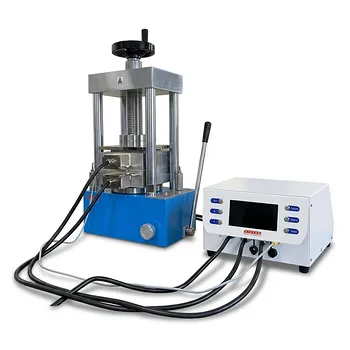
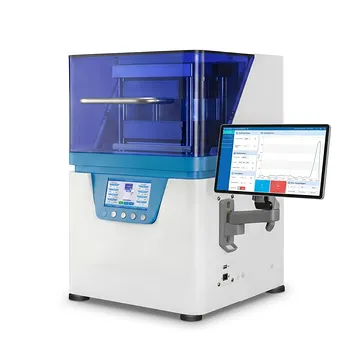
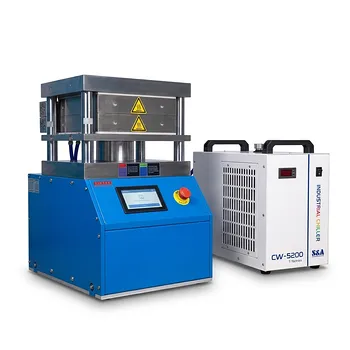
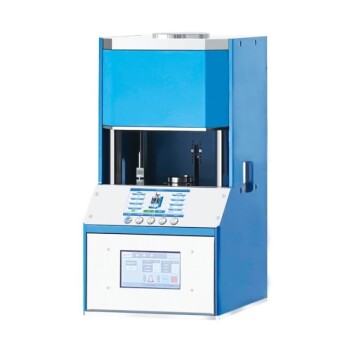
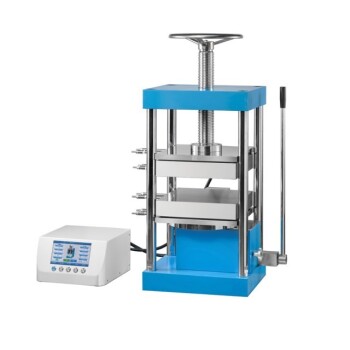
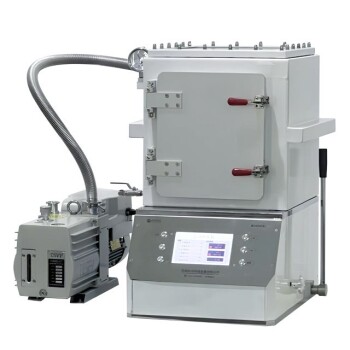
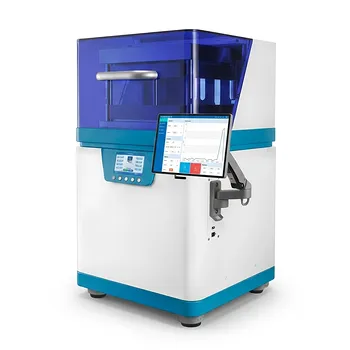
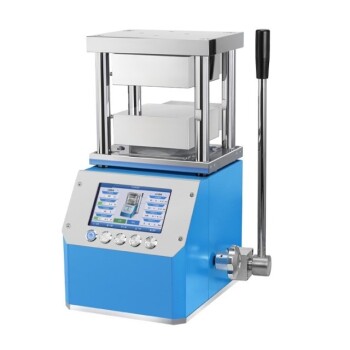
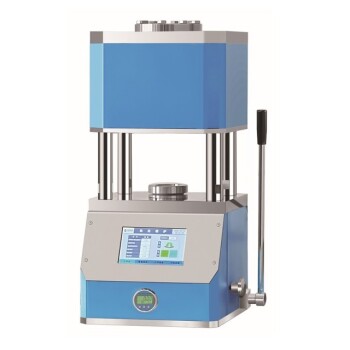
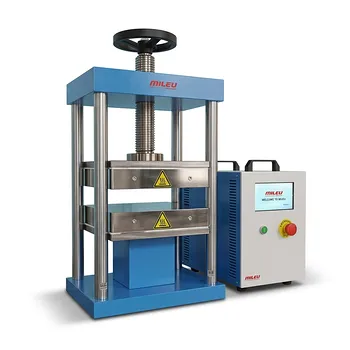
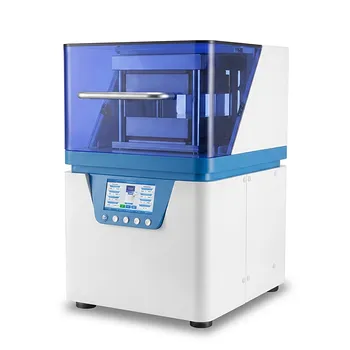
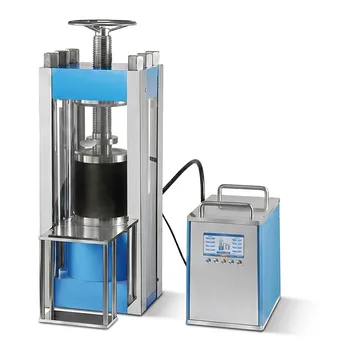
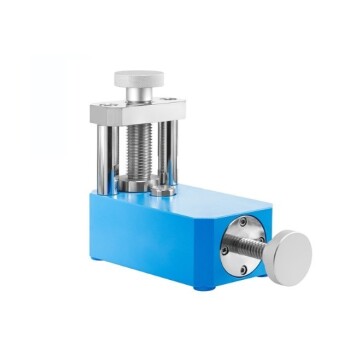
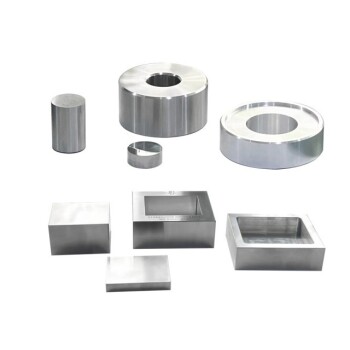
The role of a heated laboratory hydraulic press is to facilitate the controlled sintering of SRC-PEEK by providing the precise thermal and mechanical environment necessary for localized fiber bonding. This equipment allows the surface of the Polyether Ether Ketone (PEEK) fibers to undergo controlled melting and recrystallization, creating a coherent matrix that fuses the material into a dense, high-performance structure without compromising the mechanical integrity of the fiber cores.
Core Takeaway: The heated hydraulic press acts as a precision consolidation tool that balances temperature and pressure to sinter SRC-PEEK fibers into a monolithic part. This process ensures maximum density and structural integrity by converting fiber surfaces into a bonding matrix while preserving the underlying reinforcement properties.
The Mechanism of Localized Recrystallization
Creating a Coherent Recrystallized Matrix
The primary function of the press is to heat the SRC-PEEK material to a specific point where only the outer surfaces of the fibers begin to melt. This localized melting allows the fibers to bond at their contact points through a process of recrystallization, effectively turning the fiber surfaces into the material's own binder.
Preserving Fiber Core Performance
A critical advantage of using a heated hydraulic press in this context is the preservation of the core performance of the PEEK fibers. Because the heat is strictly controlled, the structural "skeleton" of the fiber remains solid and unaffected, ensuring the final composite retains the high tensile strength and stiffness inherent to the original fibers.
Sintering into a Dense Integrated Structure
By applying constant pressure during the heating phase, the press sinters the individual fiber layers into a single, integrated mass. This eliminate spaces between fibers, resulting in a dense structure that is far more resistant to delamination and mechanical failure than loosely bonded alternatives.
Achieving Structural Integrity through Pressure
Elimination of Internal Voids and Air Bubbles
High-pressure molding is essential for removing internal voids and air bubbles that can form between layers of PEEK. The hydraulic press applies uniform force (often reaching 300 kN or 400 bar in laboratory settings) to ensure that the material is compacted into a void-free blank.
Enhancing Density and Dimensional Stability
The simultaneous application of heat and pressure ensures the material reaches a viscous flow state, which improves the distribution of the polymer. This results in a specimen with high dimensional stability, meaning the final part will maintain its intended shape and size even under subsequent mechanical stress.
Achieving High Volume Fraction of Reinforcement
Because the press facilitates tight compression between layers, it allows for a higher volume fraction of reinforcement. This means more of the final part is composed of load-bearing fibers rather than just resin, leading to superior physical and mechanical properties.
Understanding the Trade-offs
Thermal Management Precision
One of the most significant challenges is the narrow processing window for SRC-PEEK; if the temperature is too low, the fibers will not bond, but if it is too high, the entire fiber will melt, destroying the self-reinforcing effect. This necessitates a press with extremely high thermal accuracy and uniform heat distribution across the plates.
Pressure Distribution vs. Fiber Displacement
While high pressure is necessary to eliminate voids, excessive or uneven force can cause fiber displacement or damage the orientation of the reinforcement. This trade-off requires the use of specialized molds and gradual pressure application to maintain the geometric profile of the part.
Cooling Rate and Crystallinity
The role of the press does not end with heating; the cooling rate controlled by the press plates significantly impacts the final crystallinity of the PEEK. Rapid cooling may lead to an amorphous structure, while slow, controlled cooling promotes recrystallization, which is vital for the material’s chemical resistance and strength.
How to Apply This to Your Project
Making the Right Choice for Your Goal
To achieve the best results with SRC-PEEK thermoforming, your approach should be tailored to the specific mechanical requirements of your application.
- If your primary focus is Maximum Tensile Strength: Prioritize precise temperature control to ensure only the fiber surfaces melt, keeping the high-strength cores intact.
- If your primary focus is Void-Free Consolidation: Focus on a high-pressure ramp-up phase to evacuate air and ensure a dense, integrated internal structure.
- If your primary focus is Dimensional Precision: Utilize specialized molds within the press to manage the material flow and prevent shrinkage during the cooling phase.
By mastering the balance of heat and pressure within a laboratory hydraulic press, you can unlock the full performance potential of self-reinforced thermoplastic composites.
Summary Table:
| Process Phase | Function of the Press | Key Outcome for SRC-PEEK |
|---|---|---|
| Localized Heating | Precise thermal control at fiber surfaces | Recrystallization bonding without melting fiber cores |
| Pressure Application | High-force compaction (up to 400 bar) | Elimination of internal voids and air bubbles |
| Consolidation | Sintering layers into a monolithic part | High reinforcement volume fraction and density |
| Cooling Phase | Managed temperature ramp-down | Optimized crystallinity for chemical and mechanical strength |
Optimize Your Composite Research with KINTEK Precision
Achieving the perfect balance of heat and pressure is critical for the success of SRC-PEEK thermoforming. KINTEK specializes in comprehensive laboratory pressing solutions designed to provide the extreme accuracy required for advanced material science and battery research.
Our versatile product range includes:
- Manual & Automatic Presses: For flexible or high-throughput laboratory needs.
- Heated & Multifunctional Models: Engineered for precise thermal management and localized sintering.
- Glovebox-Compatible Systems: Ideal for specialized environments and sensitive materials.
- Cold & Warm Isostatic Presses: Widely applied in high-density material and battery research.
Ensure your composites meet the highest standards of structural integrity and performance. Contact our technical team today to discover the ideal pressing solution for your application!
References
- Eric S. Ouellette, Jeremy L. Gilbert. Properties and Corrosion Performance of Self-reinforced Composite PEEK for Proposed Use as a Modular Taper Gasket. DOI: 10.1007/s11999-016-4861-9
This article is also based on technical information from Kintek Solution Knowledge Base .
Related Products
- 24T 30T 60T Heated Hydraulic Lab Press Machine with Hot Plates for Laboratory
- Automatic Heated Hydraulic Lab Press with Programmable Touch Screen Controls and Precision Temperature Regulation
- Automatic Heated Hydraulic Lab Press 120x120mm Plate Fully Automated Material Research Press
- Automatic Large Format Laboratory Heated Hydraulic Press 400x400mm Plate Capacity
- Automatic Heated Hydraulic Press Machine with Hot Plates for Laboratory
People Also Ask
- Function of a Laboratory Hydraulic Press with Heated Platens in SSE? Enhance Battery Density & Conductivity
- Why is a laboratory hydraulic press with heating plates required for PLA/TEC films? Achieve Precise Sample Integrity
- What role does a laboratory heated hydraulic press play in LTCC? Essential for High-Density Ceramic Lamination
- Why reduce load when applying composite strengthening tabs? Protect Specimen Integrity and Data Accuracy
- What role does a laboratory heated hydraulic press play in PI/PA based SPE membranes? Optimize Solid Battery Performance